同一个名字,两种模样:弥勒与布袋和尚
One Name, Two Faces: Maitreya and the Cloth-Bag Monk
阅读难度 · 中等Reading level · Medium
Page 1
寺门里的第一个谜题
A Mystery Near the Temple Gate
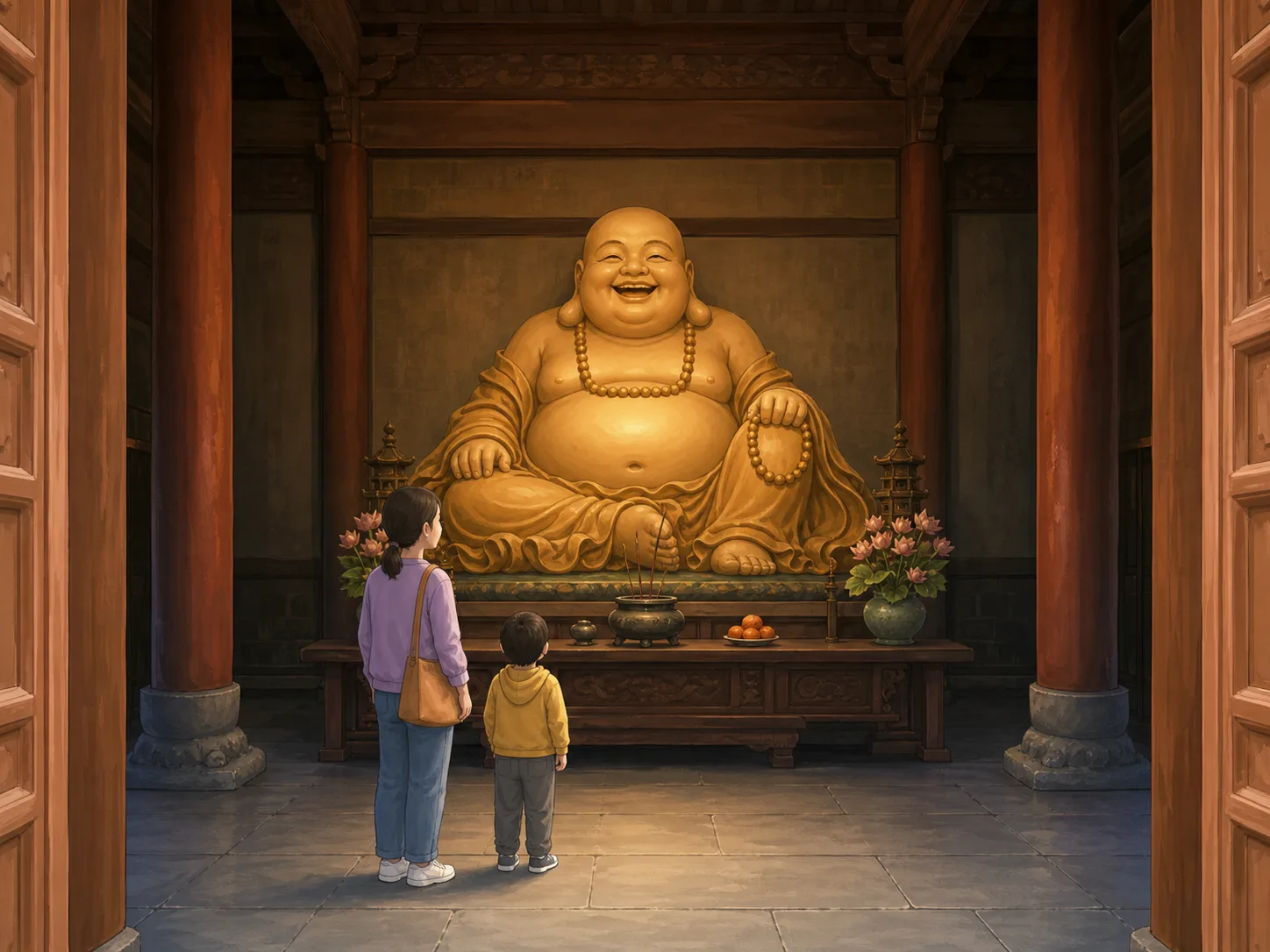
A modern imagined mother and child viewing a big-bellied Maitreya; the people, altar, and hall do not copy a specific temple.
走进一些中国汉传佛教寺院,穿过山门不久,你可能会在天王殿看见一尊笑容满面、肚子圆圆的像。他穿着和尚的衣服,有时还带着一只布袋。许多人叫他“弥勒佛”。
可是,如果你在博物馆里找到一尊公元486年的中国弥勒像,可能会大吃一惊。那尊北魏鎏金铜像肩膀宽、双腿长,神情庄严,完全不像寺门里的大肚和尚。两尊像差别这么大,为什么都叫弥勒?答案要从两条原本不同的故事说起。
Walk into some Chinese Buddhist temples, and one of the first figures you may see is a bald monk with a huge smile and a round belly. He wears a loose robe and sometimes carries a cloth bag. Many people call him Maitreya Buddha.
Now find a Chinese statue of Maitreya made in the year 486. You may be surprised. This ancient gilt-bronze figure has broad shoulders, long legs, and a calm, serious face. He looks nothing like the jolly monk near the temple gate. How can both figures have the same name? The answer begins with two stories that were once separate.
Page 2
第一条故事:还没有来到人间的未来佛
The First Story: The Future Buddha
弥勒首先是来自印度佛教的“未来佛”。佛教传统认为,我们这个时代的教法有一天会消失;在遥远的未来,弥勒将来到人间成佛,再次教导众生。在那以前,他是一位等待成佛的菩萨,居住在名叫兜率天的天界。
因此,早期佛教艺术里的弥勒并没有一种固定长相。他可以戴着首饰,像一位等待成佛的菩萨;也可以穿佛的袈裟,以未来已经成佛的样子出现。有的弥勒双脚下垂,像是随时准备起身来到人间。公元486年的北魏弥勒像,就是佛教从印度和中亚传入中国后,中国工匠创造的早期形象之一。
这时的大肚和尚形象还不是弥勒的标准模样。中国人敬奉弥勒,是因为他们期待未来的佛法与希望,而不是因为圆肚子或笑脸。
Maitreya first comes from Indian Buddhism. In Buddhist tradition, the teachings of our present age will one day be forgotten. Far in the future, Maitreya will be born in the human world, become a buddha, and teach the path again. Until then, he is a bodhisattva - a being on the way to buddhahood - waiting in a heaven called Tushita.
Early Buddhist artists did not give Maitreya only one appearance. He could wear jewelry like a princely bodhisattva who was still waiting to become a buddha. He could also wear a monk’s robe and appear as the buddha of a future age. In some sculptures, he sits with both feet down, as if he is ready to rise and enter the world. The Chinese statue from 486 is one early image created after Buddhist ideas and art traveled from India and Central Asia into China.
At that time, the big-bellied monk was not Maitreya’s standard appearance. People honored Maitreya because they looked forward to a future buddha and a new age of teaching, not because of a round stomach or a smiling face.
Page 3
第二条故事:背着布袋的契此和尚
The Second Story: Qici, the Monk with a Cloth Bag

A modern imagined Budai walking with children; the early biography does not record this smiling street scene.
再往后几百年,大约在十世纪,中国东部沿海的明州一带出现了一位叫契此的僧人。明州大致在今天浙江宁波附近。一本十世纪末编成的佛教僧人传记说,他身材肥胖,常用木杖挑着布袋走进街市,向人乞食,也会随处休息,因此人们叫他“布袋和尚”。
这部传记还记下许多神异故事:例如,他躺在雪地里,身上却没有积雪;他能用鞋子的样子预示天气;去世以后,又有人说在别处看见他背着布袋行走。这些是佛教传记保存的信仰故事,不能当作今天可以查证的新闻记录。不过,它们告诉我们,契此很早就被人看成一位不寻常的僧人。
传记提到了一首把契此称作弥勒的偈语,也说江浙一带后来常画他的像。后来的记录把偈语写得更完整,契此是弥勒化身的说法也越来越流行。这里要分清楚:佛教的未来佛弥勒并不是十世纪才出现的契此;而是在中国传统中,人们逐渐把契此看作弥勒在人间显现的一种身份。
Several centuries later, around the tenth century, a monk named Qici became known around Mingzhou on China’s eastern coast, near present-day Ningbo. A Buddhist collection of monks’ lives, finished late in that century, describes him as a heavy man who carried a cloth bag from a staff. It says that he entered marketplaces, asked for food, and rested wherever he happened to be. People came to call him Budai, which simply means “cloth bag.”
The same account also includes wonders. It says snow did not settle on him when he lay outdoors. It says people could predict the weather by the kind of shoes he wore. It even reports that someone saw him walking with his bag after his death. These are sacred stories preserved in a Buddhist biography, not events we can check like a modern news report. Still, they show that people remembered Qici as no ordinary monk.
The biography mentions a short verse that calls him Maitreya, and it says people in the region painted his picture. Later records gave a longer version of the verse, and the belief that Qici was an appearance of Maitreya spread widely. Here is the key difference: the Future Buddha did not begin as a tenth-century Chinese monk. Chinese tradition gradually came to see this particular monk as one form in which Maitreya had appeared in the human world.
Page 4
两条故事怎样走到了一起
How the Two Stories Met
当“布袋和尚是弥勒化身”被越来越多人接受后,艺术家就有了一个很容易认出的形象:光头、宽袍、圆肚、布袋,有时身边还有孩子。宋代以后,这种布袋弥勒出现在绘画和雕塑中,后来也进入许多汉传佛教寺院。
在常见的寺院布局中,天王殿靠近入口。殿中正面常供布袋和尚样式的弥勒,两旁是四大天王,背后则可能是护法神韦驮。不过,寺院建筑和造像并不处处相同:例如北京广济寺的天王殿供奉的就是另一种戴天冠的弥勒菩萨像。说“在许多寺院能看见”比说“所有寺院一进门都一样”更准确。
把笑面的弥勒放在靠前的位置,会给访客留下很强的第一印象。可是第一页图中的母子、供桌和殿堂是现代想象,不是某座寺院的精确复原。真实寺院里也不该随意触摸佛像;观看造像时,保持安静、遵守寺院规定,才是尊重这个空间的方式。
Once more people accepted Budai as an appearance of Maitreya, artists had an unforgettable figure to paint and carve: a bald head, loose robes, round belly, cloth sack, and sometimes a group of children. From the Song dynasty onward, Budai-Maitreya appeared in paintings and sculptures. In time, he also found a place in many Chinese Buddhist temples.
In one common temple plan, the Hall of the Heavenly Kings stands near the entrance. A Budai-style Maitreya often faces visitors from the center of the hall, with the Four Heavenly Kings at the sides and the guardian Weituo behind him. But temple buildings and statues are not identical everywhere. The Hall of the Heavenly Kings at Beijing’s Guangji Temple, for example, has a different Maitreya image wearing a crown. “Often” is more accurate than “always.”
Placing a smiling Maitreya near the front can give visitors a powerful first impression. However, the mother, child, altar, and building in the first picture form a modern imagined scene, not an exact copy of a named temple. Visitors also should not assume that they may touch a sacred statue. Staying quiet and following the temple’s rules is a better way to respect the space.
Page 5
大肚与笑脸,后来有了哪些意思
What Did the Belly and Smile Come to Mean?
圆肚子和笑容实在太醒目,人们慢慢赋予它们许多解释。寺院对联、民间故事和现代口语常把大肚联想到宽容,把笑脸联想到乐观、福气或亲切。英语世界里甚至有人把布袋形象叫作“Laughing Buddha”,也就是“笑佛”。
这些解释能帮助我们理解中国人为什么喜欢这个形象,却不能倒过来说,佛教经典规定“大肚子专门用来装下别人的坏脾气”。肚子是造像特征,宽容是后人从造像得到的文化联想;两者有关,却不是同一件事。布袋也不一定表示财富,它最早首先是契此形象中随身携带的袋子。
同样,我们也不能根据一尊笑像,就断言真实的契此无论遇到什么事都大笑。较早传记描写了他的外貌、布袋、乞食、奇异言行和传说,却没有记下“孩子跟着就笑、狗叫也笑、被泼脏水还笑”这些具体场面。那些好听的细节如果没有来源,就应该留在现代故事之外。
The round belly and smiling face are hard to miss, so people have given them many meanings. Temple sayings, folk stories, and modern speech may connect the belly with patience and generosity. The smile can suggest good cheer, welcome, or good fortune. In English, the Budai figure is sometimes called the “Laughing Buddha.”
These ideas help explain why the image became so loved. They do not mean that Buddhist scripture teaches that Maitreya’s stomach “holds other people’s bad tempers.” The belly is part of the statue. Patience is a later meaning that people read into it. The two are connected, but they are not the same thing. The bag does not automatically stand for money, either. It began as the object that made the monk Budai easy to recognize.
We also cannot look at a smiling statue and decide that the real Qici laughed at everything that happened. The early biography describes his body, bag, begging, unusual behavior, and wonders. It does not give us the scenes in the older story in which he laughs at children, barking dogs, trouble, or dirty water. Entertaining details without a source do not belong in a historical account.
再看那两张脸
Look at the Two Faces Again
一边是庄严的北魏弥勒,一边是大肚笑面的布袋弥勒,其中一尊并不是“错的”。第一尊让我们看见古老的未来佛信仰;第二尊让我们看见中国人怎样把一位地方僧人的传说接到弥勒信仰上,并创造出新的艺术形象。
宗教形象并不一定永远保持同一副面孔。它们会随着经典传播、人物传说、寺院空间和人们的感情不断变化。弥勒的两种模样,正好让我们看见这段变化留下的痕迹。
Place the calm Northern Wei Maitreya beside the smiling Budai-Maitreya, and neither one has to be the “wrong” image. The first shows an ancient belief in a Future Buddha. The second shows how people in China joined stories about a local monk to Maitreya’s identity and created a new artistic form.
Religious images do not always keep one face forever. They can change as teachings travel, stories grow, temples are built, and people find new meaning in what they see. Maitreya’s two faces let us watch that long change happen.