关公为什么会走进庙里?
How Did Guan Yu Become a Temple God?
阅读难度 · 困难Reading level · Hard
Page 1
先看庙里的这张脸
Begin with the Face in the Temple
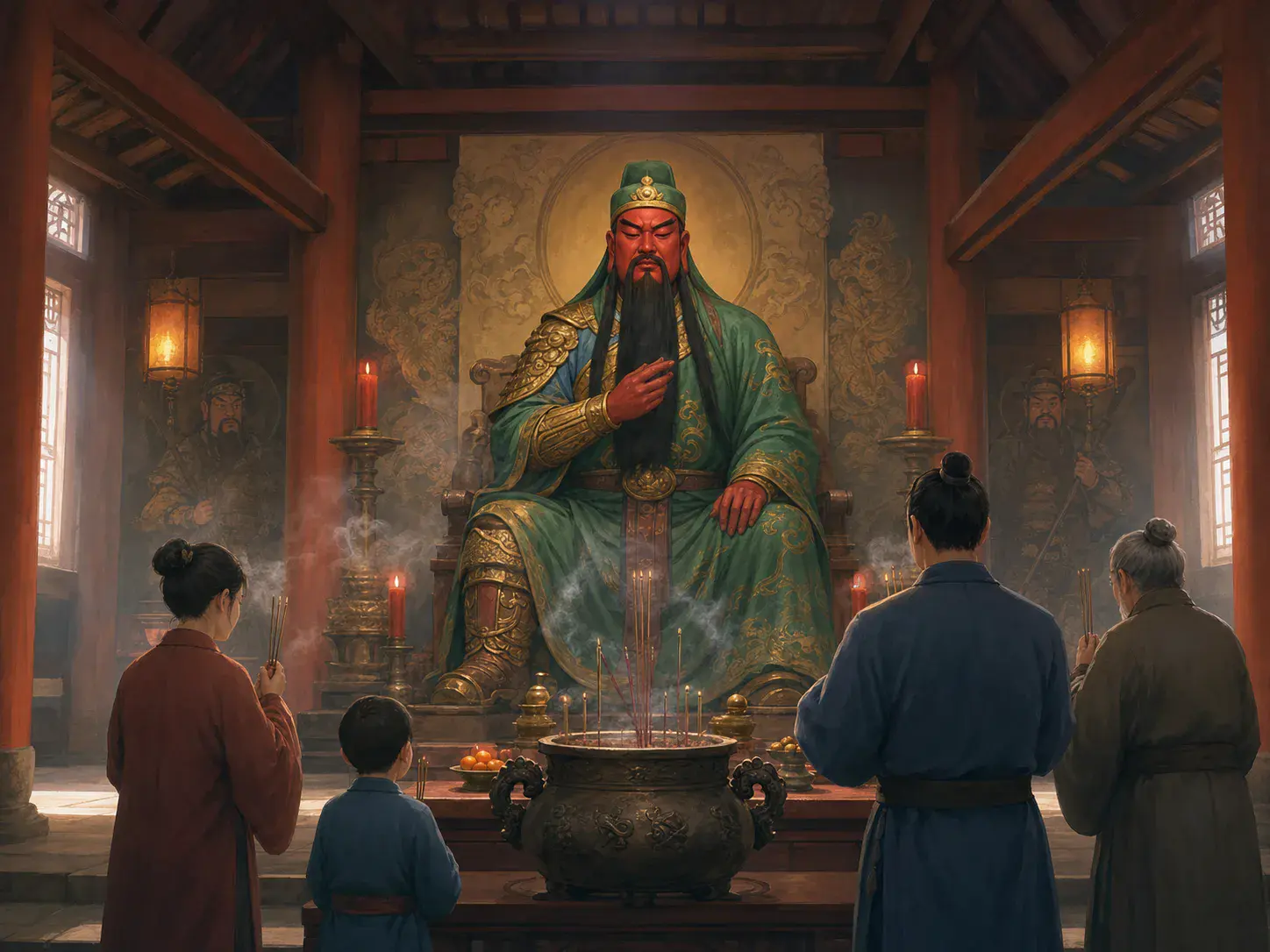
The red face, long beard, and green robe belong to Lord Guan’s later image. This modern artwork does not document a particular historical temple.
走进关帝庙,你可能先看见一张红脸、一部长须和一身绿袍。神像比真人高大得多,香炉里升起烟,身旁还站着手持兵器的侍从。眼前这位是“关公”或“关帝”,已经是一位接受祭拜的神明。
可是,公元三世纪的关羽首先是一个人。他没有一出生就长成庙里的样子,也不是死后立刻得到全中国共同供奉。一个失败身亡的将领怎样在几百年里获得寺庙、封号和许多不同身份?这才是“关公进庙”真正有趣的地方。
Walk into a temple to Lord Guan, and you may first notice a red face, a long beard, and a green robe. The statue towers over ordinary people. Incense rises in front of it, and armed attendants may stand nearby. This is Lord Guan, also called Emperor Guan, worshipped as a deity.
But in the third century, Guan Yu began as a human being. He was not born looking like a temple statue, and people across China did not all begin worshipping him as soon as he died. How did a defeated general gain temples, divine titles, and many different jobs over the next thousand years? That is the real mystery of how Lord Guan “entered” the temple.
Page 2
史书里的关羽留下了什么?
What Did the Historical Guan Yu Leave Behind?
关羽生活在东汉末年的战争年代,是刘备很早期的追随者和将领。他曾被曹操俘获,又替曹操击败颜良,报答优待后离开,回到刘备身边。后来他镇守荆州,约在公元220年前后被孙权一方击败并杀死。
我们今天认识这段历史,主要依靠陈寿在关羽死后几十年写成的《三国志》。书中说关羽和刘备、张飞“恩若兄弟”,也称赞他的勇猛,却没有记载三人在桃园焚香结拜。史书能告诉我们的并不完整,更不能证明红脸、绿袍和青龙偃月刀就是关羽本人的真实外貌与装备。
所以要先把两个名字分开:谈活着的将领时,我们称他关羽;谈后世信仰里的神明时,更适合称关公或关帝。后一个形象不是一张历史照片,而是许多时代共同完成的作品。
Guan Yu lived during the wars at the end of the Eastern Han dynasty. He was an early follower and general of Liu Bei. After Cao Cao captured him, Guan Yu fought for Cao and defeated the general Yan Liang. He then left after repaying Cao’s generous treatment and returned to Liu Bei. Years later, while defending Jing Province, he was defeated and killed by Sun Quan’s forces around 220 CE.
Our main source is the Records of the Three Kingdoms, written by Chen Shou several decades after Guan Yu’s death. It says Guan Yu, Liu Bei, and Zhang Fei were as close as brothers, but it does not say they swore an oath in a peach garden. The record praises Guan Yu’s courage, yet it cannot confirm that his face, robe, and famous crescent-shaped blade looked like the images we know today.
It helps to keep two names apart. When we mean the living general, we can say Guan Yu. When we mean the later deity, Lord Guan or Emperor Guan is clearer. The second figure is not a photograph of the first. He is a cultural image made by many centuries of people.
Page 3
祭拜比《三国演义》早得多
His Worship Began Long Before the Famous Novel
有人会把时间线讲成这样:先有《三国演义》,关羽成了大英雄,然后人们才把他请进庙里。这个顺序不对。《三国演义》大约形成于元末明初,而有据可查的关公信仰至少在唐代后期已经出现,早了好几百年。
早期信仰和关羽死亡地点附近的荆州地区关系很深。当地人讲他的亡魂、显灵和保护地方的故事,也修建祭祀他的祠庙。这些故事不能用来证明鬼神真的出现,却能告诉我们:当地人怎样记住一次暴烈的死亡,又怎样把一位亡者想象成能够影响现在的力量。
小说、说书和戏剧后来当然非常重要。它们让更多人熟悉关羽,也把他的忠义形象讲得更鲜明。但是,文学和信仰不是一条只向前走的单行道:民间祭祀影响故事,故事又反过来影响神像和祭祀。
One tempting timeline goes like this: Romance of the Three Kingdoms made Guan Yu a hero, and then people built temples for him. That order is wrong. The novel took shape around the end of the Yuan and beginning of the Ming dynasty. Evidence for the divine Lord Guan reaches back at least to the later Tang dynasty, centuries earlier.
Early worship was closely tied to the Jing region, near the area where Guan Yu was killed. Local people told stories about his restless spirit, miraculous appearances, and protection. These stories cannot prove that a ghost appeared. They do show how communities remembered a violent death and imagined that the dead general could still affect the living.
Novels, storytelling, and theater later mattered enormously. They introduced more people to Guan Yu and sharpened his image as a loyal hero. Yet literature and worship did not move in only one direction. Local religion shaped stories, and stories later reshaped statues, rituals, and beliefs.
Page 4
佛寺和道士给了他新的工作
Buddhist Monks and Daoist Ritual Gave Him New Jobs
唐代时,湖北当阳玉泉寺把当地的关公信仰纳入佛教故事。后来的传说说,关羽的神灵遇见高僧智顗,皈依佛法,并成为寺院的保护者。智顗生活在关羽死后几百年,因此这是一则解释信仰的佛教传说,不是两位历史人物真实会面的记录。
在中国佛教里,关公后来常以“伽蓝护法”的身份守护寺院和佛法。“伽蓝”原来指僧众居住修行的园地,后来也用来称佛寺;“伽蓝神”才是守护寺院的神,而且并不只指关羽。把他说成佛教传统里的护法,比说“佛教证明关羽显灵”准确得多。
到了宋代,道教仪式专家也把关公请进自己的仪式世界。他可以成为驱邪的神将,也被祈求降雨、平乱或保护地方。佛教、道教和地方信仰不是排队来给他换制服;它们在不同地区和年代彼此重叠,让同一位神明有了不同任务。
During the Tang dynasty, Yuquan Monastery in what is now Dangyang, Hubei, drew the local Lord Guan tradition into a Buddhist story. Later legend said that Guan Yu’s spirit met the monk Zhiyi, accepted Buddhist teaching, and became a protector of the monastery. Zhiyi lived centuries after Guan Yu, so this is a Buddhist sacred story explaining a belief, not a historical meeting between the two men.
In Chinese Buddhism, Lord Guan came to be honored as a qielan guardian who protects monasteries and the Buddhist teachings. The word qielan originally referred to the grounds where a monastic community lived and practiced, and later to a Buddhist monastery. A qielan deity guards such a place, and Guan Yu was not the only one. Saying that a Buddhist tradition made him a protector is more accurate than saying Buddhism proved that his spirit appeared.
By the Song dynasty, Daoist ritual specialists also called upon Lord Guan. He could serve as a spirit general who drove away dangerous forces, while communities asked him for rain, peace, or local protection. Buddhism, Daoism, and local religion did not line up and take turns changing his uniform. They overlapped in different places and periods, giving the same deity different duties.
Page 5
皇帝的封号把地方神推向全国
Imperial Titles Helped Turn a Local God into a National One
宋代以后,朝廷一次次提高关公的封号,从公、王逐渐升到“帝”。明代万历时期,他得到包含“关圣帝君”的帝号;清代朝廷又继续抬高他的地位,在许多地方兴建或支持关帝庙。
皇帝为什么重视一位早已去世的将领?朝廷喜欢他所代表的忠诚、勇武和维护秩序,也希望军人和臣民学习这些价值。不过,朝廷发一道诏书,并不会自动创造所有人的信仰。地方庙宇、道士仪式、佛寺传说、戏台故事和个人祈求,一直与官方封号同时发展。
这就像许多人不断给同一幅画增加新颜色。地方人看见保护者,道士看见神将,佛寺看见护法,皇帝看见忠臣。到了明清,关公已经不只是“三国的一位将军”,而是许多群体都能认出的神明。
From the Song dynasty onward, imperial courts repeatedly raised Lord Guan’s rank. His titles climbed from duke to king and eventually to emperor. During the reign of the Wanli emperor in the Ming dynasty, he received an imperial title that included “Saintly Emperor Guan.” Qing rulers continued to raise his status and supported shrines in many places.
Why would an emperor honor a general who had died long before? Courts valued the loyalty, martial strength, and defense of order that Lord Guan had come to represent. They hoped soldiers and subjects would learn those values too. But one imperial order did not create everyone’s faith. Local temples, Daoist ritual, Buddhist legend, theater, and personal prayer continued beside official honors.
Think of many painters adding color to the same picture. Local worshippers saw a protector. Daoist priests saw a spirit general. Buddhist monasteries saw a guardian. Emperors saw a loyal servant. By the Ming and Qing dynasties, Lord Guan had become much more than “one general from the Three Kingdoms.”
Page 6
“忠义”是怎样放到他身上的?
How Was “Loyalty and Righteousness” Built Around Him?
关羽的忠义形象不是完全凭空创造的。《三国志》已经写到他报答曹操后仍回到刘备身边,也说他与刘备关系亲近。可是,后人又不断挑选、放大和重新解释这些材料,才形成今天熟悉的关公。
桃园结义、过五关斩六将等著名情节属于后来逐渐长成的文学传统,不应当直接写进关羽的历史履历。红脸可以在戏台上表示忠勇,长须、绿袍和大刀也让观众一眼认出角色。久而久之,舞台上的英雄、书里的忠臣和庙里的神明互相借用了彼此的样子。
这并不表示“忠义”是假的,而是提醒我们:文化符号的意义由后人选择和建造。关公代表守信,是一种很有力量的历史记忆;它不能替代对关羽本人每一次选择的查证。
Lord Guan’s moral image did not come from nothing. The Records of the Three Kingdoms already describes him returning to Liu Bei after repaying Cao Cao, and it presents the bond between Guan Yu and Liu Bei as unusually close. Later generations, however, kept selecting, enlarging, and retelling these pieces until they formed the Lord Guan familiar today.
The Peach Garden Oath and the tale of passing five gates and defeating six generals grew within later literary tradition. They should not be copied directly into Guan Yu’s historical résumé. Onstage, a red face could signal loyalty and courage. The beard, green robe, and great blade made the character instantly recognizable. Over time, the hero onstage, the loyal man in books, and the deity in temples borrowed one another’s features.
That does not make loyalty meaningless. It shows how a cultural symbol is built through choices. Lord Guan as a model of keeping faith became a powerful historical memory. That memory cannot replace checking what the human Guan Yu actually did.
Page 7
为什么商铺里也会有关公?
Why Does Lord Guan Appear in Shops?
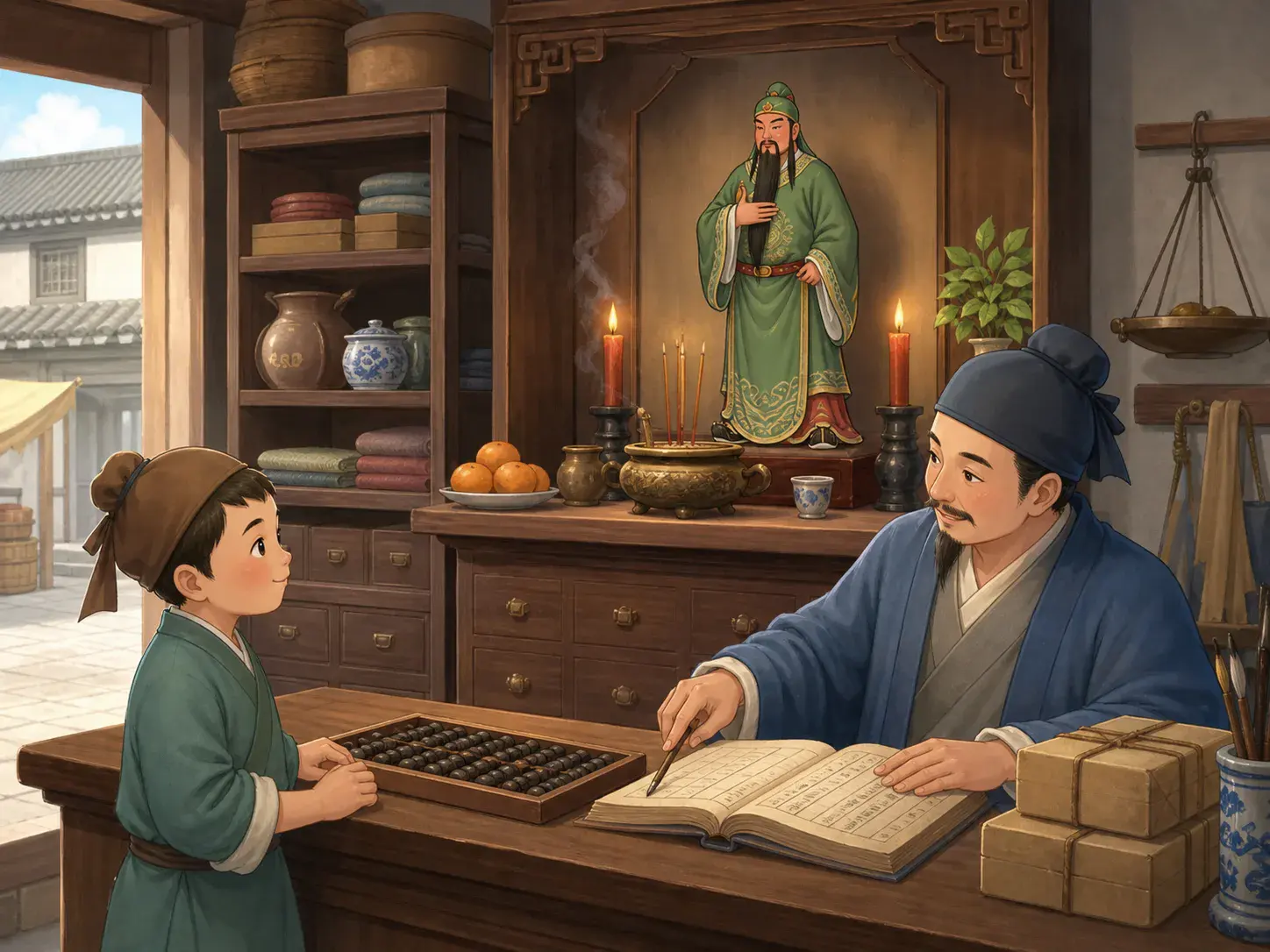
The shop shrine points to Lord Guan’s later link with trust in business. The family, account book, and lesson are imagined.
第二幅图把关公像放进一间商铺。掌柜在账本旁教孩子使用算盘,神龛就在身后。这是一幅现代想象画,却抓住了明清以来的一种真实现象:一些商人和行业团体会把关公当作保护者。
尤其是走得很远的山西商人,会在会馆里祭祀同乡关羽。会馆既是同乡商人见面、互助和处理事务的地方,也可能包含关帝庙、戏台和公共仪式。共同拜一位代表忠义的神,可以提醒成员守约,也能加强“我们属于同一个团体”的感觉。
不过,不是所有商人都拜关公,也不能简单说他自古就是“专门送钱的财神”。在商业环境中,人们看重的往往是信任、团结、保护和公平交易。神龛并不能保证每笔生意诚实;真正的信用仍要靠人怎样行动。
The second picture places a Lord Guan shrine inside a shop. A merchant teaches a child beside an abacus and an account book. The scene is modern artwork, but it points to a real development: from the late imperial period onward, some merchants and trade groups treated Lord Guan as a protector.
Shanxi merchants who traveled far from home were especially connected with Guan Yu, who also came from Shanxi. Their guildhalls gave people from the same region places to meet, help one another, and handle business. Some included a Lord Guan temple, a stage, and shared ceremonies. Worshipping a deity linked with loyalty and righteousness could remind members to keep agreements and strengthen the feeling that they belonged to one community.
This does not mean every merchant worshipped Lord Guan, or that he had always been a “wealth god” whose special job was handing out money. In commercial settings, trust, group unity, protection, and fair dealing were often more important. A shrine could express those values, but it could not make every transaction honest. People still had to keep their own promises.
Page 8
一尊神像,许多种理解
One Statue, Many Ways of Understanding It
现在再看第一幅图。红脸巨像和整齐站立的祭拜者并不是某座历史关帝庙的照片,而是现代画家综合常见元素创造的场景。它能帮助我们辨认关公崇拜,却不能证明所有庙宇、仪式和信众都完全一样。
有人把关公视为道教神明,有些佛寺把他当护法,地方社区可能请他守护一方,军人、商人和不同职业团体又会强调不同品格。英文有时把他简单叫作 “God of War”,也就是“战神”,但这个名字太窄:关公还被请来驱邪、求雨、维护道德和保护群体。
理解关公,不是寻找一个永远不变的标准答案,而是看见同一个历史人物怎样被不同的人重新解释。宗教传统并不总像几个互不相干的盒子;在关公身上,它们常常交叉、借用,又保留自己的说法。
Look again at the first image. Its giant red-faced statue and neatly arranged worshippers do not document one named historical temple. A modern artist combined familiar elements to create the scene. It helps us recognize Lord Guan worship, but it cannot prove that every temple, ritual, and worshipper is the same.
Some people understand Lord Guan as a Daoist deity. Some Buddhist temples honor him as a guardian. Local communities may ask him to protect their area, while soldiers, merchants, and other groups emphasize different virtues. English sometimes calls him simply the “God of War,” but that label is too narrow. Lord Guan has also been asked to drive away demons, bring rain, uphold morality, and defend communities.
Understanding Lord Guan does not mean hunting for one unchanging answer. It means watching different people reinterpret the same historical figure. Religious traditions are not always separate boxes. In Lord Guan’s story, they often cross, borrow from one another, and still keep their own explanations.
他不是一天走进庙里的
He Did Not Enter the Temple in One Day
关羽没有在《三国演义》出版以后突然变成神。大约从他死后所在地区的地方记忆开始,佛寺、道教仪式、朝廷封号、戏剧小说、商人会馆和普通信众,在一千多年里不断为关公增加新的故事和职责。
庙里的关公因此既和历史上的关羽有关,又不等于关羽本人。研究这段变化,真正要问的不是“人怎么会一下子变成神”,而是:一代代人为什么需要这位守护者,又各自希望他替自己守住什么?
Guan Yu did not suddenly become a god after Romance of the Three Kingdoms appeared. Beginning with memories near the region where he died, Buddhist monasteries, Daoist ritual, imperial titles, plays and novels, merchant guildhalls, and ordinary worshippers kept adding stories and duties for more than a thousand years.
The Lord Guan in a temple is connected to the historical Guan Yu, but he is not identical to him. The best question is not “How can a person instantly turn into a god?” It is this: Why did generation after generation need this guardian, and what did each group hope he would protect?