一张考卷能打开多大的门? - 中国古代怎样选官
How Wide Could an Exam Open the Door? Choosing Officials in Imperial China
阅读难度 · 困难Reading level · Hard
Page 1
第一把锁:家世
The First Lock: Family Background
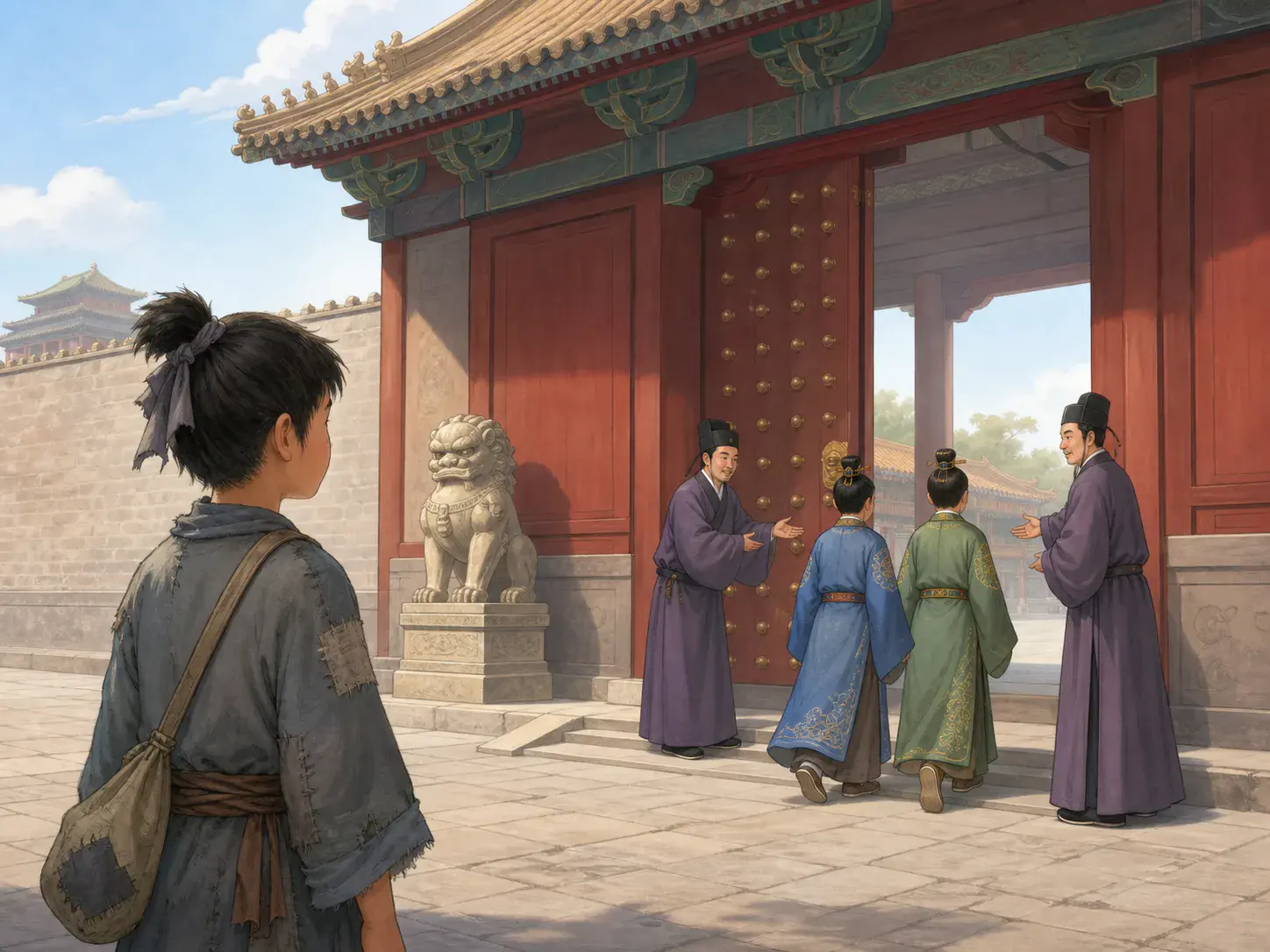
This modern palace gate is symbolic, not a scene from one exact dynasty. Family status mattered, but appointment and other routes existed too.
假如一座城要选管理粮仓、记录法律和传达命令的人,应该先看什么?是看他出生在哪个家族,听谁推荐,还是请他坐下来答题?中国古代用了两千多年,反复试过这些办法。
早期中国并没有一套从头到尾不变的“选官制度”。在西周等时代,贵族身份和家族关系常常决定一个人离权力有多近,重要职位也可能由同一家族世代担任。不过,君主也会任命官员;到了战国和秦,国家的官僚组织越来越复杂,更需要会书写、懂法律、能办事的人。把那时说成“贵族的孩子自动当官,其他人完全没有机会”,太简单了;但对大多数农民和手工业者来说,得到教育、接近掌权者,确实极难。
所以,第一幅图里的宫门更像一个比喻,不是某个朝代真实发生的一幕。门外的孩子面对的,不只是一扇门,还有家世、教育和关系织成的好几把锁。
Suppose a city needs people to manage its grain, record its laws, and carry out orders. What should matter most when choosing them: the family they were born into, the people who recommend them, or the answers they write on a test? For more than two thousand years, Chinese governments kept trying different combinations of all three.
Early China did not have one unchanging system for choosing officials. In eras such as the Western Zhou, noble birth and family ties often placed a person close to power, and some important duties stayed within the same families. Rulers appointed officials as well, and by the Warring States and Qin periods, growing governments needed people who could write, understand laws, and handle practical work. It would be too simple to say that every noble child automatically received an office while nobody else had a chance. Still, for most farmers and craftspeople, getting an education or attracting a ruler's attention was extremely difficult.
The palace gate in the first picture is therefore a symbol, not a scene from one exact dynasty. The child outside faces more than one locked door. Family status, education, and connections all stand between him and a government post.
Page 2
汉代察举:先要被人看见
Han Recommendations: First, Someone Had to Notice You

This image only illustrates local observation. One kind act did not earn an office; reputation, nomination, and evaluation all mattered.
汉代建立庞大的帝国后,需要不断寻找官员。朝廷使用“察举”等途径,让地方官在辖区内考察人才,再把合适的人推荐给中央。“孝廉”是其中著名的一科,重视对父母的孝行和做官应有的清廉;有些被推荐者还要到中央接受考问。太学等学校和属吏升迁,也提供了另外的入口。
这和只按家世分配职位并不一样,却也不是今天人人报名的统一考试。一个人得先进入地方官和乡里名流的视线,才可能被提名。学问和声誉有用,人际关系和地方评价也很重要;推荐者若判断错误、偏爱熟人,制度就会出问题。
因此,第二幅图可以帮助我们想象“地方考察”,却不能当作察举现场的照片。地方官不会只看见一个孩子扶老人,便立刻让他当官。真正的过程牵涉长期声誉、官员提名和后续考核。
After the Han built a large empire, the government needed a steady supply of officials. One important method was chaju, in which local officials observed men in their districts and nominated promising candidates to the central government. A famous category called xiaolian looked especially for men known as filial and incorrupt - respectful toward parents and honest enough for public service. Some nominees were then questioned or examined at the capital. Imperial schools and promotion from lower government work created other paths as well.
This was different from simply handing offices down by birth, but it was not an open test that anyone could sign up for. A candidate first had to enter the view of officials and influential people in his community. Learning and reputation mattered, but so did local relationships. If a recommender favored friends or judged badly, a capable person might never be nominated.
The second picture can help us imagine local observation, but it is not a snapshot of chaju at work. An official did not see a child help an older neighbor and immediately give him a government job. Selection involved a longer reputation, an official nomination, and often another stage of evaluation.
Page 3
九品中正:给人评分,也给家门评分
Nine Ranks: Rating a Person - and His Family
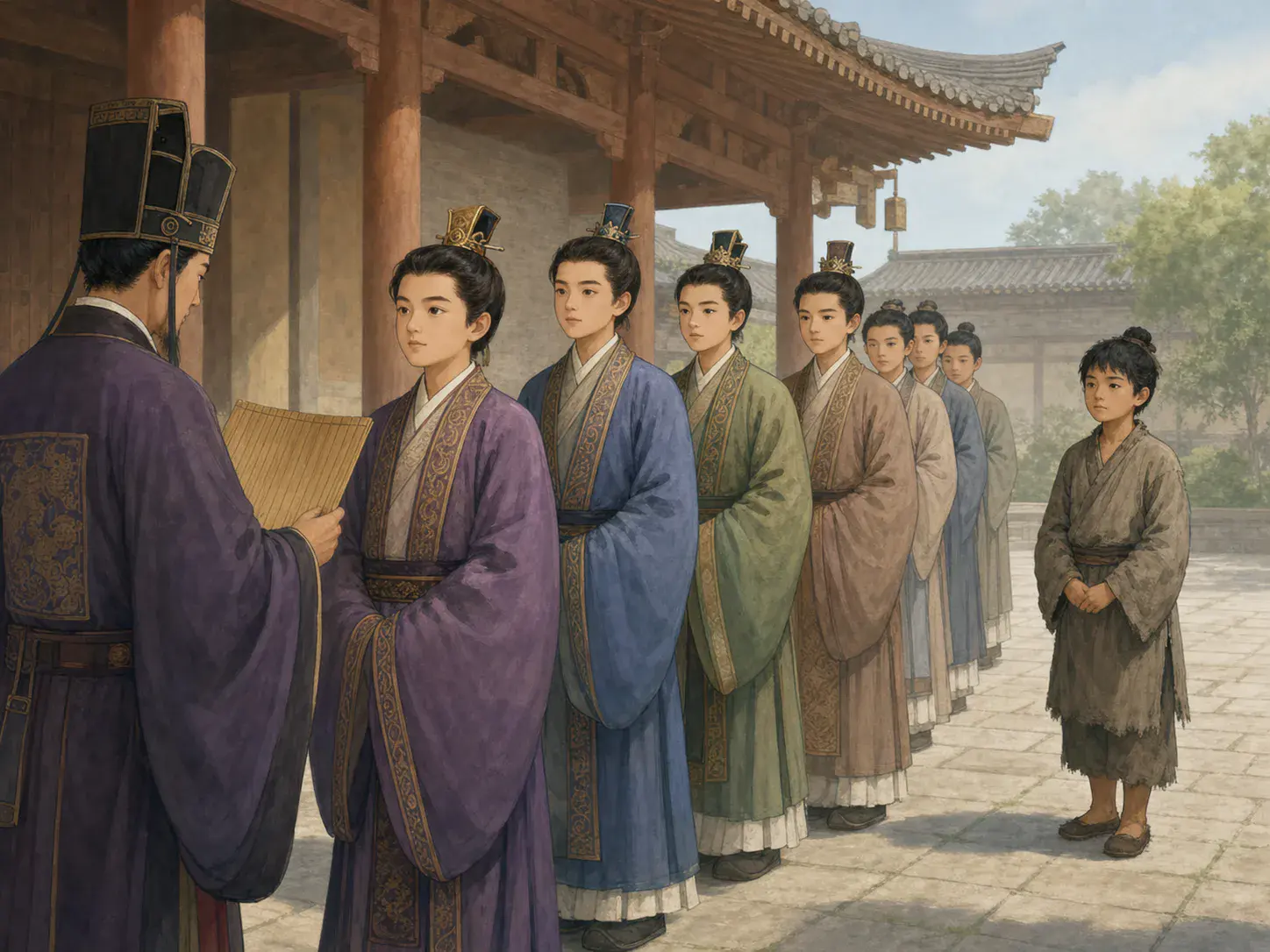
This modern illustration turns a complex system into a line to show how family status shaped rankings. It is not a record of an actual selection.
汉末战乱使人口流动,地方社会和旧有评价网络受到破坏。三国时的魏开始实行后来被称为“九品中正制”的办法:由“中正”调查本地士人,把他们分成不同等级,再把评价交给官府,作为安排起点职位的依据。它刚出现时,是想让中央更有秩序地掌握人才,并不只是一个“故意挡住穷人”的计划。
可是,中正常从有势力的地方家族中产生。时间一久,候选人的家族声望越来越影响评分,高门大族更容易取得好的起点。这里不能简单地说“汉代公平了,魏晋又退回去了”:汉代举荐同样可能被地方势力左右,而九品中正也会评价能力和品行。真正值得注意的是,两套制度都把一个难题交给少数评选者 - 谁有资格被看见,又由谁来评价他?
第三幅图把复杂制度画成一条队伍,只能表达“门第影响排序”这个概念。它不是魏晋官员实际在街上给孩子排队打分的记录。
War and migration at the end of the Han disrupted communities and their old ways of judging people. During the Three Kingdoms period, the state of Wei introduced what became known as the nine-rank system. Officials called “rectifiers” investigated educated men from their home regions, placed them in ranked categories, and sent those ratings to the government. The grades helped determine where a new official could begin his career. At first, the system was an attempt to organize recruitment after years of disorder, not simply a plot designed to block poor people.
Yet rectifiers often came from powerful local clans. Over time, a candidate's family reputation weighed more heavily, and members of great families were more likely to receive high ratings and good starting positions. This does not give us a neat story in which Han recommendations were fair and the Wei and Jin suddenly moved backward. Han recommenders could also be influenced by local power, while nine-rank officials did consider character and ability. Both systems left a hard question in the hands of a small group: who deserved to be noticed, and who had the authority to judge?
The third picture turns this complicated process into a line of people. It illustrates the idea that family status could shape a ranking; it is not a record of officials lining up children and scoring them in a street.
Page 4
隋唐科举:新路出现了,却不是唯一的路
Sui and Tang Exams: A New Road, Not the Only Road
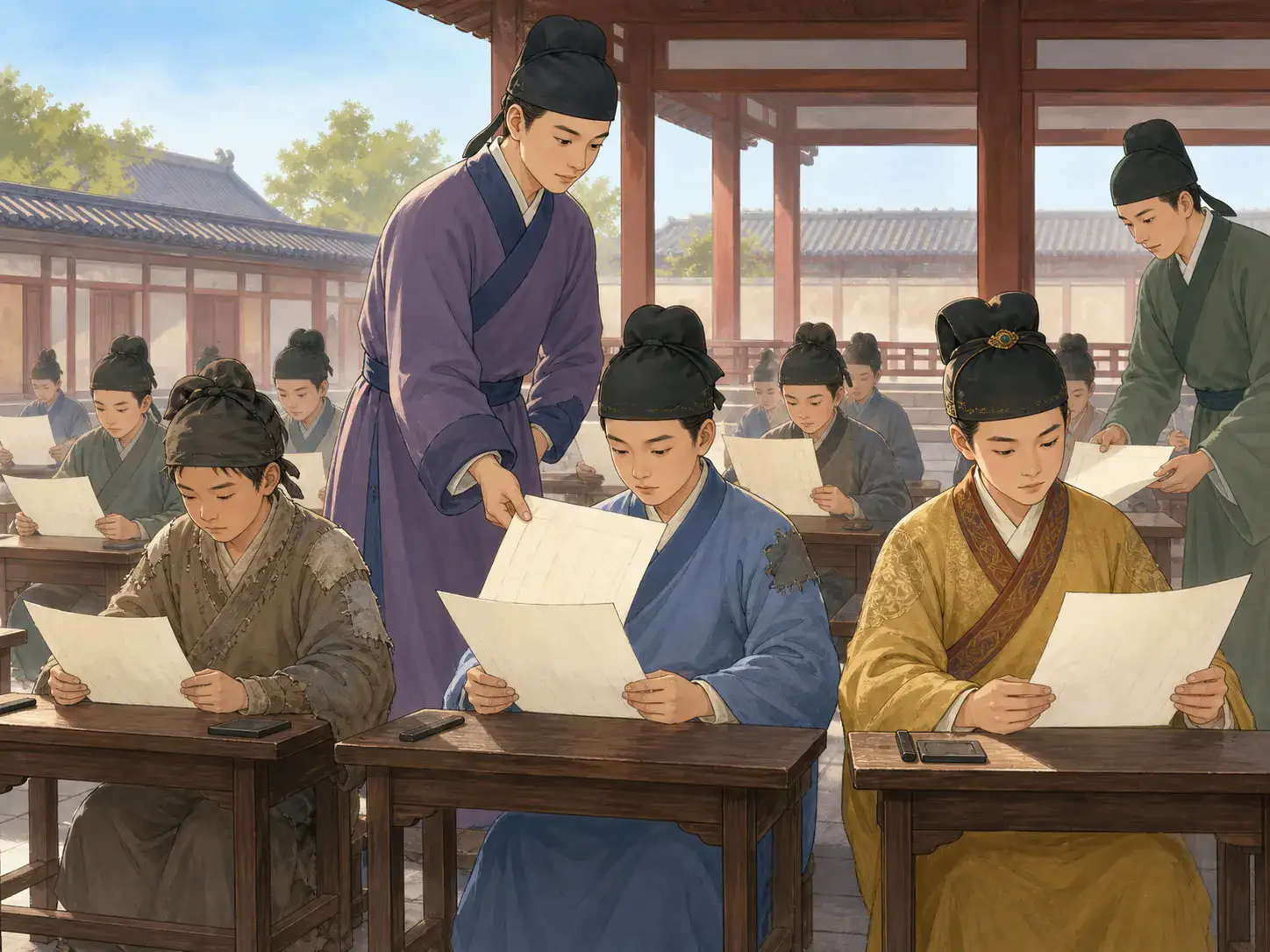
This is a concept image about comparing written work, not evidence of an anonymous, equal Tang exam. Education, nomination, and connections still mattered.
科举并不是隋朝某一天突然出现的一张新考卷。汉代已有“被推荐后考试”的做法,南北朝也不断调整选官。隋朝的诏令和考试承接了这些旧制度,参加者仍需官员举荐;到了唐代,考试的种类、时间和组织方式才逐渐稳定,更多男子原则上可以通过学校或地方送考进入竞争。
“原则上可以参加”不等于“每个人都有同样机会”。准备考试需要多年读书,还要有书、老师、时间和路费。唐代考生的名声、文章在考前的传播,以及官员和名士的推荐,也可能影响结果。通过礼部考试通常还不等于立刻得到官职,考生可能仍要等待或接受其他选拔;与此同时,门荫、学校、军功和地方幕府也是进入仕途的道路。
所以,第四幅图不是“唐代穷孩子和官员之子匿名同场、公平竞争”的历史证据。它只能代表一个渐渐变得重要的新想法:家世之外,朝廷也用可以比较的答卷来选择一部分人。
The imperial examination system did not suddenly appear with a brand-new test paper on one day in the Sui dynasty. Han officials had already examined nominated candidates, and later governments kept changing recruitment practices. Sui orders and examinations grew out of those older methods, and candidates still needed official nomination. During the Tang, exam categories and schedules became more regular, and more men could, in principle, enter the competition through government schools or nomination from their home areas.
“Allowed in principle” did not mean “equally able to compete.” Preparing required years of education, along with books, teachers, time, and money for travel. In the Tang, a candidate's reputation, writing circulated before the test, and introductions from officials or famous scholars could also affect his chances. Passing the examination administered by the Ministry of Rites did not always bring an immediate post; another selection or a long wait might follow. Hereditary privilege, government schools, military service, and jobs on regional staffs continued to offer other routes into government.
The fourth picture is therefore not evidence that a poor Tang student and an official's son took an anonymous, perfectly equal test. It represents a new idea that was becoming increasingly important: alongside family background, the court could compare at least some candidates through written work.
Page 5
宋代以后:让卷子说话,也别忘了台阶
After the Song: Let the Paper Speak - but Notice the Stairs
到了宋代,科举规模扩大,进士出身的官员比唐代更多,一些没有显赫做官记录的家族也由此进入官僚队伍。为了减少考官认人的机会,宋代逐步使用封住姓名、给考卷编号和由书吏重抄答卷等办法。殿试把最终排名放到皇帝主持的考试中,考试也越来越成为读书人生活的中心。
不过,考试扩大并没有让家族优势消失。宋代官员亲属仍可通过“荫补”取得入仕资格;能长期供一个孩子读书、反复赶考的家庭,也比缺少书本和时间的家庭更有优势。正式规则主要面向男性,还有身份限制和地区名额。公平不只在考场里发生:一个人能不能走到考场,也是公平的一部分。
明清时期,地方、乡试、会试和殿试组成更严密的阶梯,名额制度让不同地区都有一定位置,也让竞争变得非常激烈。考试围绕儒家经典和规定文体展开,“八股文”并非只把句子背下来就能写,但格式严格,考生必须在有限框架内展示经义、结构和文字能力。考中可以带来地位与机会,失败者却可能多年投入而仍停在门外;地方精英也能凭学校、书籍和家族资源保持优势。
The examinations grew much larger under the Song. More officials held the prestigious jinshi degree than in the Tang, and some came from families with little or no recent record of government service. To make favoritism harder, Song exam offices gradually sealed candidates' names, replaced names with numbers, and had clerks copy papers so examiners could not recognize the handwriting. A palace examination shaped the final ranking, and the testing system moved closer to the center of educated men's lives.
Expansion did not erase family advantage. Song officials could still use hereditary “protection privilege” to help relatives qualify for service. A household able to support years of study and repeated journeys to examinations had an advantage over one that needed every child to work. The formal route was mainly for males, and rules about status and regional quotas also shaped eligibility. Fairness did not begin inside the examination hall; being able to reach the hall was part of the question too.
During the Ming and Qing, local qualifying tests, provincial exams, metropolitan exams, and the palace exam formed a more tightly organized ladder. Quotas reserved places for different areas, but competition was fierce. Candidates studied Confucian classics and wrote in required forms. The famous “eight-legged essay” was not produced by memorization alone, but its strict structure forced writers to display knowledge and skill within narrow boundaries. Success could bring status and opportunity, while years of failure could consume a family's resources. Local elites still held advantages through schools, books, money, and educated relatives.
Page 6
1905年以后:门换了,问题还在
After 1905: A New Door, the Same Questions
十九世纪末,中国面对战争、外交压力和新知识体系,越来越多人认为旧考试不能培养国家急需的人才。清政府在教育改革中于1905年停止科举,转而发展新式学校。延续许多世纪的制度结束了,但“怎样选人才才公正”并没有成为一道已经答完的题。
现在再看那四幅门和考卷的图,我们不必讲一个“家世 - 推荐 - 分数,世界越来越公平”的直线故事。更准确的说法是:历代不断把家世、声誉、知识、考试和皇权组合起来;科举扩大了竞争范围,也改变了什么知识最受重视,却从未消除财富、性别、地区、关系和家庭资源的影响。
By the late nineteenth century, China faced wars, foreign pressure, and new fields of knowledge. More reformers argued that the old examinations did not train the experts the country now needed. In 1905, as part of a broader education reform, the Qing government ended the civil service examinations and turned toward a new school system. A centuries-old institution stopped, but the question of how to choose people fairly did not.
Looking back at the four pictures, we no longer need a straight-line tale that says, “First family, then recommendation, then scores - and everything became fairer.” A more accurate story is that different dynasties combined family status, reputation, education, tests, and imperial power in changing ways. The examinations widened competition and changed which kinds of learning brought honor, but they never removed the effects of wealth, gender, region, personal networks, or family resources.
同一张纸,不等于同一个起点
The Same Paper Is Not the Same Starting Point
一张相同的考卷,可以让比较更有规则,却不自动带来相同的起点。真正难的问题不是“要不要考试”,而是:谁能走进考场?考什么?谁来评分?考中以后,又由谁得到职位?
Giving candidates the same paper can make comparison more orderly. It does not automatically give them the same starting point. The deepest questions are not only “Should there be a test?” They are also: Who can reach it? What does it measure? Who judges it? And after the scores are counted, who actually receives a job?