一张地图为什么装不下中国菜?
Why Can't One Map Hold All of Chinese Food?
阅读难度 · 中等Reading level · Medium
Page 1
八种颜色画完了,中国菜就画完了吗?
Do Eight Colors Complete the Map?
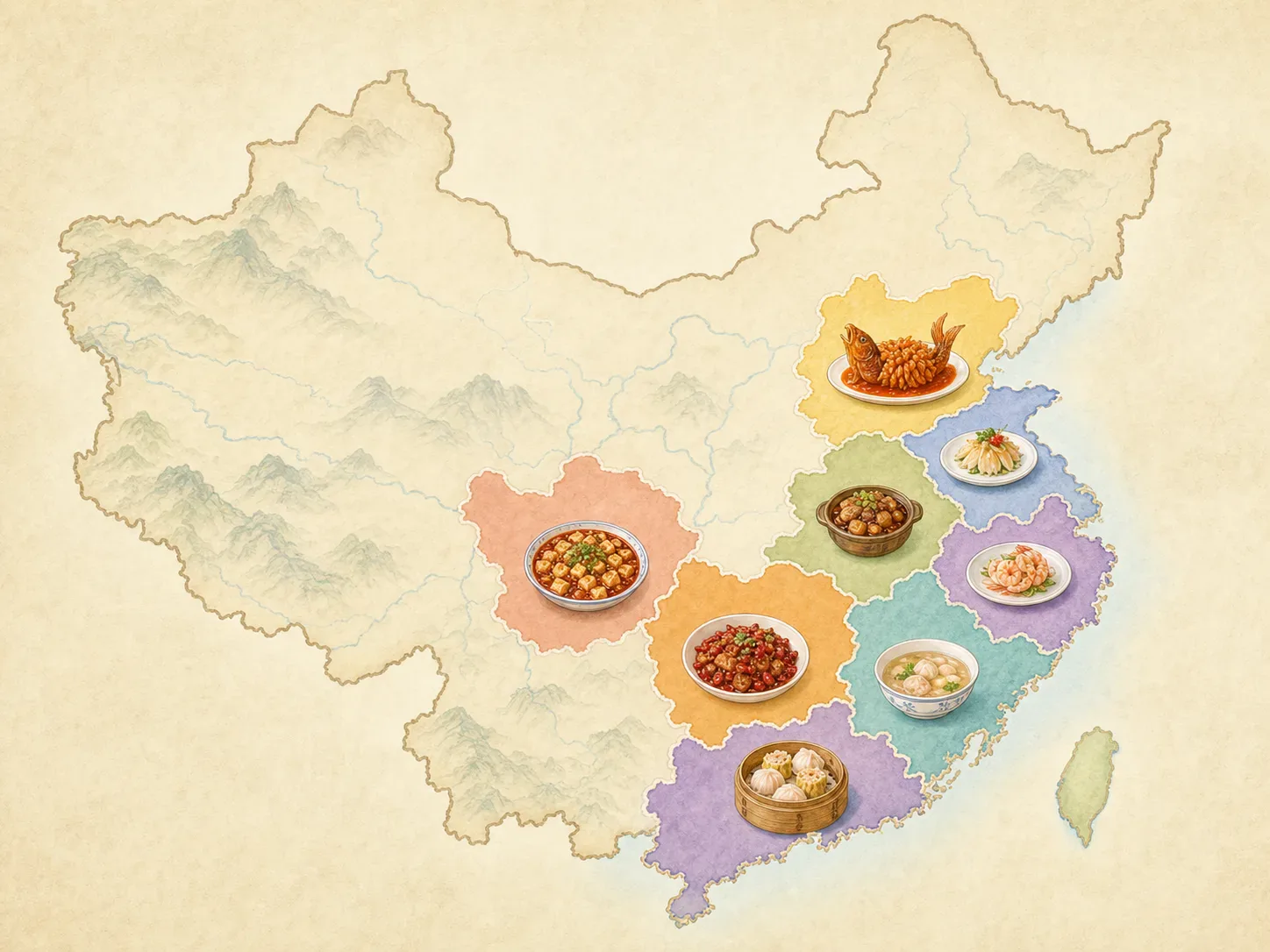
This modern guide shows approximate areas and sample dishes for the familiar “Eight Great Cuisines.” The colors are not exact borders, and the map is not a complete list of food in China.
假如你拿到一盒彩笔,把鲁、川、粤、苏、闽、浙、湘、徽八种菜系涂在地图上,很快就会碰到一个问题:北京、东北、云南、新疆和西藏吃什么?各地少数民族的食物、清真菜、寺院素菜、街头小吃和家里每天做的饭,又该涂成什么颜色?地图上没有着色的地方,厨房当然不会是空的。
今天常说的“八大菜系”,是近现代整理和介绍地方烹饪时形成的一种常见分类。更早和后来的书里,还出现过“四大”“五大”“十大”等不同分法。八个名称背后的地方烹饪传统可能很老,但把它们选出来,排成一套固定名单,并不是从古代一直没有变化的规矩。
而且,菜系的边界不像省界那样画一条线就结束。同一省内可以有几套不同的口味;一种做法也能沿河流、商路和移民路线走到别处。所谓“南甜北咸、东辣西酸”的口诀容易记,却会把千千万万张餐桌压成四句话。八大菜系可以当作八扇入口,却不能当作关住中国菜的八只盒子。
Imagine coloring a map for the Shandong, Sichuan, Cantonese, Jiangsu, Fujian, Zhejiang, Hunan, and Anhui cuisines. You would soon run into a problem. What color should you use for Beijing, the Northeast, Yunnan, Xinjiang, or Tibet? Where would you place the foods of China's many ethnic communities, Muslim cooking, Buddhist vegetarian dishes, street snacks, and ordinary family meals? An uncolored place on the map does not have an empty kitchen.
The familiar “Eight Great Cuisines” are one modern way of organizing and presenting regional cooking. Other writers have grouped Chinese cuisines into four, five, ten, or still more traditions. The cooking behind some of the names may be very old, but the fixed list of eight is not an unchanged rule handed down from ancient times.
A cuisine does not stop neatly at a provincial border, either. One province can contain several different food traditions, while a technique can travel along rivers, trade routes, and migration paths. Rhymes that reduce the country to four compass directions and four flavors are easy to memorize, but they flatten millions of tables into a slogan. Think of the eight cuisines as eight doors - not eight boxes that can hold all Chinese food.
Page 2
川菜的红辣椒,是一位“新来客”
Sichuan's Red Chilies Were Newcomers
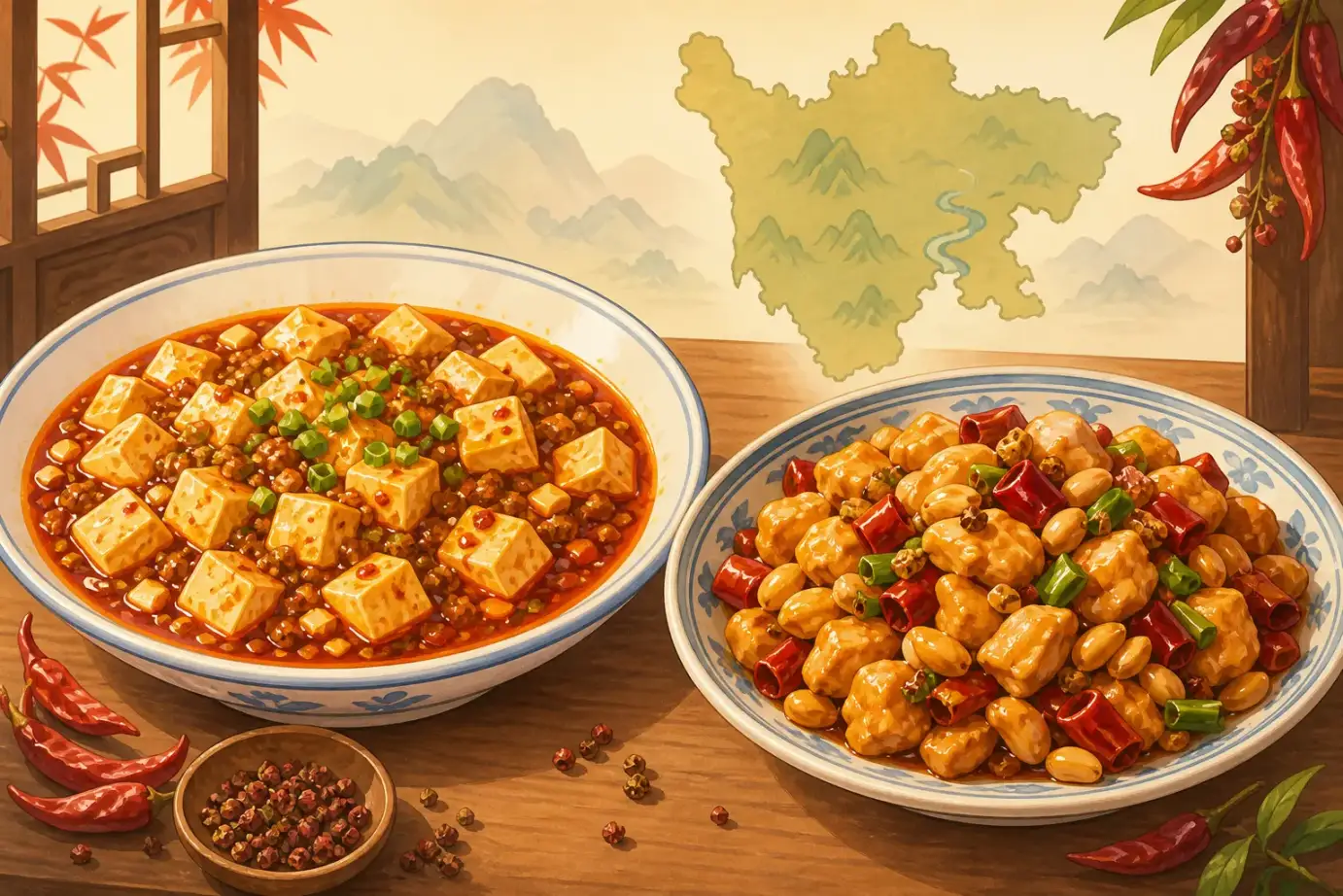
This modern food illustration uses mapo tofu, kung pao chicken, chilies, and Sichuan pepper to suggest familiar Sichuan flavors. Not every Sichuan dish is hot and numbing, and recipes change across cooks and generations.
看看图里的红辣椒。要是把这桌菜端到一千年前的四川,厨师不会把它认作“祖传川味”,因为那时中国还没有辣椒。辣椒原产美洲,十六世纪才随着跨洋交流来到中国;现有史料显示,1570年代以前中国没有辣椒。它最早在东南沿海的一些记录里出现,后来才逐渐进入内陆厨房。
四川人原本就使用姜、蒜和花椒等辛香料。花椒带来的“麻”和辣椒带来的“辣”并不是一回事。明末清初的战争与此后的大规模移民,又让来自湖北、湖南、江西、广东等地的人把种子、做法和口味带进四川。气候和物产提供了条件,可人怎样种、怎样卖、怎样搭配,才让辣椒在几百年里变成川菜的重要角色;潮湿天气并不会自动替厨师写出菜谱。
麻婆豆腐就是这种变化的好例子。成都地方记载到清末才把它列为名菜,关于陈家饭铺老板娘做出这道菜的故事也流传很广。我们可以说它在晚清成都已经出名,却不能把每个细节都当成亲眼记录。今天麻婆豆腐和宫保鸡丁已经走遍世界,各家还会改变肉类、辣度和酱汁。川菜保留了来路,也一直在产生新版本。
Look at the red chilies in the picture. If this meal traveled back to Sichuan a thousand years ago, a cook would not recognize them as an ancient local ingredient. Chilies originated in the Americas and reached China through overseas exchange in the sixteenth century. The surviving evidence places them in China only after the 1570s, first in records from parts of the southeastern coast and later in inland kitchens.
Sichuan cooks already worked with lively seasonings such as ginger, garlic, and Sichuan pepper. The buzz of Sichuan pepper and the heat of a chile are different sensations. After destructive wars in the late Ming and early Qing periods, large migrations brought people from Hubei, Hunan, Jiangxi, Guangdong, and elsewhere into Sichuan. They carried seeds, methods, and tastes. Climate and crops created possibilities, but people still had to grow, sell, combine, and choose ingredients. Humid weather cannot write a recipe by itself.
Mapo tofu is a good example of food changing through time. Local Chengdu records identify it as a famous dish by the late Qing period, and a well-known story credits the woman who cooked at a small Chen family restaurant. We can say that the dish was famous in late nineteenth-century Chengdu without treating every detail of the origin story like an eyewitness report. Today, mapo tofu and kung pao chicken have traveled around the world, and cooks keep changing the meat, heat, and sauce. Sichuan food carries its history while continuing to make new versions.
Page 3
广东的一只蒸笼里,也装着好几种地方
One Guangdong Steamer Holds Many Places
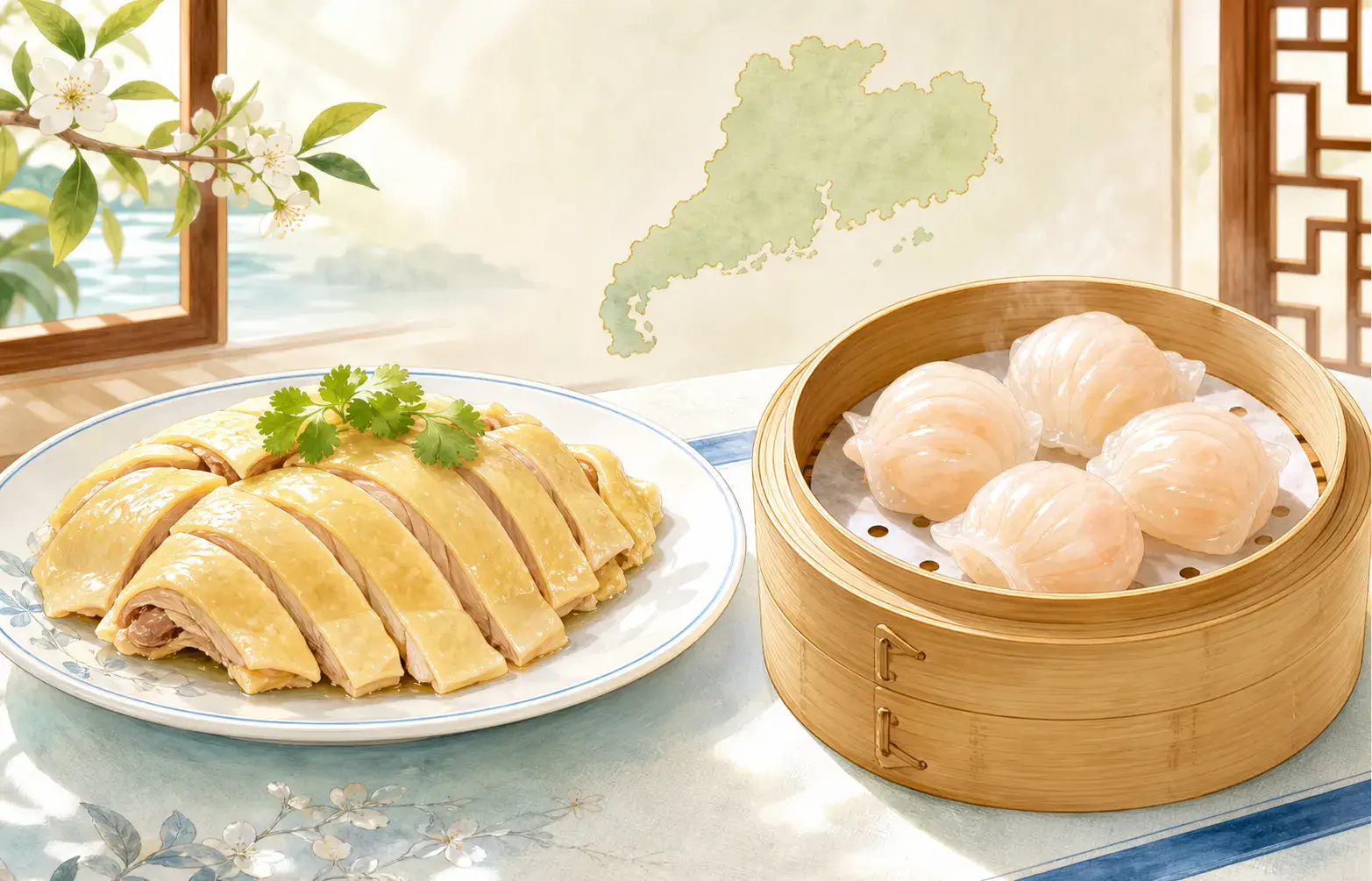
This modern illustration shows familiar Cantonese examples such as white-cut chicken and shrimp dumplings. They do not represent every part of Guangdong, every teahouse, or every home meal.
掀开一笼点心,可能有虾饺、烧卖,也可能出现某家茶楼刚设计的新点心。“点心”不是一道固定的菜,而是一大类配茶吃的小份食物;茶楼、厨师和客人一直在改变它。图里的白切鸡看似简单,真正制作时却要控制水温和时间,再配姜葱等蘸料。少放浓重酱汁,不等于少花功夫。
“粤菜”也不是“广东全省只有一种菜”。广府、潮州、客家以及广东其他地方的烹饪,在食材、语言、迁徙历史和做法上都有差别。沿海和河网让鱼虾容易进入许多市场,广州的商业与港口又让外地食材和新技术不断到来;但广东还有山区、农田和许多离海很远的家庭。清蒸、煲汤很重要,烧味、砂锅、腌制食品和浓香酱汁也同样存在。只说“粤菜清淡”,就像只用一只虾饺介绍整座城市。
十九世纪,许多前往美国的中国移民来自广东南部少数几个县。他们带去熟悉的烹饪知识,却要面对新的食材、设备、价格、顾客和严厉的排华环境。后来美国各地中餐馆的故事,正是从这些具体的出发地和新的生活条件中长出来的,而不是把一份永远不变的“中国菜单”装上船。
Lift the lid from a dim sum basket and you might find shrimp dumplings, siu mai, or a new creation from that particular teahouse. Dim sum is not one fixed dish. It is a large family of small foods served with tea, and teahouses, cooks, and customers keep changing it. The white-cut chicken in the picture may look simple, but a cook must manage the water temperature and timing carefully, then prepare seasonings such as ginger and scallion. Using less heavy sauce does not mean doing less work.
“Cantonese cuisine” does not mean that all of Guangdong cooks one way. The food traditions of Guangzhou, Chaozhou, Hakka communities, and other parts of the province differ in ingredients, language, migration history, and technique. Coasts and rivers bring fish and shellfish to many markets, while Guangzhou's trade and port connections have long brought in outside ingredients and new ideas. Yet Guangdong also has mountains, farms, and families far from the sea. Steaming and slow soups matter, but so do roast meats, clay-pot cooking, preserved foods, and deeply flavored sauces. Calling all Cantonese food “light” is like using one shrimp dumpling to explain an entire city.
In the nineteenth century, many Chinese migrants to the United States came from a small group of counties in southern Guangdong. They carried cooking knowledge with them, but they met new ingredients, equipment, prices, customers, and harsh anti-Chinese laws. The story of Chinese restaurants across America grew from these particular hometowns and new conditions - not from one unchanging “Chinese menu” packed onto a ship.
Page 4
山东的一桌饭,能同时看见海和麦田
A Shandong Table Can Face the Sea and the Wheat Fields
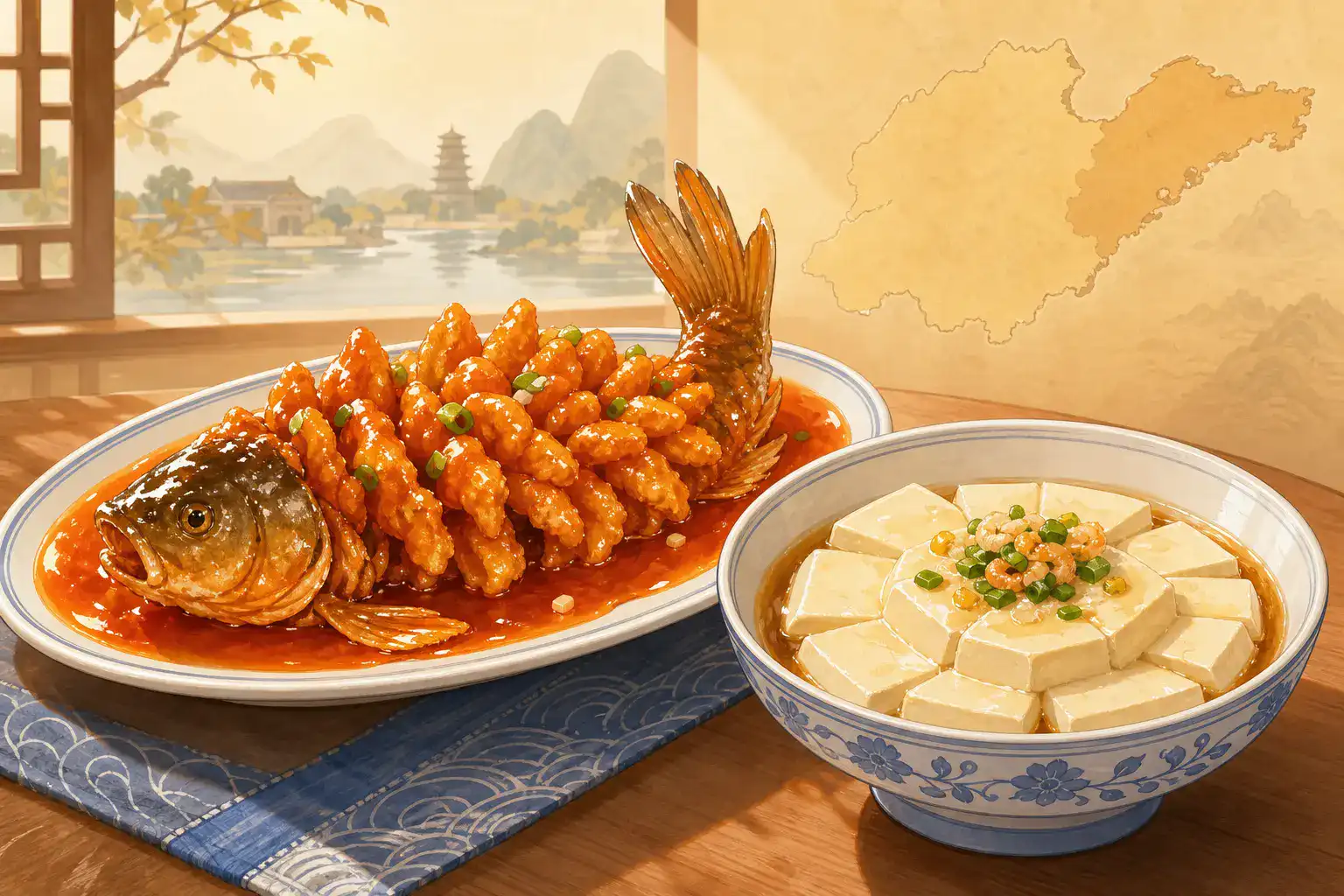
The sweet-and-sour carp and tofu are modern representative dishes. Shandong cooking includes Jinan, Jiaodong, Confucius-family, and other traditions, while banquet showpieces are not everyday meals for everyone.
A coastal province in eastern China. On a map, its peninsula reaches into the Yellow Sea; Beijing is northwest of it, and Shanghai is farther south.有伸进海里的半岛,也有黄河经过的平原。胶东沿海的厨房擅长处理海鱼、贝类和海参;济南一带发展出汤菜、爆炒等做法;曲阜的孔府菜又与富裕家族的宴席传统有关。把这些都叫“鲁菜”很方便,却不要忘记,一个名字里面已经站着好几个地方和不同生活阶层。
图中的糖醋鲤鱼常被当作山东名菜,它的造型和酸甜汁很适合宴席上桌;右边的豆腐却提醒我们,普通食材也能通过汤、火候和刀工变出许多做法。代表菜通常由餐馆、比赛和旅游宣传选出来,不一定是每个山东家庭最常吃的菜,更不能证明北方人顿顿“又咸又重”。
主食也没有一句“南米北面”那么整齐。考古研究显示,古代北方长期以粟和黍等谷物为主,南方许多地区较多利用稻米和其他植物;来自亚洲西南部的小麦在约四千年前以后进入中国,再慢慢改变北方饮食。后来人口迁徙、运河运输、城市市场和现代农业又让米与面越过原来的产区。今天山东餐桌上的馒头、面条、米饭和杂粮,讲的是一段不断移动的历史,不是气候下达的一条命令。
A coastal province in eastern China. On a map, its peninsula reaches into the Yellow Sea; Beijing is northwest of it, and Shanghai is farther south. has a peninsula reaching into the sea as well as plains crossed by the Yellow River. Kitchens along the Jiaodong coast are known for handling fish, shellfish, and sea cucumber. The Jinan area developed important soup and quick-cooking techniques. Confucius-family cuisine in Qufu grew partly from the banquet traditions of a wealthy household. Grouping all of these as “Shandong cuisine” is useful, as long as we remember that one label already contains several places and social worlds.
The sweet-and-sour carp in the picture is often presented as a Shandong classic. Its shape and glossy sauce make it a dramatic banquet dish. The tofu beside it reminds us that ordinary ingredients can also be transformed through broth, heat, and knife work. Restaurants, cooking contests, and tourism campaigns often help choose “representative dishes.” Such showpieces are not necessarily what every Shandong family eats most often, and they certainly do not prove that all northern food is heavy and salty.
Staple foods do not fit perfectly into the saying “rice in the south, wheat in the north,” either. Archaeology shows that people in ancient northern China relied heavily on millets, while many southern communities used more rice and other plants. Wheat arrived from Southwest Asia after about 2000 BCE and only gradually changed northern diets. Later migration, canal transport, city markets, and modern farming carried rice and flour far beyond their earlier growing regions. The steamed buns, noodles, rice, and mixed grains on a Shandong table tell a history of movement - not an order issued by the weather.
Page 5
辣椒先到浙江,为什么浙菜却不以辣出名?
Chilies Reached Zhejiang Early - So Why Isn't Its Food Famous for Heat?
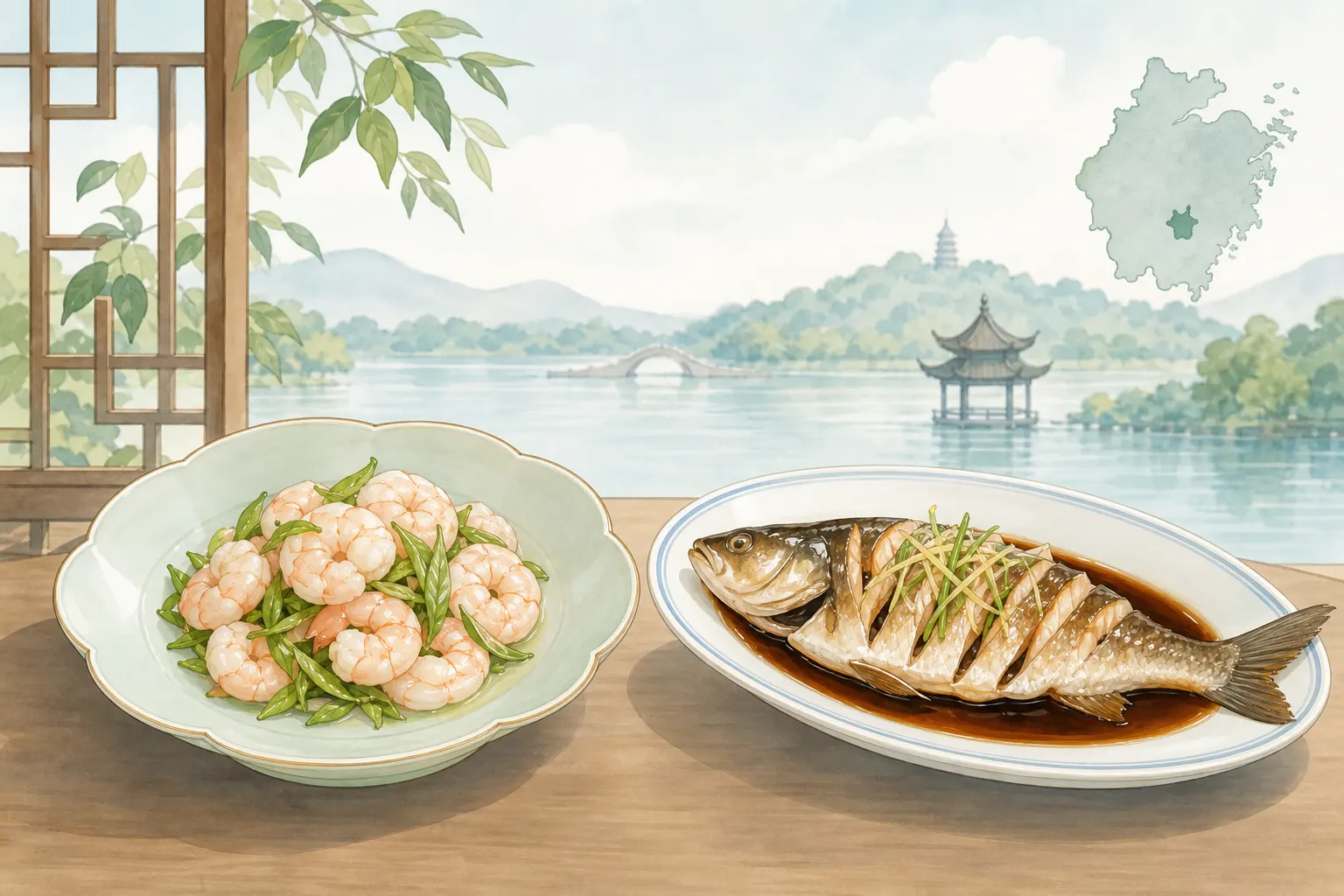
This modern illustration uses shrimp and fish to suggest Zhejiang's waterways. It is not an exact reconstruction of Dragon Well shrimp or West Lake vinegar fish, and it cannot represent every local cuisine in Zhejiang.
辣椒在中国最早的一批文字记录,恰好出现在浙江及附近沿海;可是今天提到浙菜,人们更常想到鲜鱼、虾、竹笋、茶叶、黄酒和比较细致的调味,而不是一片火红。这是一个很有意思的线索:一种植物先在哪里出现,不等于那里一定会最爱吃它。价格、种植方式、当地旧口味、移民路线和厨师选择,都会改变最后的结果。
浙江内部也很难用一只盘子说完。杭州靠近西湖和茶区,宁波、温州面向海洋,绍兴以黄酒闻名,山地与河谷又有自己的食材。龙井虾仁、西湖醋鱼是常见的杭州代表菜,但名菜故事常会把传说、餐馆宣传和可以查到的历史混在一起。我们可以说这些菜今天与杭州联系紧密,却不必给每道菜编一个精确到某年某人的出生故事。
图上的鱼、虾和嫩绿叶子因此只是提示,不是答案。真实的一餐还取决于季节、家庭预算、宗教习惯、谁负责做饭,以及今天市场里能买到什么。地理给厨房一套可能的食材,人们再用记忆、手艺和选择,把这些材料做成“家乡味”。
Some of China's earliest written records of chilies come from Zhejiang and nearby coastal areas. Yet when people describe Zhejiang food today, they are more likely to mention fresh fish, shrimp, bamboo shoots, tea, rice wine, and careful seasoning than a wall of fiery heat. That gives us an important clue: the place where a plant first appears does not have to become the place that loves it most. Price, farming, older tastes, migration routes, and cooks' choices all shape what happens next.
Zhejiang itself cannot fit on one plate. Hangzhou sits near West Lake and tea-growing country. Ningbo and Wenzhou face the sea. Shaoxing is closely connected with rice wine, while mountain and river-valley communities use their own ingredients. Dragon Well shrimp and West Lake vinegar fish are familiar Hangzhou examples, but famous-dish stories often mix legend, restaurant advertising, and evidence that historians can actually check. We can say that these dishes are strongly associated with Hangzhou today without inventing an exact birthday and creator for each one.
The fish, shrimp, and green leaves in the picture are clues, not answers. A real meal also depends on season, family budget, religious practice, who is cooking, and what today's market has for sale. Geography offers a kitchen some possibilities. People use memory, skill, and choice to turn those possibilities into the taste of home.
菜系的地图,还会漂洋过海
The Map Keeps Moving Across the Ocean
美国的中餐馆不是“中国菜的错误复印件”。早期广东移民在排华法案和种族歧视下寻找工作与生存空间;二十世纪初,餐馆也因为移民法规对“商人”身份的特殊规定而迅速增加。厨师使用美国能买到的蔬菜和肉类,调整分量、价格与出餐速度,顾客的选择也影响菜单。炒杂碎、炒面和后来各式外卖菜,就这样在移民家庭、餐馆员工、供应商和食客之间形成了真实的美式中餐传统。
1965年以后,来自香港、台湾和中国大陆不同地区的新移民又带来更多地方菜;与此同时,老餐馆继续保留自己的味道。把一盘菜只分成“正宗”或“假的”,会错过它为什么改变、谁靠它生活、谁把它当作家的味道。
所以,认识中国菜最好的问题不是“哪八种才算数”,而是:这道菜用了什么材料和技术?谁把它带到这里?它为哪些人改变过?一张地图可以帮我们开始旅行,却永远装不下每一间厨房正在发生的新故事。
Chinese American restaurants are not faulty photocopies of food in China. Early migrants from Guangdong searched for work and safety amid exclusion laws and racial hostility. In the early twentieth century, restaurants also grew rapidly because immigration rules offered a narrow path to “merchant” status for some owners. Cooks used vegetables and meat available in the United States and adjusted portions, prices, and speed. Diners' choices shaped menus too. Chop suey, chow mein, and later takeout dishes became a real Chinese American tradition made among immigrant families, restaurant workers, suppliers, and customers.
After 1965, newer migrants from Hong Kong, Taiwan, and many parts of mainland China brought additional regional foods, while older restaurants kept serving dishes with histories of their own. If we sort every plate into only “authentic” or “fake,” we miss why it changed, who made a living from it, and who remembers it as the taste of home.
The best question about Chinese food is not “Which eight cuisines count?” Ask instead: What ingredients and techniques shaped this dish? Who carried it here? For whom has it changed? A map can begin our journey, but it can never hold every new story unfolding in a kitchen.