木兰:一首诗怎样长成一千年的传奇?
Mulan: How Did One Poem Grow into a Thousand-Year Legend?
阅读难度 · 困难Reading level · Hard
Page 1
木兰先是一首诗,不是一份身份证明
Mulan Begins as a Poem, Not an Identity Card
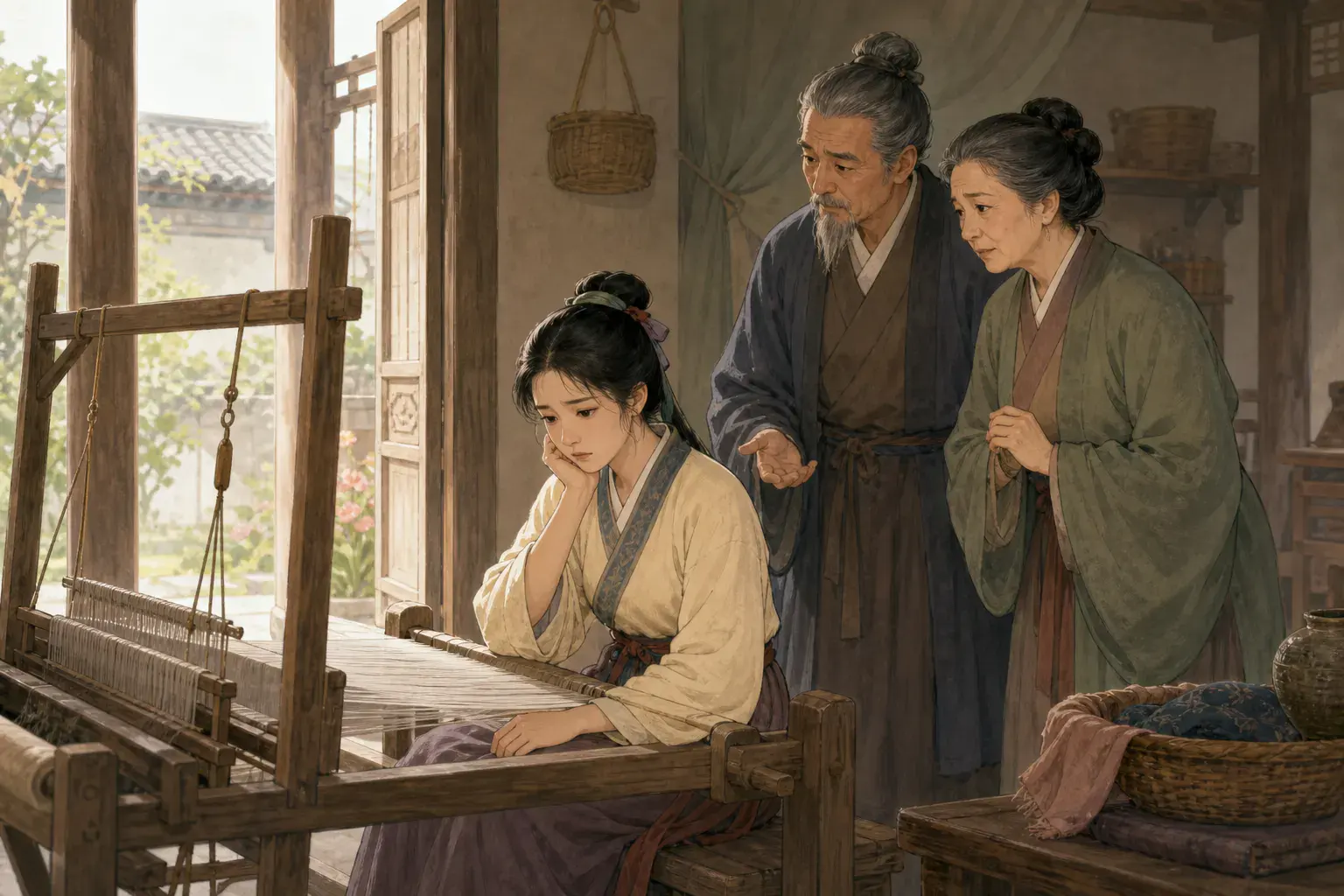
A modern story illustration, not a historical record of Mulan receiving the conscription notice. The surviving poem gives no surname, hometown, or exact date for her.
“唧唧复唧唧,木兰当户织。”《木兰诗》没有先让英雄挥刀,而是让读者听见织布机旁的声音忽然停了。木兰昨夜看见军帖,征兵名单上有父亲的名字;家里没有成年的儿子,也没有哥哥能代替他,于是她决定买马和装备,替父出征。今天人们常说父亲年老多病,可现存诗只说明家里没有成年儿子,并没有写他的年龄或病情。
这首叙事诗通常被看作来自中国北方,可能保留了北朝时代的生活记忆,但它的作者、最初写作日期和原始文字都无法确定。六世纪的一部音乐书据说已经收过《木兰》,可那部书已经失传;今天能完整读到的文本,保存在大约五百年后编成的《乐府诗集》中。诗能证明一个木兰故事很早就在流传,却不能证明历史上一定有一位姓名、籍贯和经历都能查清的士兵。
“Click-clack, click-clack - Mulan weaves beside the doorway.” The Ballad of Mulan does not begin with a hero swinging a sword. It begins with the loom falling silent. Mulan has seen a military notice bearing her father's name. There is no grown son and no older brother to take his place, so she decides to buy a horse and gear and serve instead. Modern retellings often make her father old and sick, but the surviving poem says only that the family has no adult son. It gives neither his age nor an illness.
This narrative poem is usually connected with northern China and may preserve memories of life during the Northern Dynasties. Yet its author, first date, and original wording are unknown. A sixth-century music book reportedly included a song called “Mulan,” but that book has been lost. The complete text we can read survives in the Collection of Music Bureau Poems, compiled roughly five hundred years later. The poem proves that a Mulan story circulated long ago. It does not prove that historians can identify one soldier with a known full name, hometown, and life record.
Page 2
“花”不是原诗给她的姓
The Ballad Never Gives Her the Surname Hua
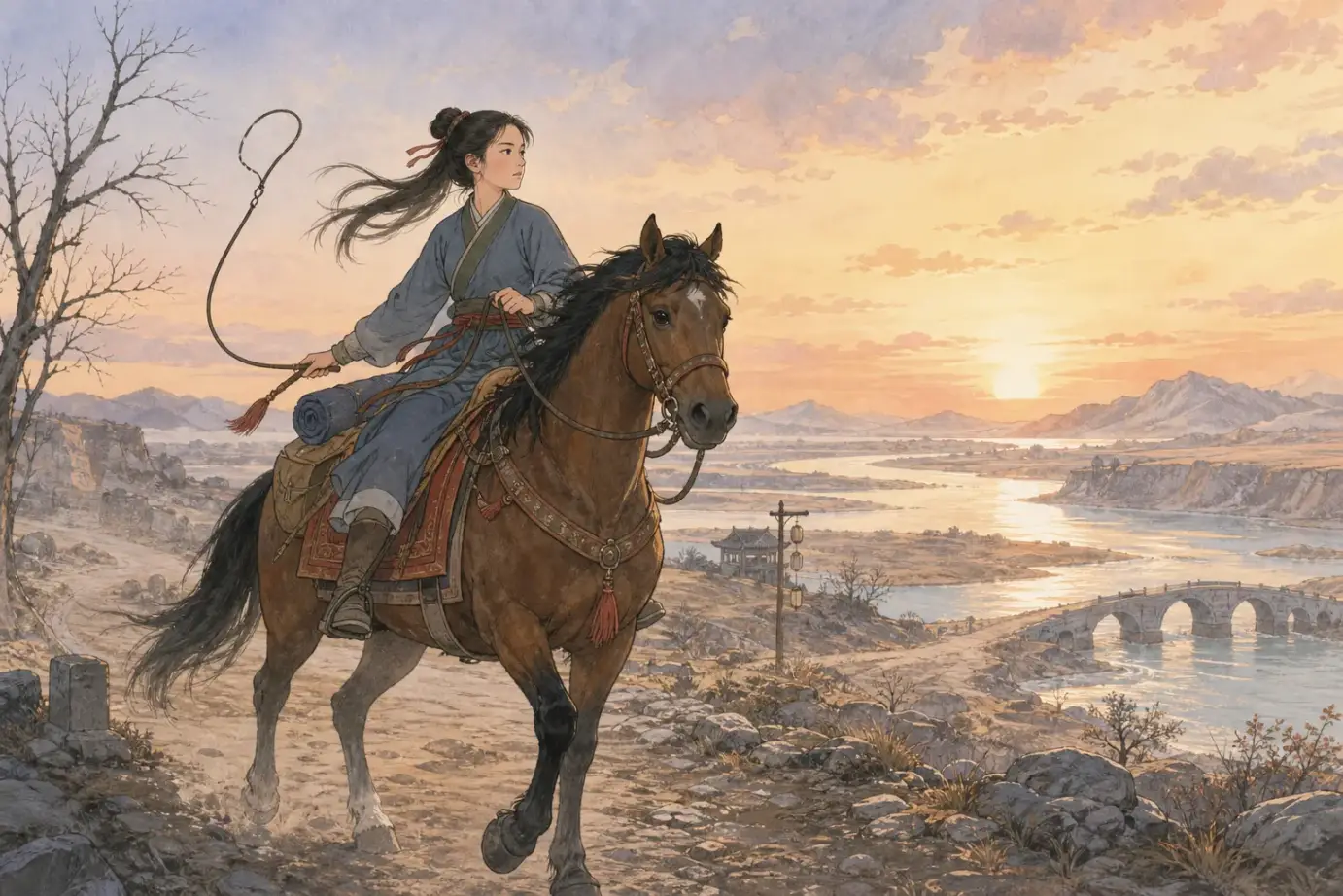
A modern imagined scene, not a portrait of an identified historical person. The poem names the Yellow River, Black Mountain, and Yan Mountain, but those names do not make a certain campaign map.
原诗从头到尾只叫她“木兰”,没有“花”这个姓,也没有写她出生在哪一座村庄。后来不同地方的庙碑、戏曲、小说和地方传说,给了她“花”“朱”“魏”等不同姓氏,也争相说木兰来自本地。这些说法很有文化意义,却互相冲突,不能一起成为同一份传记。因此,“花木兰”是今天最熟悉的名字,但不是原诗留下的完整姓名。
诗中的世界也不像后来电影里那种边界清楚的“古代中国”。同一位统治者既被叫作“可汗”,也被叫作“天子”;木兰骑马远行,路上听见黄河水声和北方骑兵的声音。这些线索使许多研究者想到由鲜卑拓跋建立的北魏,以及北方不同语言和生活方式彼此交会的社会。不过,地名和称号经过传唱、抄写与改写,不能让我们断定木兰属于哪个族群,或参加了哪一场具体战争。
The ballad calls its heroine simply “Mulan.” It never gives her the surname Hua, and it never names her home village. In later centuries, temple inscriptions, plays, novels, and local traditions gave her different surnames - including Hua, Zhu, and Wei - and several places claimed her as their own. Those traditions matter, but they conflict with one another and cannot all belong to one biography. “Hua Mulan” is now her most familiar name, not a full name preserved by the earliest poem.
The poem's world is also less tidy than the single, clearly bordered “ancient China” seen in some movies. It calls the same ruler both khan and “Son of Heaven.” Mulan travels on horseback and hears the Yellow River and northern cavalry. These clues lead many scholars toward the Northern Wei, a dynasty founded by the Tuoba branch of the Xianbei, and toward a northern society where different languages and ways of life met. But place-names and titles passed through singing, copying, and editing. They cannot tell us Mulan's exact community or which campaign she joined.
Page 3
一场漫长战争,为什么只用了四行?
Why Does a Long War Take Only Four Lines?
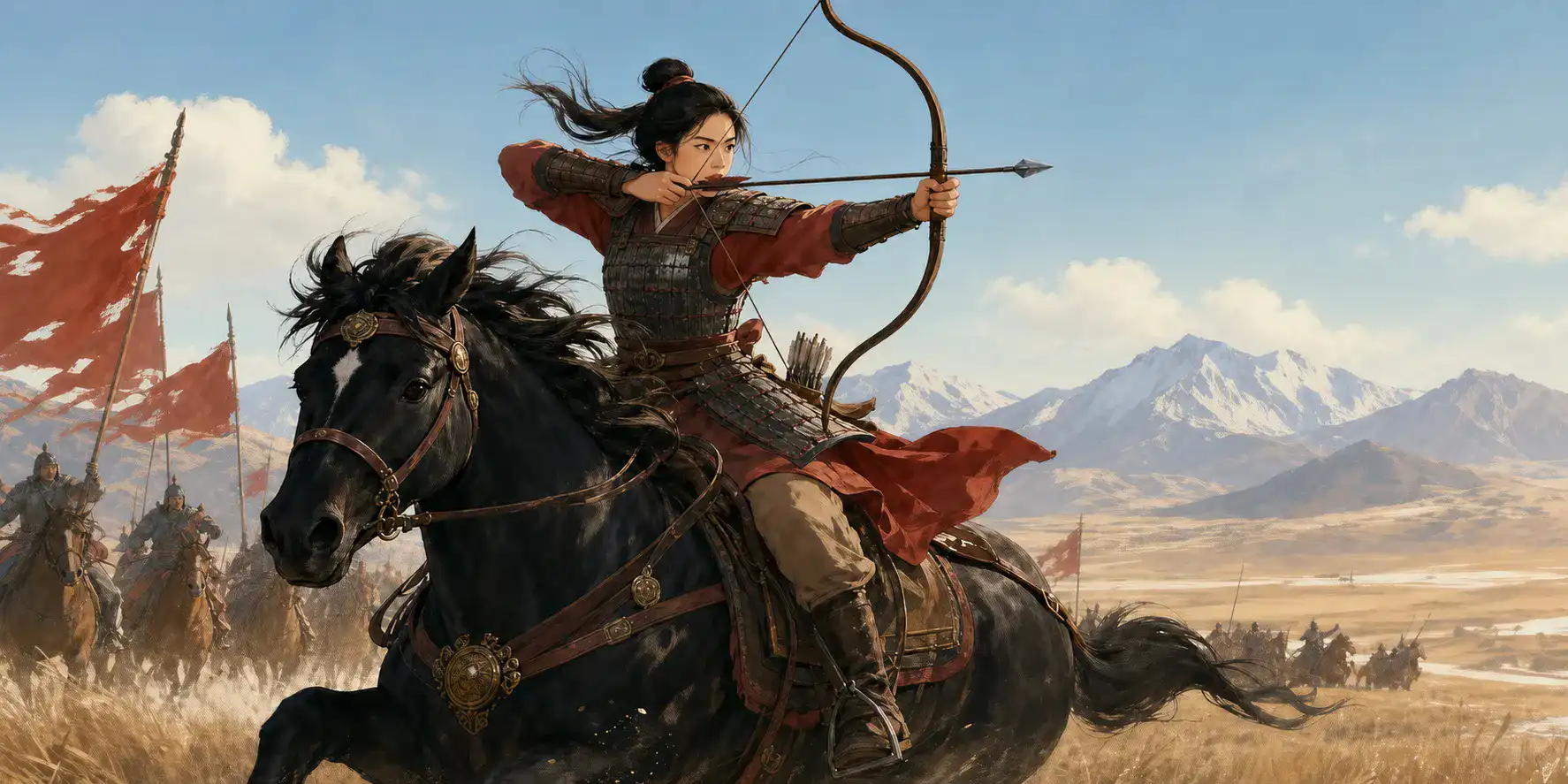
A modern imagined scene, not a reconstruction of a Northern Dynasties camp. The ballad does not say how Mulan trained, shot arrows, became a general, or won a battle by herself.
木兰买好马具,早晨辞别父母,夜晚已经听见黄河流水;再走一天,她听见北方骑兵的鸣声。接着,诗像忽然加快的马蹄,只用几句就越过整个战争:“万里赴戎机,关山度若飞。朔气传金柝,寒光照铁衣。将军百战死,壮士十年归。”读者看见寒夜、盔甲和死亡,却没有一场战役的名字,也没有木兰在军营里的对话。
后来故事常替这片空白加上训练、比武、朋友、将军和惊险计谋,那些情节可以很好看,却不是原诗提供的资料。诗后来又说伙伴和木兰“同行十二年”,前面却说壮士“十年归”;古诗里的“十”和“十二”可能强调时间很长,不一定是精确到日历的服役记录。最诚实的讲法不是替她填满十二年,而是承认:诗故意把战争压得很短,把决定、离家和回家写得更亮。
Mulan buys her horse gear, leaves her parents in the morning, and hears the Yellow River by night. After another day's travel, she hears northern cavalry. Then the poem suddenly gallops across the entire war in a few lines: she flies over mountain passes, night-watch clappers sound in the northern cold, moonlight shines on armor, generals die in many battles, and surviving soldiers return after ten years. We see cold, armor, and death - but no named battle and no conversation in camp.
Later storytellers filled this open space with training, contests, friends, promotions, and clever battle plans. Those episodes can make excellent stories, but the ballad does not supply them. Near its end, the poem says that Mulan's comrades traveled with her for twelve years, although an earlier line says warriors returned after ten. In old poetry, “ten” and “twelve” may signal a very long time rather than a calendar-perfect service record. The honest choice is not to invent every missing year. It is to notice what the poem does: it compresses the war and makes the decision, departure, and homecoming shine.
Page 4
她立了什么功?原诗没有告诉我们
What Great Deed Did She Perform? The Ballad Does Not Say
战争结束后,木兰去见统治者。诗说她被记了很高的军功,得到丰厚赏赐;可汗问她想要什么,她不要“尚书郎”这样的官职,只请求能送她回故乡的快马或骆驼。她的功劳究竟来自指挥、侦察、作战还是多年服役,诗完全没有解释。说她“成为中国第一位女将军”或凭一场神奇战斗拯救全国,都超过了文本能支持的范围。
这个空白反而留下一个有意思的问题:木兰已经证明自己能完成士兵的工作,为什么她最想要的却是回家?也许诗珍惜亲情,也许它不信任官场,也许听众只是喜欢一个首尾相接的归家故事。我们不能访问匿名作者的心思,但能观察选择带来的效果:木兰没有靠一个新头衔证明自己。她做完危险的事,然后自己决定下一步往哪里走。
When the war ends, Mulan meets the ruler. The ballad says that she receives high honors and rich rewards. When the khan asks what she wants, she refuses an official post and asks only for a fast camel or horse to carry her home. The poem never explains whether her honors came from command, scouting, fighting, or simply years of service. Claims that she became “China's first woman general” or saved the whole country in one magical battle go beyond the text.
That blank space leaves us with a more interesting question. Mulan has proved that she can do a soldier's work, so why is going home the reward she wants most? Perhaps the poem values family. Perhaps it distrusts official life. Perhaps its listeners simply enjoyed a journey that circles home. We cannot interview the anonymous poet, but we can see the effect of the choice: Mulan does not need a new title to prove herself. She completes a dangerous task, then chooses where her life goes next.
Page 5
回家以后,伙伴为什么才“看见”她?
Why Do Her Comrades Only “See” Her After She Comes Home?
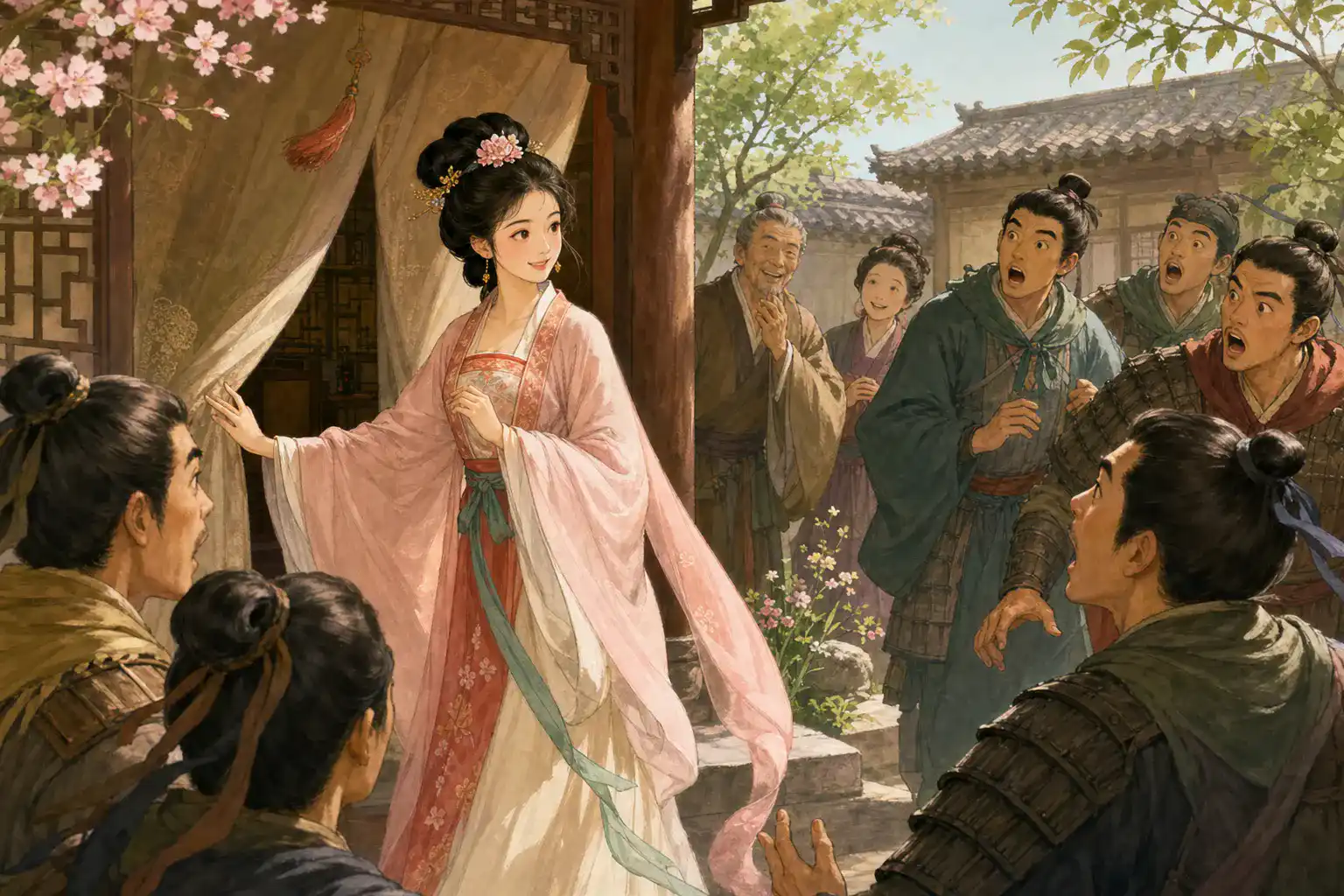
A modern story illustration. The poem says Mulan puts on her old clothes, arranges her hair, and applies yellow face decoration; it does not describe the exact clothing style.
父母出城迎接,姐姐整理衣裳,弟弟忙着准备饭菜。木兰推开旧房门,脱下战袍,穿上以前的衣服,对着镜子整理头发、贴上花黄。她走出门,同行多年的伙伴大吃一惊:他们竟然一直不知道木兰是女子。原诗没有描写她每天怎样隐藏身份,也没有写身份被发现后受罚;“秘密暴露就会被处死”是一些后世改编增加的危险。
诗最后没有讲道理,而是放出两只兔子:“雄兔脚扑朔,雌兔眼迷离;双兔傍地走,安能辨我是雄雌?”兔子一起奔跑时,你还能立刻分清吗?这不是一堂简单的生物课,而是一幅机灵的比喻:人们以为衣服、工作和外表能马上告诉自己谁是谁,可并肩行动多年,木兰和伙伴首先是一起赶路、受冷和活下来的士兵。
Mulan's parents come outside the town to meet her. Her older sister prepares her clothes, and her younger brother rushes to make a feast. Mulan opens the doors to her old room, removes her wartime robe, puts on her former clothes, arranges her hair, and applies yellow face decoration. When she steps outside, her longtime comrades are astonished: they never knew she was a woman. The ballad does not explain how she hid her identity each day, and it never says she would be executed if discovered. That threat comes from some later adaptations.
The poem ends not with a lecture, but with two running hares. One line describes a male hare's feet and a female hare's eyes; then it asks: when both race side by side, who can tell which is which? This is not a simple biology lesson. It is a quick, clever comparison. People think clothing, work, and appearance will instantly tell them who someone is. Yet after years moving side by side, Mulan and her comrades have first been soldiers who traveled, froze, and survived together.
Page 6
每个时代都给木兰换过一件衣服
Every Age Has Dressed Mulan in New Clothes
木兰回家了,故事却没有停。十六世纪,徐渭的戏曲第一次让“花”成为她广为人知的姓,还写她解开缠足去穿军靴。可是木兰早期故事所指向的北朝,比缠足成为普遍风俗早了许多世纪;这个细节告诉我们的主要是明代舞台怎样想象女性。后来的小说给她不同结局,二十世纪的戏剧和电影又把她写成民族英雄,现代动画则加入会说话的伙伴和新的爱情线。
改编不是偷偷把故事弄坏。每个版本都会选择自己最关心的问题,真正的问题是有没有把标签贴清楚。读者可以喜欢一条会说话的龙,也可以被一个壮烈结局打动,只要不把它们倒推成北朝史实。比较版本时,我们甚至能反过来认识创作者生活的时代:他们希望女孩怎样勇敢?希望家庭、国家和个人选择谁排在前面?
Mulan returned home, but her story did not stop. In a sixteenth-century play, Xu Wei helped make Hua her best-known surname and showed her unbinding her feet to fit into soldiers' boots. Yet the Northern Dynasties world suggested by the early ballad came centuries before footbinding became a widespread custom. That detail tells us more about how a Ming audience imagined women. Later novels gave Mulan new endings. Twentieth-century theater and film made her a national hero, while modern animation added talking companions and new romances.
Adaptation does not secretly ruin a story. Every version chooses the questions its own audience cares about. What matters is labeling the layers clearly. A reader can enjoy a talking dragon or be moved by a tragic ending without pushing either one backward into Northern Dynasties history. Comparing versions can even teach us about the people who created them. How did they want a girl to be brave? Which came first in their world: family, state, or personal choice?
木兰真实存在过吗?答案藏在问题里
Was Mulan Real? The Question Has More Than One Answer
如果“真实”是指能在正史中查到生卒年和战役的一个人,目前没有足够证据证明木兰存在。如果“真实”是指一首古老诗歌、一千多年不断变化的讲述,以及无数读者从中得到的勇气,那么木兰当然真实地影响了世界。
最好的读法不是在“全部是真事”和“全部没意义”之间二选一。我们可以先听织布机停下,再跟着诗跨过黄河,最后看两只兔子并肩奔跑;同时记住哪里是早期诗句,哪里是后人新添的衣服。木兰的力量,或许正来自这两件事同时成立:我们不知道她究竟是谁,可一代代人仍在用她追问,一个人的能力应该由什么决定。
If “real” means one person whose birth, death, and battles can be checked in an official history, there is not enough evidence to prove Mulan existed. If “real” means an old poem, more than a thousand years of changing stories, and courage carried to countless readers, then Mulan has certainly had a real effect on the world.
We do not have to choose between “every detail happened” and “none of it matters.” We can hear the loom stop, follow the poem across the Yellow River, and watch two hares race side by side - while still marking which parts belong to the early ballad and which clothes later storytellers added. Mulan's power may come from both truths at once: we do not know exactly who she was, yet generation after generation has used her to ask what should determine a person's abilities.