一本伟大的书,也会有错误吗?李时珍与《本草纲目》
Can a Great Book Still Be Wrong? Li Shizhen and Bencao Gangmu
阅读难度 · 困难Reading level · Hard
Page 1
书很重要,不等于每句话都正确
An Important Book Is Not Right About Everything
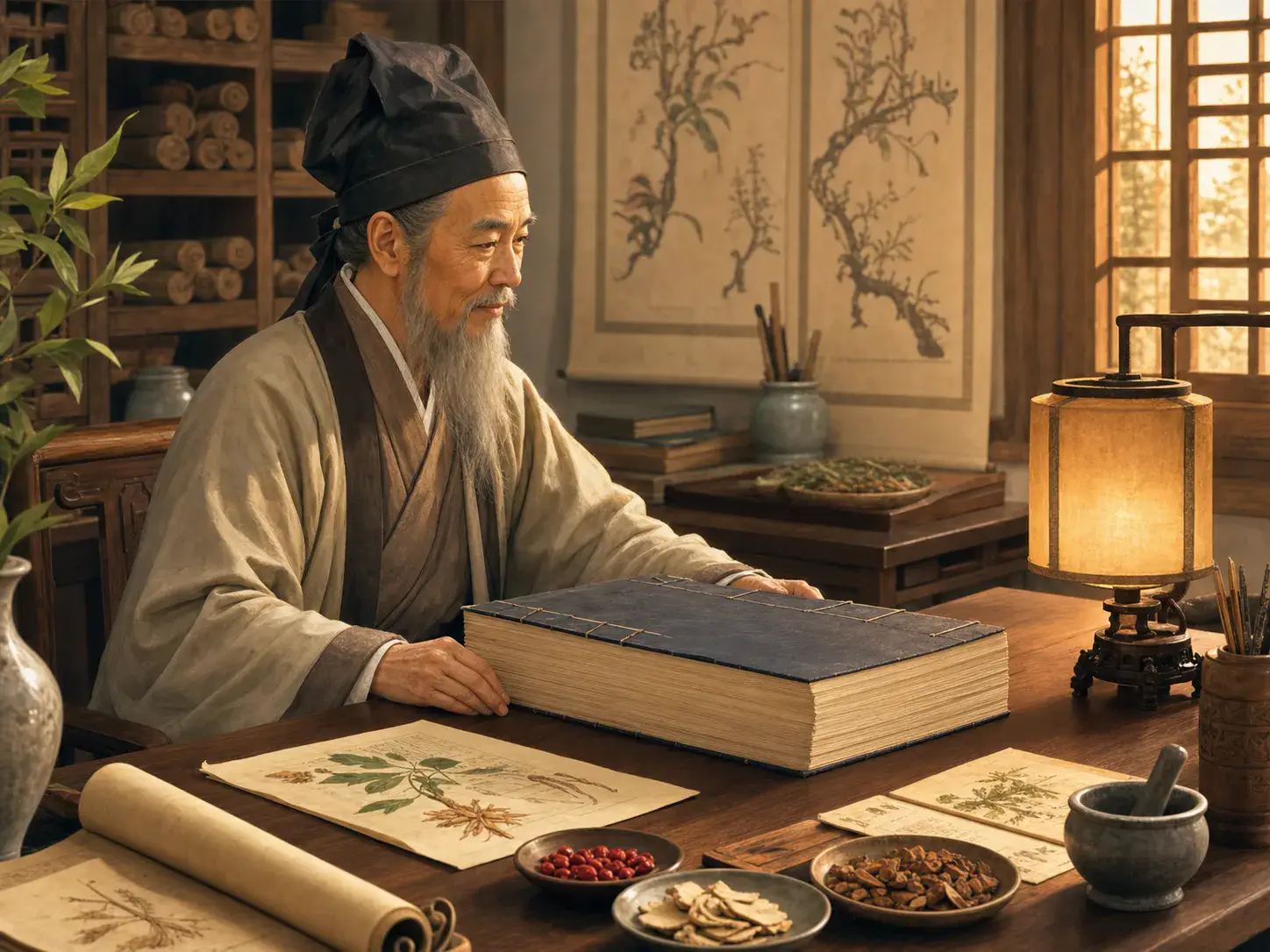
This is a modern imagined portrait of Li Shizhen with a large book, not a historical likeness or an actual page of Bencao Gangmu. Surviving early editions are woodblock-printed volumes whose pages and illustrations can be checked in library collections.
小禾在图书馆屏幕上翻看一部四百多年前的药物书。书页上有植物、动物和矿物,也有许多旧书的引文。老师告诉她:“这是李时珍编写的《本草纲目》,中国本草史上极有影响的一部书。”
“那里面写的都对吗?”小禾问。
这个问题正好打开李时珍的故事。一部书可以在整理名称、保存旧资料和建立分类方面非常了不起,同时也保留作者时代的错误。今天尊重李时珍,不需要把他写成从不出错的“现代科学家”;更好的办法,是看看他怎样检查前人的书,也用同样认真的态度检查他的书。
At a library computer, Xiaohe scrolls through a book about medicines printed more than four hundred years ago. Its pages show plants, animals, and minerals, together with quotations from many older works. “This is Bencao Gangmu, compiled by Li Shizhen,” her teacher says. “It became one of the most influential books in the history of Chinese materia medica.”
“So is everything in it correct?” Xiaohe asks.
That question opens Li Shizhen's story. A book can be remarkable for organizing names, preserving older sources, and building a system of classification while still carrying mistakes from its own time. Respecting Li today does not require turning him into a flawless “modern scientist.” A better tribute is to see how carefully he checked earlier books - and then bring the same care to checking his.
Page 2
他先走科举路,后来走进医书和诊室
From the Exam Road to Medical Books and Patients
李时珍1518年出生在明代蕲州,也就是今天湖北蕲春一带,家里几代与行医、药物有关。当时,读书人若通过层层科举,可能取得身份并进入官场。传记资料说,他十四岁左右取得生员资格,常被通俗地称作“秀才”,后来三次参加更高一级的乡试都没有成功。于是,他没有继续把人生押在考试上,而是跟父亲学习医术,在家乡看病、读书和写作。
后来的记载还说,他曾在楚王府任职,并短期接触北京的太医院。这些经历的具体职位和时间,在不同传记里并不完全一致,因此不能编成一段“治好王子、立刻被召进皇宫”的传奇。但它们提醒我们:李时珍既接触临床经验,也有机会接触书籍与药材。他写过脉学等医书,绝不是到了晚年才忽然决定研究药物。
科举失败也不必写成“考试没有用”。阅读古文、查找引文和辨析同名异物,正需要长期的文字训练。李时珍换了道路,却把读书本领带进了医学。
Li Shizhen was born in 1518 in Qizhou, in the area of today's Qichun, Hubei. Several generations of his family were connected with healing and medicinal materials. At the time, a student who passed a series of civil service examinations could gain status and perhaps enter government. Biographical accounts say that Li qualified as a local student at about fourteen - often simplified as becoming a xiucai - but later failed the higher provincial examination three times. Instead of staking his whole life on more exams, he studied medicine with his father, treated people near home, read, and wrote.
Later accounts also place him in the household of the Prince of Chu and briefly connect him with the Imperial Medical Institute in Beijing. Biographies disagree about the exact offices and timing, so we should not turn them into a dramatic tale in which Li cures a prince and is instantly summoned to the palace. They do suggest that he encountered both clinical practice and wider collections of books and materials. He wrote other medical works, including studies of the pulse. His interest in medicine did not suddenly appear in old age.
Nor does leaving the exam path mean his earlier study was useless. Comparing quotations, reading difficult classical prose, and sorting out several things with the same name all required deep training with texts. Li changed roads, but he carried his reading skills into medicine.
Page 3
他不是一位独自在深山“尝遍百草”的英雄
He Was Not a Lone Hero Tasting Every Plant in the Mountains
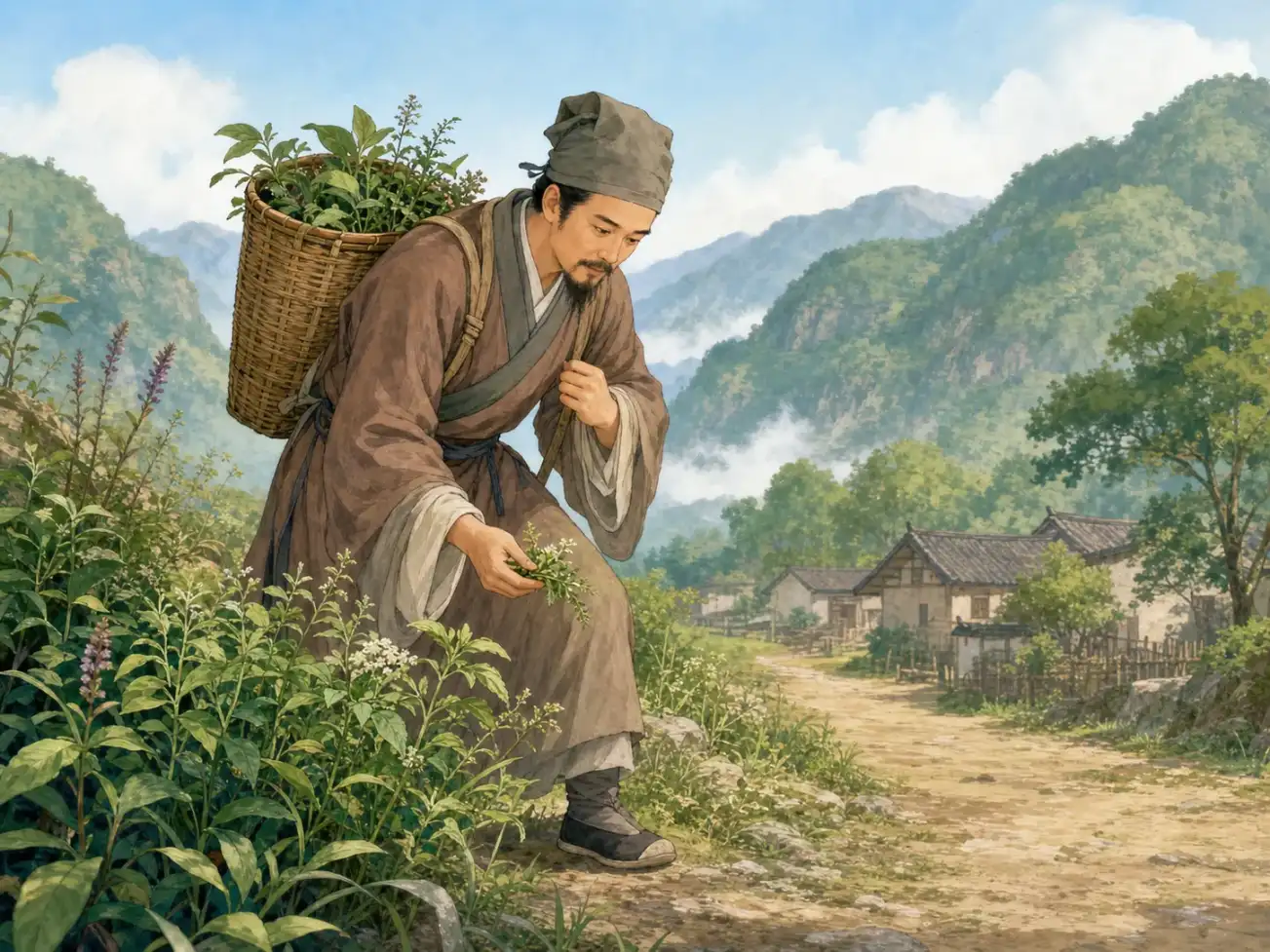
This is a modern imagined scene based on later herb-gathering stories, not a record of one expedition. Li valued specimens and local knowledge, but tales that he crossed all China, tasted every drug, or returned to gathering after a snakebite lack reliable evidence.
旧本草中的一个名称,可能在不同地方指不同植物;同一种材料,也可能有好几个名字。只抄下一句,错误就会继续旅行。李时珍因此比较历代本草、医方、经史和其他著作,追查旧引文从哪里来;他也观察实物,向药工、采集者、农人、渔人等熟悉材料的人询问名称、产地和用法。知识不是只从一位“天才”脑中冒出来的,许多没有写进书名的人也参与了它。
后世故事常把他画成背着竹筐走遍大半个中国、亲口尝遍每一种药,甚至中毒或被蛇咬后仍继续采集。史料能支持他重视调查、访问各地知识和核对材料,却不能证实这些惊险细节,也不能画出一张可靠的全国路线图。“神农尝百草”本来就是古代传说,更不能倒过来当作李时珍一定亲自试毒的证据。
而且,亲尝未知植物不是今天可以模仿的研究方法。相似的叶子可能属于完全不同的物种,植物、矿物和动物材料都可能有毒。孩子不能根据古书、图片或网络自行采摘、尝吃或配药。
One name in an old materia medica might point to different plants in different places. One substance could also have several names. Copy a sentence without checking, and its mistake keeps traveling. Li compared earlier materia medica, recipe books, classics, histories, and other writings, tracing where quotations came from. He also examined materials and sought knowledge from people familiar with them, including drug workers, collectors, farmers, and fishers. Names, habitats, and uses did not spring from the mind of one “genius.” Many people whose names never reached the book's cover helped create its knowledge.
Later stories often picture Li crossing most of China with a basket, personally tasting every drug, or returning to his search after poisoning or a snakebite. Historical evidence supports his interest in investigation, regional knowledge, and actual materials. It does not confirm these thrilling details or provide a dependable map of journeys across the whole country. The tale of the ancient Divine Farmer tasting a hundred herbs is itself a legend; it cannot prove that Li tested poisons on his own body.
Tasting an unknown plant is not a research method to copy today. Similar leaves can belong to completely different species, and plant, mineral, or animal substances can all be poisonous. Children must never gather, taste, or mix a medicine from an old book, a picture, or a website.
Page 4
一条药物记录,像一份“证据档案”
Each Entry Worked Like an Evidence File
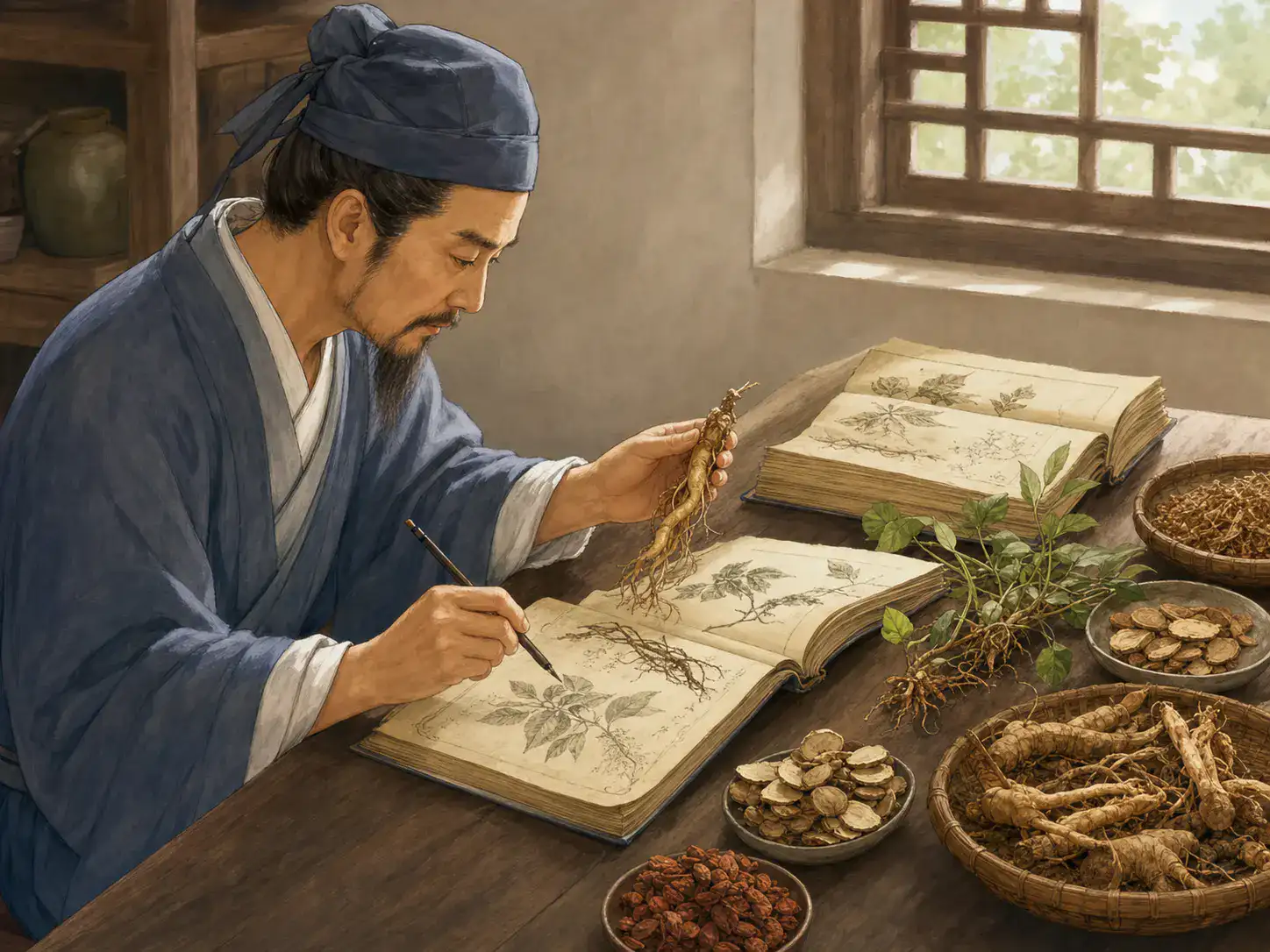
This is a modern imagined study, not a historical portrait of Li Shizhen. The plants, slices, drawings, and pages on the table cannot identify any particular medicinal substance accurately.
《本草纲目》的力量不只在“大”,还在整理方法。李时珍把材料分成水、火、土、金石、草、谷、菜、果、木、虫、鳞、介、禽、兽、人等部,再往下分组。这里的“本草”不是只指草药:书中也收动物、矿物、食物和人造物。这样的次序不是今天按物种亲缘关系建立的生物分类,却让读者比在旧书堆里乱找更容易比较相关条目。
许多条目像一份档案:先确定正名并列出别名,再汇集产地、形态和前人说法;还可能讨论加工方法、旧医理中的“气味”、传统主治、李时珍的评论和附方。他会保留引文,让后来的读者知道某句话来自谁;也会考证名称,指出同名异物或前人图文不合。这种把旧说、观察和判断分层放在一起的做法,是全书的重要贡献。
常见统计说,全书有52卷、1892个药物条目,其中374项是李时珍在前代本草基础上的增收,并收集约1.1万条方剂。插图常被概括为“约1100幅”,但不同刻本的图版、复制和计数并不完全一样;美国国会图书馆所藏1603年本的目录说明为正文52卷、附图2卷。数字必须和具体版本、统计口径放在一起看。
The strength of Bencao Gangmu lies not only in its size but in its method of organization. Li arranged materials into broad sections such as water, fire, earth, metals and stones, herbs, grains, vegetables, fruits, trees, insects, scaled creatures, shelled creatures, birds, beasts, and humans, then divided them further. The Chinese term bencao does not mean herbs alone. The book also includes animals, minerals, foods, and manufactured objects. This is not a modern biological system based on evolutionary relationships, but it made related entries easier to compare than they had been in a jumble of earlier books.
Many entries work like evidence files. They establish a main name and list alternatives, then collect information about origin, appearance, and earlier claims. They may also discuss processing, traditional qualities called “flavor and nature,” reported uses, Li's comments, and attached recipes. Li often preserved quotations so later readers could tell who had made a claim. He investigated names and pointed out cases in which different substances shared a name or an old picture did not match its text. Layering old claims, observations, and judgment in this way was one of the book's great achievements.
A common count gives the work 52 juan, or textual sections, and 1,892 medicinal entries, 374 of them additions to the earlier materia medica record. It also gathers about 11,000 prescriptions. Summaries often mention about 1,100 illustrations, but plates, copies, and counts vary among editions. The Library of Congress describes its 1603 edition as 52 juan of text plus two of illustrations. Numbers make sense only when we name the edition and the counting method.
Page 5
他改正旧错,也把一些旧错带进了新书
He Corrected Old Errors - and Carried Some Forward
李时珍能发现前人把名称、图像或材料混在一起,也敢在引文后写下自己的不同判断。这种订正精神很重要。但他没有显微镜、现代化学、随机对照试验或今天的物种分类,也无法亲自核验收进书里的每一条古代记录。为了尽量包罗广泛,他引用了医学书、历史、文学和志怪材料;信息越多,可靠程度也越不整齐。
书中不仅有植物,还记录动物来源、人身体来源、矿物和人造材料;有些疗法依靠象征、相似联想或鬼怪病因,有些矿物含汞、砷等会造成严重伤害的成分。某一种材料过去“被认为能治病”,不等于现代研究已证明它有效,更不等于剂量和制法安全。把《本草纲目》直接叫作“现代医学百科全书”,反而会看不见它真正属于十六世纪的价值。
因此,“伟大”和“有错”可以同时成立。它伟大,因为它保存并重组了庞大的知识传统,重视名称考证和订正,也给后人留下可以继续检查的来源;它有错,因为任何时代的作者都有工具、观念和资料边界。真正继承李时珍的精神,不是替每一句旧话辩护,而是继续问:“证据在哪里?后来有没有更好的证据?”
Li could spot cases in which earlier writers had confused names, pictures, or materials, and he was willing to place his own disagreement after a quotation. That habit of correction matters. But he had no microscope, modern chemistry, randomized controlled trials, or today's systems of biological classification. Nor could he personally verify every ancient report he included. To cast a wide net, he drew from medicine, history, literature, and tales of the strange. The more material he gathered, the more uneven its reliability became.
The book records not only plants but substances from animals and human bodies, minerals, and manufactured objects. Some remedies depend on symbolism, resemblance, or supernatural ideas about illness. Some mineral materials contain mercury, arsenic, or other substances that can cause serious harm. A material “believed to treat” something in the past has not automatically been shown effective by modern research, and its preparation and dose are not automatically safe. Calling Bencao Gangmu a “modern medical encyclopedia” would actually hide what makes it valuable as a sixteenth-century work.
“Great” and “wrong in places” can both be true. The book is great because it preserved and reorganized an enormous body of knowledge, took names and corrections seriously, and left sources for later readers to check. It contains errors because every author works within the tools, ideas, and evidence of a time. The best way to carry Li's spirit forward is not to defend every old sentence. It is to keep asking, “Where is the evidence? Has better evidence appeared since?”
Page 6
从1578年的初稿,到不断被翻印、批注和重查
From a 1578 Draft to Centuries of Reprinting and Rechecking
李时珍用了大约二十七年编纂这部书,1578年完成初稿,后来反复修订。学者王世贞在1590年为它作序。最早的金陵胡承龙刻本,权威目录中既有1593年的著录,也常见1596年的刊行说法;这些日期可能涉及刻版、印成和版本记录的不同口径。李时珍1593年去世,所以“他临终前把手稿交给儿子,三年后书商才来”的完整戏剧场面并不能仅凭书目日期证实。我们可以确定的是:早期刻本出现于他生命末期前后,而广泛传播主要发生在他身后。
这本书并没有从此停住。它约在1607年被正式介绍到日本,日本本地1637年开始重印,学者继续加训读标记、插图、注释和本地观察。到了十九世纪,英国药物学研究者仍会选择、翻译并核查其中的中国药材知识。第一部全书英文译本直到2003年才出版。2011年,早期《本草纲目》版本入选联合国教科文组织《世界记忆名录》。传播不是所有地方都照单全收,而是不断重印、翻译、比较、删改和再研究。
今天读它,最安全的角色是历史侦探,不是给自己开药的医生。“天然”不等于安全,草药可能有副作用、剂量风险、误认问题,也可能和药物相互作用。生病或误食不明物时,应立刻告诉可信任的成年人,并请医生、药师或当地毒物控制机构帮助,不能翻古书自己试方。
Li worked on the compendium for about twenty-seven years. He completed a first draft in 1578 and continued revising it. The scholar Wang Shizhen wrote a preface in 1590. Major catalogs give both 1593 and 1596 for the earliest Jinling edition printed by Hu Chenglong, perhaps reflecting different records of block cutting, printing, and edition dates. Li died in 1593. Bibliographic dates alone therefore cannot prove the full dramatic scene in which he arranges his manuscript on his deathbed and a printer appears exactly three years later. What we can say is that an early edition emerged around the end of his life, while broad circulation came mostly after his death.
The book did not then stand still. It was formally introduced in Japan around 1607, and local Japanese reprints began in 1637. Scholars added reading marks, illustrations, commentary, and observations about local specimens. In the nineteenth century, British pharmaceutical researchers were still selecting, translating, and checking Chinese drug knowledge from it. The first complete English translation of the entire work did not appear until 2003. In 2011, early Bencao Gangmu editions entered UNESCO's Memory of the World Register. Transmission did not mean accepting every claim. It meant reprinting, translating, comparing, cutting, expanding, and investigating again.
Today, the safest role for a reader is historical detective, not self-prescribing doctor. “Natural” does not mean safe. An herb may cause side effects, be dangerous at a particular dose, be mistaken for another species, or interact with medicine. If someone is ill or swallows an unknown substance, tell a trusted adult immediately and get help from a doctor, pharmacist, or local poison control service. Never test an old formula on yourself.
小结:最好的纪念,是继续核对
In Summary: The Best Tribute Is to Keep Checking
李时珍从科举学习转向行医与写作,把读书、辨名、观察和询问他人的经验放进同一项长期工程。《本草纲目》的1892个条目不是“一个人尝遍天下”的成果,而是李时珍整理许多古书、实物和社会知识后建立的庞大档案。
这部书纠正了旧错,也留下新疑问和时代局限。它最有生命力的地方,正是后来的读者没有停止批注和重查。面对任何医学说法 - 古代的、现代的,甚至这篇故事里的 - 我们都应该先问证据,并把真正的健康决定交给受过训练的专业人员。
Li Shizhen moved from examination study into medical practice and writing. He brought textual scholarship, name checking, observation, and other people's experience into one long project. The 1,892 entries in Bencao Gangmu were not the result of “one man tasting everything under heaven.” They formed an enormous archive built as Li reorganized older books, materials, and shared knowledge.
The work corrected inherited errors and also left new questions and limitations of its time. Its most living quality may be that later readers never stopped annotating and checking it again. Whenever we meet a medical claim - ancient, modern, or even in this story - we should ask for evidence and leave real health decisions to trained professionals.