李白:诗人走进了传说
Li Bai: When a Poet Becomes a Legend
阅读难度 · 困难Reading level · Hard
Page 1
我们背的李白,是诗人还是传说人物?
Is the Li Bai We Know a Poet - or a Legend?
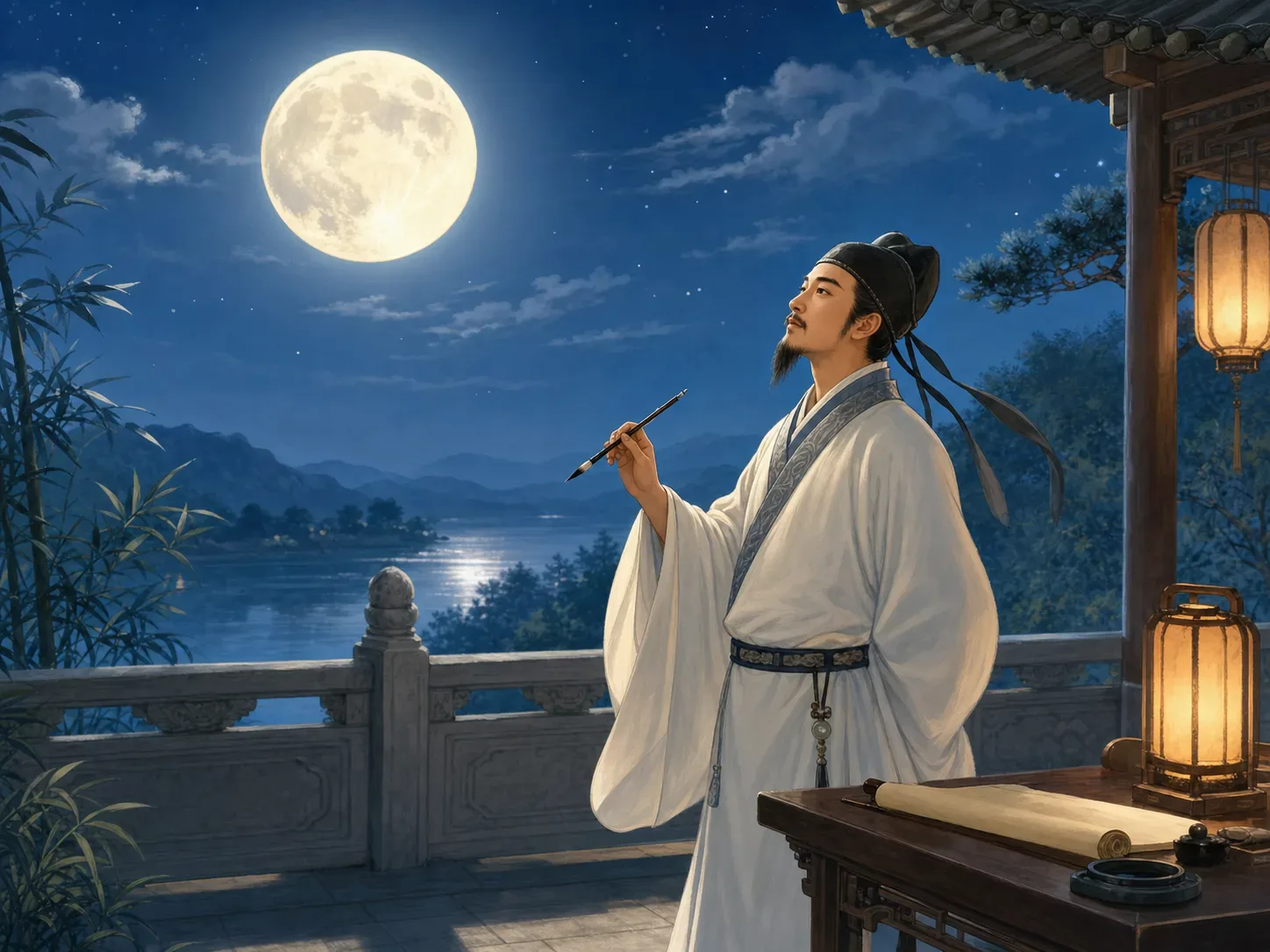
Modern poetic imagination, not a historical portrait of Li Bai or a record of where he wrote “Quiet Night Thought.” The moon later became an important part of how people picture him.
“床前明月光,疑是地上霜。举头望明月,低头思故乡。”许多孩子最早认识李白,就是从《静夜思》开始。四句诗把月光、错觉和想家连在一起,短得可以一口气念完,却能陪一个人记很久。
可是,今天人人熟悉的文字,不一定和最早流传的版本完全一样。现存一些宋代刻本写的是“床前看月光”和“举头望山月”;到了明代,一些选本中已经出现今天熟悉的“明月光”和“望明月”的组合,后来的选本和课本又让它越来越固定。这并不表示诗是假的,而是提醒我们:一首诗能流传一千多年,也会经过抄写、刻印、选择和校订。我们背诵的不只是李白的四句诗,也是一段书本怎样旅行的历史。
“Moonlight before my bed - I think it might be frost upon the ground. I raise my head and look at the bright moon; I lower it, thinking of home.” Many children first meet Li Bai through these four lines from “Quiet Night Thought.” The poem links moonlight, a moment of confusion, and homesickness. It is short enough to say in one breath, yet it can stay with a reader for years.
But the words everyone knows today are not exactly the same in every old copy. Some surviving editions from the Song dynasty say, “Before the bed, I look at moonlight,” and later, “I raise my head to see the mountain moon.” By the Ming dynasty, some collections already used the familiar combination “bright moonlight” and “look at the bright moon.” Later collections and schoolbooks helped that version become standard. This does not make the poem fake. It shows that a poem traveling for more than a thousand years passes through copying, printing, choosing, and editing. When we recite Li Bai, we are also reciting the history of a book on the move.
Page 2
连他的出生地,也藏在互相矛盾的记录里
Even His Birthplace Is Hidden in Conflicting Records
李白大约生于七〇一年,可是他的出生地和家族来历没有一个所有材料都同意的答案。根据较早的序文和墓碑材料,许多学者推测他出生在西域碎叶一带,大约五岁时随家人迁到蜀地,也就是今天的四川;另一些唐代材料却把他的出生地放在蜀地。至于他的祖先是谁、父亲做什么,各种说法也互相冲突。
比较确定的是,李白少年时代在蜀地成长,在那里读书、学剑,也接触了道教思想。把“可能生于碎叶”直接写成毫无疑问的事实,会把复杂证据压扁;把他的家庭想成神秘商人、贵族后代或异族之家,也都超出了能证明的范围。传记有时不是一条填满日期的直线,而是一张有清楚部分、也有空白部分的旧地图。
Li Bai was probably born in 701, but the surviving records do not all agree about his birthplace or family. From early prefaces and a later tomb inscription, many scholars think he was born near Suyab in Central Asia and moved with his family to Shu - today's Sichuan - when he was about five. Other Tang sources place his birth in Shu. Accounts also disagree about his ancestors and his father's work.
We can say with more confidence that Li Bai grew up in Sichuan, where he read widely, practiced swordsmanship, and learned about Daoist thought. Saying “he was certainly born in Suyab” flattens complicated evidence. Turning his family into mysterious merchants, nobles, or outsiders goes beyond what can be proved. A biography is sometimes less like a straight line of dates and more like an old map, with clear roads in some places and blank spaces in others.
Page 3
他远游,也一直想在现实世界里做事
He Traveled - but He Also Wanted a Public Life
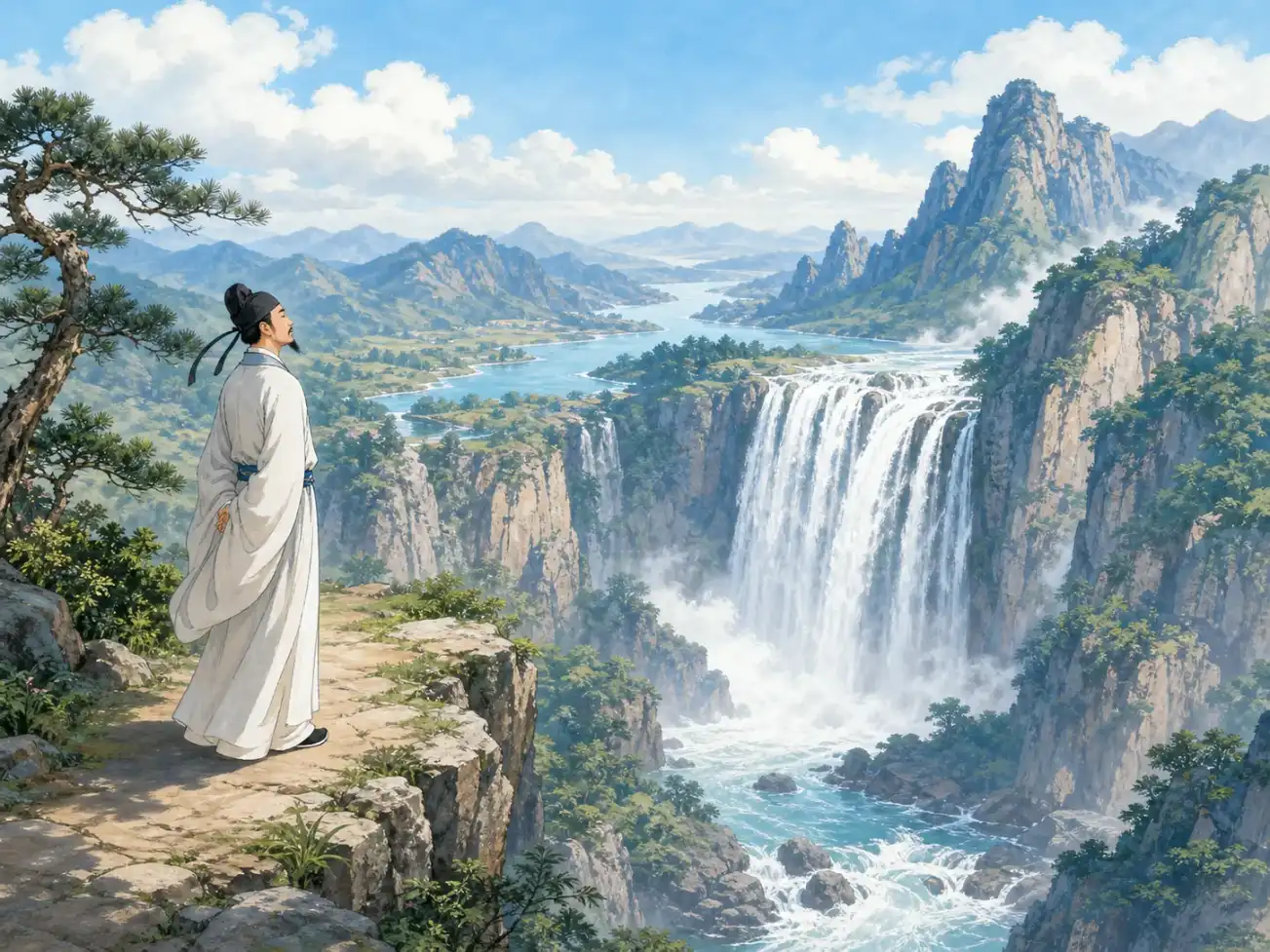
Modern poetic imagination, not a record of one verified journey. Li Bai wrote about Mount Lu's waterfall, but “three thousand feet” and the Milky Way are poetic exaggeration and comparison.
二十多岁时,李白离开蜀地,此后到过长江沿岸、长安和许多州县。他访友、求见有影响力的人、写信推荐自己,也希望得到施展才能的机会。他没有一辈子只在山里喝酒写诗;远游既给他景色和朋友,也帮助他建立关系、寻找进入政治生活的门。
李白写风景时,常把眼前世界一下推大。《望庐山瀑布》中说:“飞流直下三千尺,疑是银河落九天。”瀑布当然没有精确量过三千尺,也不是银河真的掉下来。夸张让读者先感到水势猛、山崖高,再去想诗人仰头时的震动。诗能证明他怎样使用语言,却不能自动证明他当时站在哪一块石头上、天气如何,或心里只有哪一种想法。
In his twenties, Li Bai left Sichuan. Over the years he traveled along the Yangtze River, visited Chang'an, and passed through many towns and regions. He met friends, sought introductions to powerful people, and wrote letters explaining what he could do. He hoped for a chance to use his talents in public life. He did not spend his whole life drinking and writing alone in the mountains. Travel gave him landscapes and friendships, but it also helped him build connections and look for a way into politics.
When Li Bai wrote about nature, he could suddenly make the world feel enormous. In “Viewing the Waterfall at Mount Lu,” he wrote, “The flying stream plunges three thousand feet - as if the Milky Way were falling from the sky.” The waterfall was not measured at exactly three thousand feet, and the Milky Way did not really fall. Exaggeration lets us feel the force of the water and the height of the cliff before we picture the poet looking up in wonder. A poem can show how Li Bai used language. It cannot automatically prove which rock he stood on, what the weather was like, or the one exact thought in his mind.
Page 4
翰林供奉不是现代官职,宫廷故事也不是现场录像
His Palace Role Was Not a Modern Job - and Court Tales Are Not Video
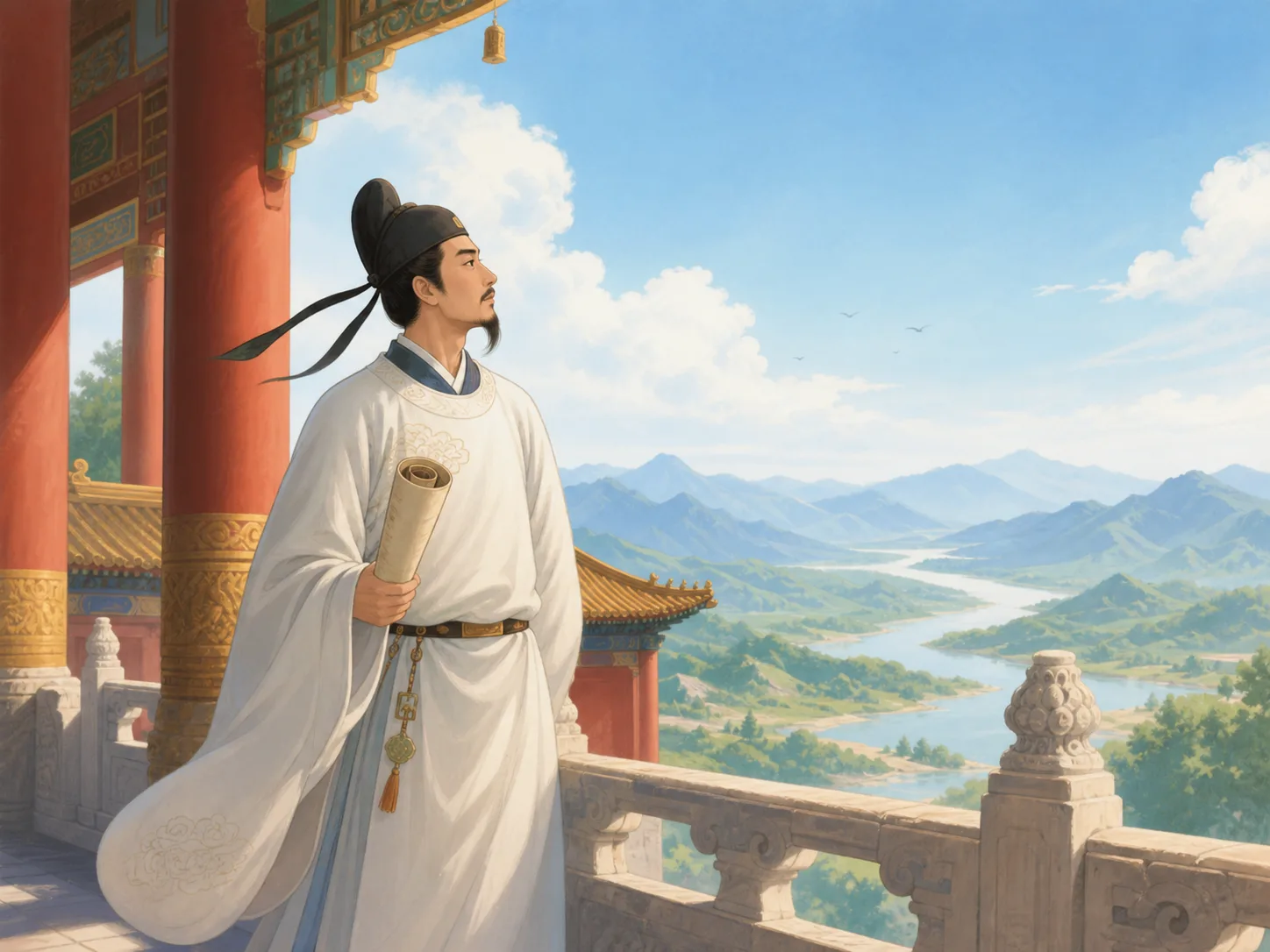
Modern imagined scene, not a portrait of Li Bai at the Chang'an court. Records support his Hanlin service, but not this exact place, clothing, or expression.
七四二年,唐玄宗召李白到长安,让他供奉翰林。这个称号听起来像现代政府职位,其实更接近皇帝身边凭文学才华待命、起草文字和参加宫廷活动的人,并不表示李白掌握了国家大权。大约两年后,他离开宫廷。后来常有人用“皇宫留不住自由诗人”解释这一段,可李白确实渴望政治机会;离开也包含失意,不只是潇洒转身。
传说把这两年讲得越来越热闹:李白醉着写诗,杨贵妃为他磨墨,高力士替他脱靴。较晚的笔记和故事保存了这些情节,却没有足够证据让我们把它们当作现场事实。另一个“铁杵磨成针”的故事,说少年李白看见老妇人把铁棒磨成针,于是回去苦读;它出现在李白去世几百年后的宋代材料中。两类故事一个赞他的傲气,一个教人坚持,都告诉我们后人需要什么样的李白,却不能代替他的传记。
In 742, Emperor Xuanzong called Li Bai to Chang'an to serve as a Hanlin literary attendant. The title can sound like a modern government office, but his role was closer to being a talented writer on call for the emperor. He drafted writing and joined court activities; he did not help run the whole government. About two years later, he left the court. People often summarize this part of his life by saying, “The palace could not hold a free poet.” Yet Li Bai truly wanted a political chance, and leaving included disappointment, not just a carefree escape.
Later tales made those two years much more dramatic. In them, a drunken Li Bai writes poems while the emperor's favorite consort, Yang Guifei, grinds his ink and the powerful palace attendant Gao Lishi removes his boots. These scenes survive in later notes and stories, not in evidence strong enough to treat them like video from the room. Another tale says that, as a boy, Li Bai saw an old woman grinding an iron bar into a needle and returned to his studies after learning not to give up. That story appears in sources written centuries after his death. One kind of tale celebrates his pride; the other teaches persistence. Both reveal the Li Bai later readers wanted, but neither can replace a biography.
Page 5
杜甫真的认识他,但两位诗人没有天天同行
Du Fu Really Knew Him, but They Did Not Travel Together for Years
李白离开长安后,在七四四年前后见到了比他年轻十一岁的杜甫。两人的诗为这段交往留下了证据:杜甫后来多次写诗想念、担心李白,李白也有写给杜甫的作品。可是他们实际相聚的次数有限,不是一对多年每天同行的“诗人搭档”。诗把短暂的相遇保存得比相处时间更长。
更大的变化很快来了。七五五年,安史之乱爆发,战争打乱了唐朝的城市、道路和朝廷。李白后来加入永王李璘的队伍;皇室内部冲突中,永王失败,李白被捕入狱,随后被判流放夜郎。关于他为什么加入、知道多少,各种解释并不完全相同。可以确定的是,这个选择把他卷进了真实而危险的政治,不再只是月亮、酒和山水的浪漫故事。
After leaving Chang'an, Li Bai met Du Fu, a poet eleven years younger, around 744. Their poems are evidence that the friendship was real. Du Fu later wrote several poems remembering and worrying about Li Bai, and Li Bai also addressed poems to Du Fu. But they met only a limited number of times. They were not a poetry team traveling together every day for years. Their poems made a short time together last much longer than the meetings themselves.
A far greater change soon arrived. In 755, the An Lushan Rebellion tore apart Tang cities, roads, and the imperial court. Li Bai later joined the forces of Prince Li Lin, also called the Prince of Yong. During a struggle inside the royal family, the prince was defeated. Li Bai was arrested, imprisoned, and eventually sentenced to exile in Yelang, far to the southwest. Sources do not agree completely about why he joined or how much he understood. What is clear is that this choice pulled him into dangerous real politics, far beyond the romantic picture of moonlight, wine, and mountains.
Page 6
流放路上遇赦,最后却没有捞月亮
Pardoned on the Road - and No, He Did Not Die Catching the Moon
七五九年,李白在前往夜郎的途中遇到大赦,不必继续流放。他写诗回望这场灾难,也继续寻找报国机会;晚年甚至曾想随军,却因病返回。七六二年,他在安徽当涂去世。接近他那个时代的材料把他写成患病后去世,具体病因仍不清楚。
几百年间,另一个结局却越来越有名:李白喝醉后乘船,看见水里的月亮,伸手去捞,落水而死。这个“捉月”故事没有可靠史料支持,却把酒、江水、月亮和死亡连成了一个像诗一样的画面。它流传,不是因为证据更强,而是因为太符合“诗仙”形象。真正会读传记的人,可以同时懂得两件事:传说很有力量,传说仍然是传说。
In 759, Li Bai received a pardon while traveling toward Yelang, so he did not have to complete his exile. He wrote poems looking back on the disaster and kept searching for a way to serve. Late in life, he even tried to join a military campaign, but illness forced him to turn back. He died in Dangtu, in today's Anhui Province, in 762. Sources close to his lifetime describe him dying after becoming ill, though the exact illness remains uncertain.
Over the centuries, a different ending became famous. In the story, Li Bai is drunk on a boat. He sees the moon in the water, reaches down to catch it, falls in, and drowns. No strong historical evidence supports this “catching the moon” tale, but it joins wine, river, moonlight, and death in a scene that feels like a poem. It lasted not because its evidence was better, but because it perfectly fit the image of the “Immortal Poet.” A careful reader can understand two things at once: a legend can be powerful, and it can still be a legend.
让诗和传说各自站稳
Let the Poems and Legends Stand on Their Own
我们背的李白,既来自一个真实的人,也来自一千多年不断增加的想象。真实的李白远游、求仕、入宫、交友,也在战争中做过带来严重后果的选择;传说中的李白让权贵脱靴、从铁杵学会坚持,最后追着月亮离开人间。
不必毁掉传说,才能看清诗人。只要把标签放对:诗是留存下来的作品,生平要比较早期记录,传说则告诉我们后人怎样记住他。这样再抬头看月亮时,我们看见的不只是一个永远潇洒的人,而是一位经历过野心、失望、友情、战争和疾病,仍把语言写得发亮的诗人。
The Li Bai we recite comes from both a real person and more than a thousand years of growing imagination. The real Li Bai traveled, sought a public role, served at court, made friends, and chose a side during a war - with serious results. The legendary Li Bai made powerful people remove his boots, learned persistence from an iron bar, and finally chased the moon out of this world.
We do not have to destroy the legends to see the poet clearly. We only need the right labels. Poems are surviving works. A life story must be tested against early records. Legends show how later people chose to remember him. Then, when we look up at the moon, we see more than an endlessly carefree man. We see a poet who knew ambition, disappointment, friendship, war, and illness - and still made language shine.