唐代长安:远方来了,城门却有规则
Tang Chang'an: Distant Worlds, City Rules
阅读难度 · 困难Reading level · Hard
Page 1
先别急着走进那条大街
Before We Walk Down That Avenue
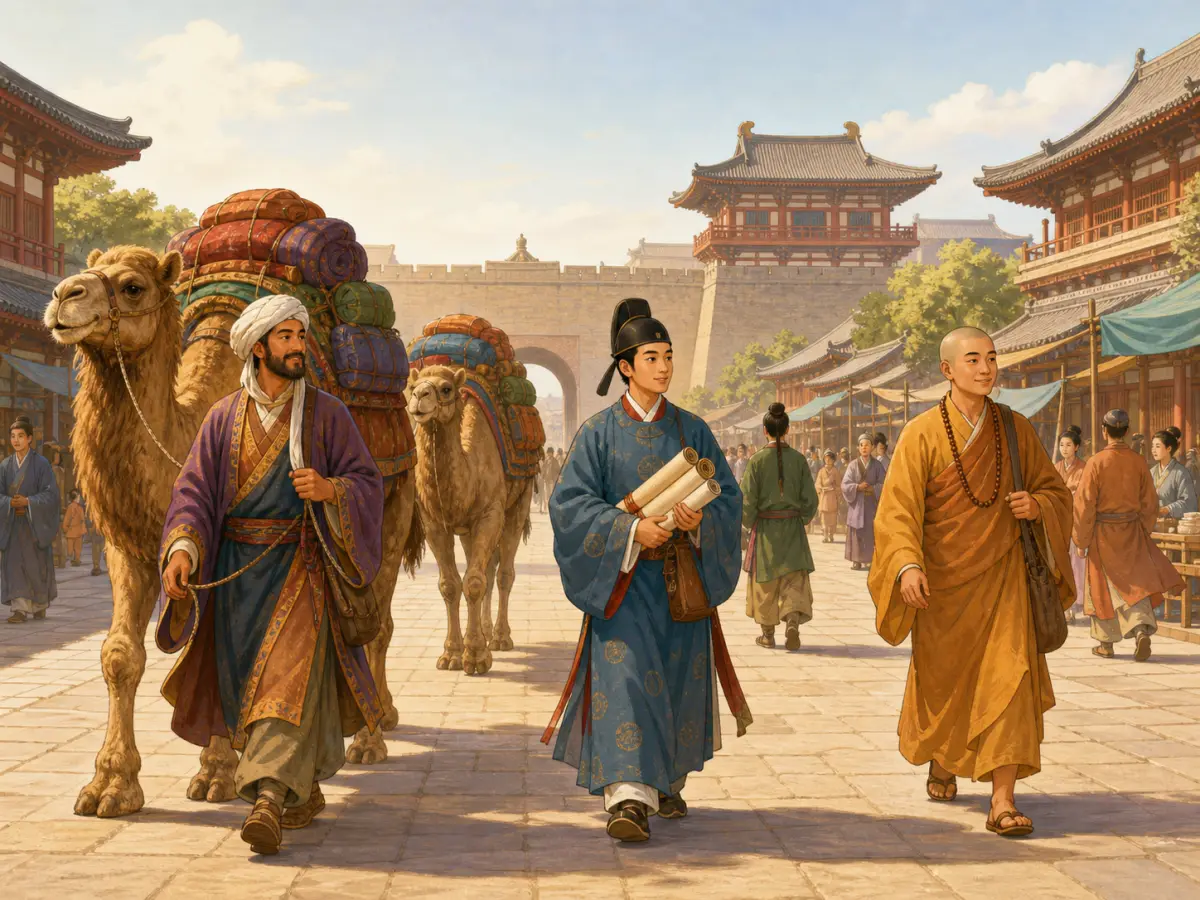
Modern imagined scene: The people, camels, buildings, and shared walk do not show a recorded event - or prove that visitors always mixed freely.
你面前有一幅唐代长安的复原图:城墙围出一片巨大的长方形,南北和东西道路交叉,把城市分成一格一格的里坊。正中的朱雀大街从南门伸向皇城,像一条画在地面上的粗线。只看这张图,你能知道街上每天是谁在走、他们说什么语言、彼此是否友好吗?不能。城市平面图能告诉我们空间怎样安排,却不能自动变出一个热闹的早晨。
考古测量和历史复原通常认为,隋唐长安城内面积约八十四平方公里,朱雀大街宽约一百五十米上下。研究者也常用“几十万到约一百万人”来讨论盛期城市人口,但算法会因年代、城内外范围和史料解释而变化。常见复原图画出一百零八个居民坊和东西两市;有的统计方式把市场等格子算进去,数字便不同。这些都是帮助我们认识城市规模的估计,不是某一天精确拍下的全城快照。
宽阔也不等于自由。坊和市场有围墙、门和规定时刻,夜间出行受到限制;宫城、皇城和普通居民区的位置更显示出权力与身份的等级。长安的确汇聚远方来客,但它首先是唐帝国精心管理的首都。
Suppose someone hands you a reconstructed plan of Tang Chang'an. A huge rectangle of walls surrounds a grid of north-south and east-west roads. Walled residential wards fill many of the blocks. Down the middle, Zhuque Avenue runs from the southern gate toward the government and palace districts like a thick line drawn on the ground. Can the plan tell you exactly who walked there each morning, what languages they spoke, or whether they got along? No. A city plan shows how space was arranged. It cannot create a busy street scene by itself.
Archaeological surveys and modern reconstructions usually give the walled city an area of about 32 square miles, or 84 square kilometers, and estimate Zhuque Avenue at roughly 490 feet, or around 150 meters, across. Scholars have suggested populations ranging from several hundred thousand to around one million at the city's height, depending on the date, the area counted, and how incomplete records are interpreted. Many plans show 108 residential wards plus the East and West Markets; other counting systems include market or administrative blocks and reach a different total. These numbers help us picture the scale, but they are estimates - not a perfect snapshot of one day.
Broad streets did not mean unlimited freedom. Wards and official markets had walls, gates, and schedules, while movement at night was restricted. The positions of the palace, government offices, and ordinary neighborhoods also displayed rank and power. Chang'an did gather people from far away, but it was first of all a carefully governed imperial capital.
Page 2
两座市场,不是两种世界
Two Markets, Not Two Separate Worlds
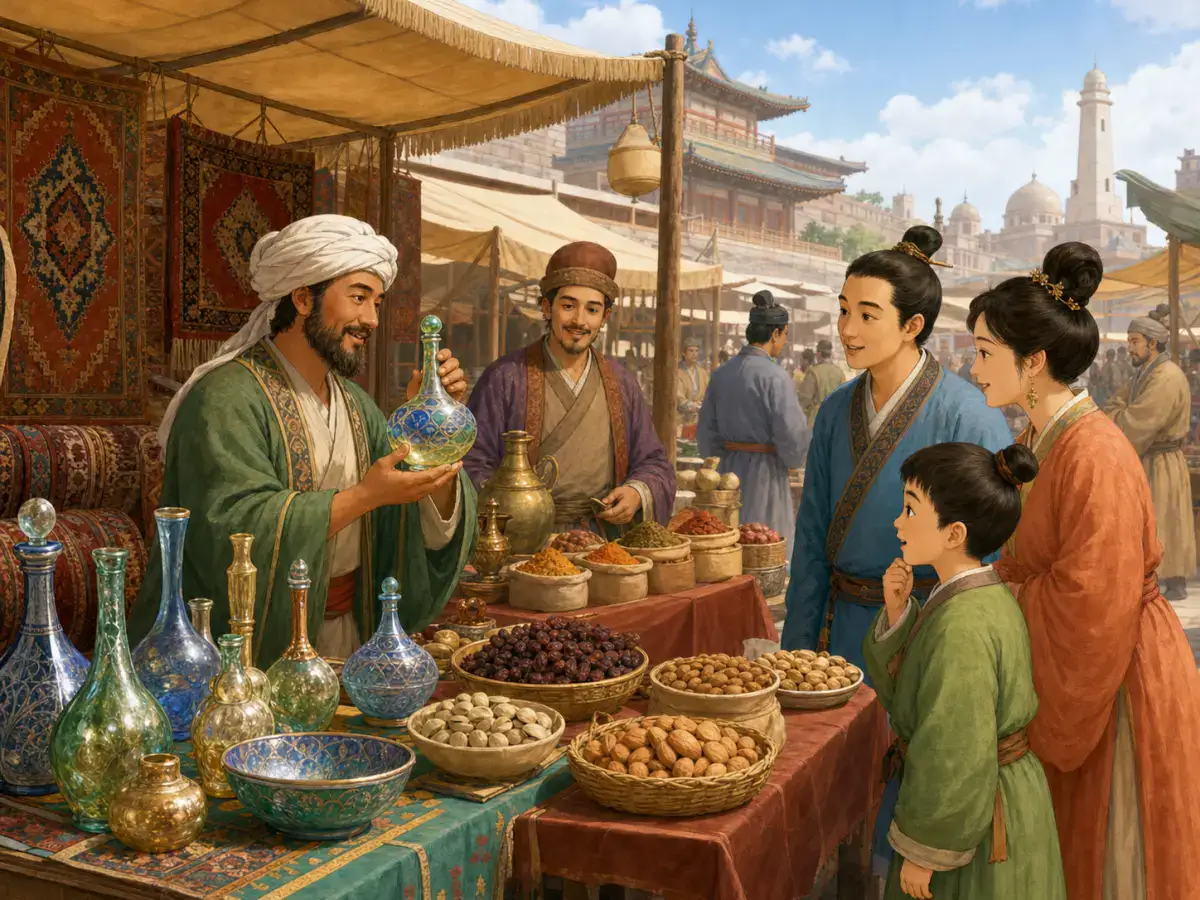
Modern imagined scene: The people and goods are combined at one invented stall, and the buildings do not accurately reconstruct the West Market site.
长安有两座大型官设市场:东市和西市。旧故事常把东市说成“只卖本地货”,把西市说成古代的“国际商场”,好像两边有一道看不见的国界。真实情况更复杂。两市都有管理交易的官署,要检查度量衡、处理商事并控制开闭时间;城市里的买卖也并非永远只待在两堵市场墙内,中晚唐以后,坊内店铺和夜市逐渐冲开了旧制度的边界。
西市靠近通向西方的城门和道路,遗址中发现了道路、排水沟、桥、井、陶器和钱币,因此它确实特别适合观察远距离贸易。来自中亚的生活在古代中亚、说伊朗语族语言的一群人;他们的商路连接了丝绸之路沿线许多城市。以跨城商路闻名,波斯人和其他中亚人也在长安经商、做手艺、任职或生活。可是,一件玻璃器或一枚外国钱币可能经过许多双手才到长安,不能让我们指认“这一摊一定是谁开的”。东市同样出售多种商品,也会接触外来物品和使节。两座市场不是“国内”和“国外”的简单分区。
Chang'an had two large official marketplaces, the East Market and the West Market. A simple story sometimes turns the East Market into a place for “Chinese goods only” and the West Market into an ancient international mall, as if an invisible national border separated them. The evidence is messier. Both markets had government offices that supervised trade, checked measures, settled market matters, and controlled opening hours. Business did not stay forever behind those two sets of walls either. By the middle and late Tang, shops inside residential wards and night markets increasingly pushed against the old rules.
The West Market stood near gates and routes leading west. Archaeologists have uncovered roads, drains, a bridge, wells, pottery, and coins there, so it is an especially useful place for studying long-distance exchange. An Iranian-speaking people of ancient Central Asia whose trade networks linked many cities along the Silk Roads., an Iranian-speaking people from Central Asia, were famous for trade networks linking many cities. Persians and other Central Asians also lived in Chang'an as merchants, artisans, officials, and residents. Yet a glass vessel or foreign coin might have passed through many hands before reaching the capital. It cannot tell us who owned one imagined stall. The East Market also sold many kinds of goods and received foreign objects and envoys. The two markets were not simply “domestic” and “foreign.”
Page 3
谁算“远方来客”?
Who Counted as a Visitor?
墓志、法律、宗教碑刻、文书和艺术品留下了许多不同的人:粟特和波斯商人及其家属,来自中亚的工匠、军人和乐舞者,朝鲜半岛各国的使节、学生和移民,日本使团,南亚和中亚的佛教僧人。有人短暂停留,有人在长安成家,有人成为唐朝登记在册的臣民。还有人并非自愿来到这里,而是战争俘虏、被进贡或被买卖的奴婢。把所有人都叫作“外国游客”,会抹掉他们完全不同的处境。
唐代文献常用“胡”等大类称呼多种人群,并不等于今天清楚的国籍标签。现代学者用“国际化”或“世界性城市”来概括长安的跨地区联系,也是在提出一种解释。这个词能帮助我们看见交流,却可能让人误以为人人平等。唐朝法律会登记户口、检查旅行文书、管理使节与贸易,并按身份、官阶、性别和是否属于唐朝臣民区别对待。某些跨境婚姻和私人接触受到限制,城市的繁华也包含劳役、贡赐、战争和不自由的人口流动。
Epitaphs, laws, religious inscriptions, documents, and works of art preserve traces of many different people: Sogdian and Persian merchants and families; Central Asian artisans, soldiers, musicians, and dancers; envoys, students, and migrants from kingdoms on the Korean Peninsula; Japanese missions; and Buddhist monks from South and Central Asia. Some stayed briefly. Others raised families in Chang'an or became registered Tang subjects. Still others did not arrive freely at all. They were prisoners of war, people sent as human tribute, or enslaved people who had been bought and sold. Calling everyone a “foreign tourist” would erase these very different lives.
Tang writers often grouped varied peoples under broad labels such as hu. Those labels did not work like clear modern nationalities. When scholars today call Chang'an “cosmopolitan,” they are offering a modern interpretation of its wide connections. The word helps us notice exchange, but it can falsely suggest equality. Tang authorities registered households, checked travel documents, supervised embassies and trade, and treated people differently according to status, official rank, gender, and whether the state counted them as Tang subjects. Some marriages across political borders and some private contacts were restricted. The city's splendor also depended on labor, tribute, warfare, and movements of people who were not free.
Page 4
遣唐使带回去的,不是一箱“答案”
The Japanese Missions Did Not Pack Up One Box of Answers
Modern imagined scene: Clothing cannot identify these people, and no source records this map-copying scene. Mission members had many different jobs and experiences.
从630年到九世纪,日本朝廷多次任命遣唐使团;不同学者会按“计划、出发、到达或完成往返”给出不同次数。一个使团不只有一位“学生”,还可能包括大使、副使、官员、翻译、留学生、僧人、医生、乐师、工匠、水手和随员。他们进行外交礼仪,也学习制度、佛教、文字、历法、医药和艺术。有人几年后回国,有人留居很久;例如阿倍仲麻吕进入唐朝仕途,空海则随804年使团入唐学佛,后来回到日本。
海路确实危险,风暴、迷航、搁浅和船毁在不同航次中造成过死伤与漂流。可是,不能把某一次灾难变成“每次必有三分之一死亡”的固定比例。有的船顺利抵达,有的整船失联,有的人漂到意外地点后获救。风险会随路线、季节、船只和一次次航程改变。
日本的奈良和平安京,也就是后来的京都,在轴线和方格布局上受到隋唐都城规划影响,但它们按日本的地形、政治和规模重新安排。交流不是把一张长安地图完整复印回国;使团成员选择、理解、改造所见之物,回国后还要和本地社会一起把它变成新的制度与文化。
From 630 into the ninth century, Japan's court appointed a series of official missions to Tang China. Modern totals differ because scholars may count missions that were planned, launched, reached China, or completed the round trip. A mission did not consist of one kind of “student.” It could include ambassadors, deputy envoys, officials, interpreters, long-term students, monks, doctors, musicians, craftspeople, sailors, and attendants. They performed diplomacy and studied government, Buddhism, writing, calendars, medicine, and the arts. Some returned after a few years; others stayed much longer. Abe no Nakamaro entered Tang government service, while the monk Kūkai traveled with the 804 mission, studied Buddhism, and returned to Japan.
The sea voyage was truly dangerous. Storms, navigation errors, groundings, and wrecks caused deaths and long drifts on different missions. But one disaster cannot become a rule that “one-third always died.” Some ships arrived safely. Some disappeared. Some survivors washed up far from their planned destination and eventually found a way home. Risk changed with the route, season, ship, and particular voyage.
The Japanese capitals of Nara and Heian-kyō - later Kyoto - were influenced by the axes and grids of Sui-Tang capital planning. Yet Japanese planners adjusted those ideas to local land, politics, and scale. Exchange did not mean photocopying a complete plan of Chang'an and carrying home a box of answers. Travelers selected, understood, and reshaped what they encountered; then people at home helped turn it into something new.
Page 5
一张画错的景教碑
A Picture That Gets the Stele Wrong
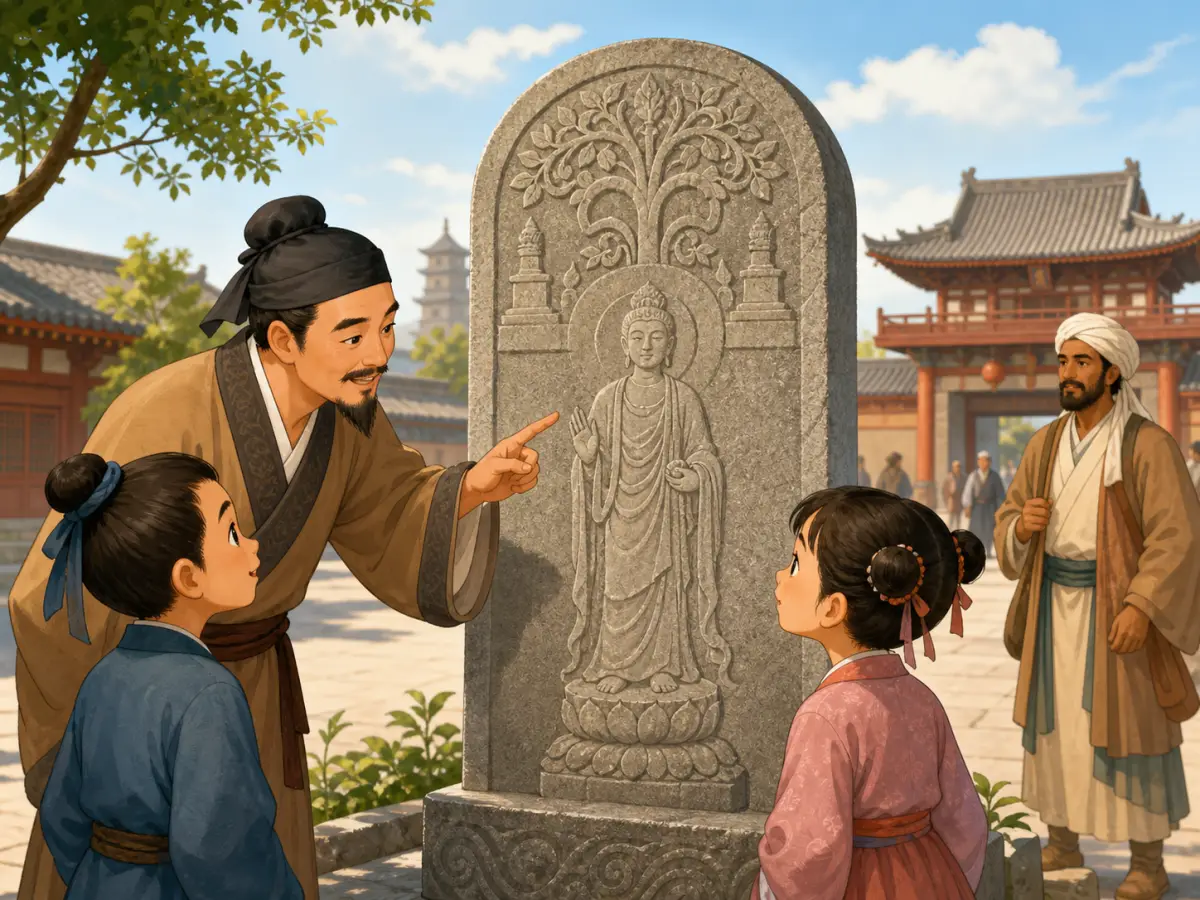
Inaccurate modern illustration: The real stele is covered mainly with Chinese text and Syriac names, with a cross and other decoration at the top. It does not show this Buddha.
看看这张插图,你会以为景教碑中央刻着一尊佛像。真实的“大秦景教流行中国碑”不是这样:它在781年立于长安,碑面主要是长篇中文文字,旁边还刻有叙利亚文姓名,碑顶装饰中可以看到十字架。碑文回顾了被唐人称为“景教”的东方教会基督教传统,记载阿罗本于635年来到长安,也赞颂几位皇帝给予的支持。它是极珍贵的历史材料,同时也是这个宗教群体纪念自身经历的文字,不能当成全城人口调查。
石碑在后来很长时间里不见于世,1625年才在西安附近重新出土。它证明景教团体曾在唐代中国活动,也让我们看见宗教词语和图像怎样在中文环境中重新表达;它却不能证明长安人人信教、各宗教人数相等,或社会一直和谐。事实上,唐政府对宗教的态度会改变。会昌年间的845年前后,朝廷大规模打击佛教,同时压制景教、祆教和摩尼教等外来宗教,寺院、人员和财产都受到影响。
所以这张画虽然画错了,仍有一个用途:它提醒我们把“漂亮的故事”放回证据旁边比较。长安既有翻译、交易和学习,也有城门、身份、禁令与迫害;两面一起看,才比较接近真实历史。
Look at this illustration and you might think the Jingjiao Stele had a large Buddha carved in its center. The real monument is nothing like that. Erected in Chang'an in 781, it is covered mainly with a long Chinese inscription and includes names written in Syriac. A cross appears among the decorations at the top. The text looks back on the Christian tradition that Tang writers called Jingjiao, part of the Church of the East. It says that a religious leader named Aluoben reached Chang'an in 635, and it praises support from several emperors. The stele is precious evidence, but it is also a community's monument to its own history - not a census of the entire city.
The stone disappeared from view for centuries and was unearthed near Xi'an in 1625. It proves that Church of the East communities were active in Tang China and shows how religious ideas and images were expressed in a Chinese setting. It does not prove that most residents converted, that every religion had equal standing, or that harmony lasted forever. Government policy changed. Around 845, during the Huichang suppression, the court attacked Buddhist institutions on a huge scale and also suppressed Jingjiao, Zoroastrianism, Manichaeism, and other foreign religions. Religious buildings, people, and property suffered.
That makes the inaccurate picture useful in one unexpected way: it reminds us to compare a beautiful story with the surviving evidence. Chang'an held translation, trade, and learning - but also gates, ranks, bans, and persecution. We need both sides to see the city more clearly.
“世界相遇”不是故事的终点
“Worlds Met” Is the Beginning, Not the Ending
再回到那张城市图。道路把远方的人带进长安,坊墙和制度又安排他们可以在哪里停留、交易和行动。物品、音乐、宗教与知识越过了边界,人却不一定能同样自由地越过身份和法律的边界。
今天说长安“国际化”,最有意思的不是给它戴上一枚“开放城市”的奖章,而是继续追问:谁来了?为什么来?谁欢迎他,谁管理他,谁没有留下自己的声音?这样,地图上的方格才会变成一座真实、复杂、值得认识的城市。
Return to the city plan one last time. Roads carried people from far away into Chang'an. Ward walls and government systems shaped where they could stay, trade, and move. Objects, music, religions, and knowledge crossed boundaries, but people could not always cross boundaries of law and status just as freely.
Calling Chang'an “cosmopolitan” should not be the end of the story or a prize for being an “open city.” It should begin a better set of questions: Who came? Why? Who welcomed them, who supervised them, and whose voice is missing from the record? Those questions turn the squares on a map into a real, complicated city worth knowing.