丝绸之路:谁把许多条路连成了一张网?
The Silk Roads: Who Wove Many Routes into a Network?
阅读难度 · 困难Reading level · Hard
Page 1
古人走在路上时,并不知道它叫“丝绸之路”
Ancient Travelers Did Not Call It the Silk Road
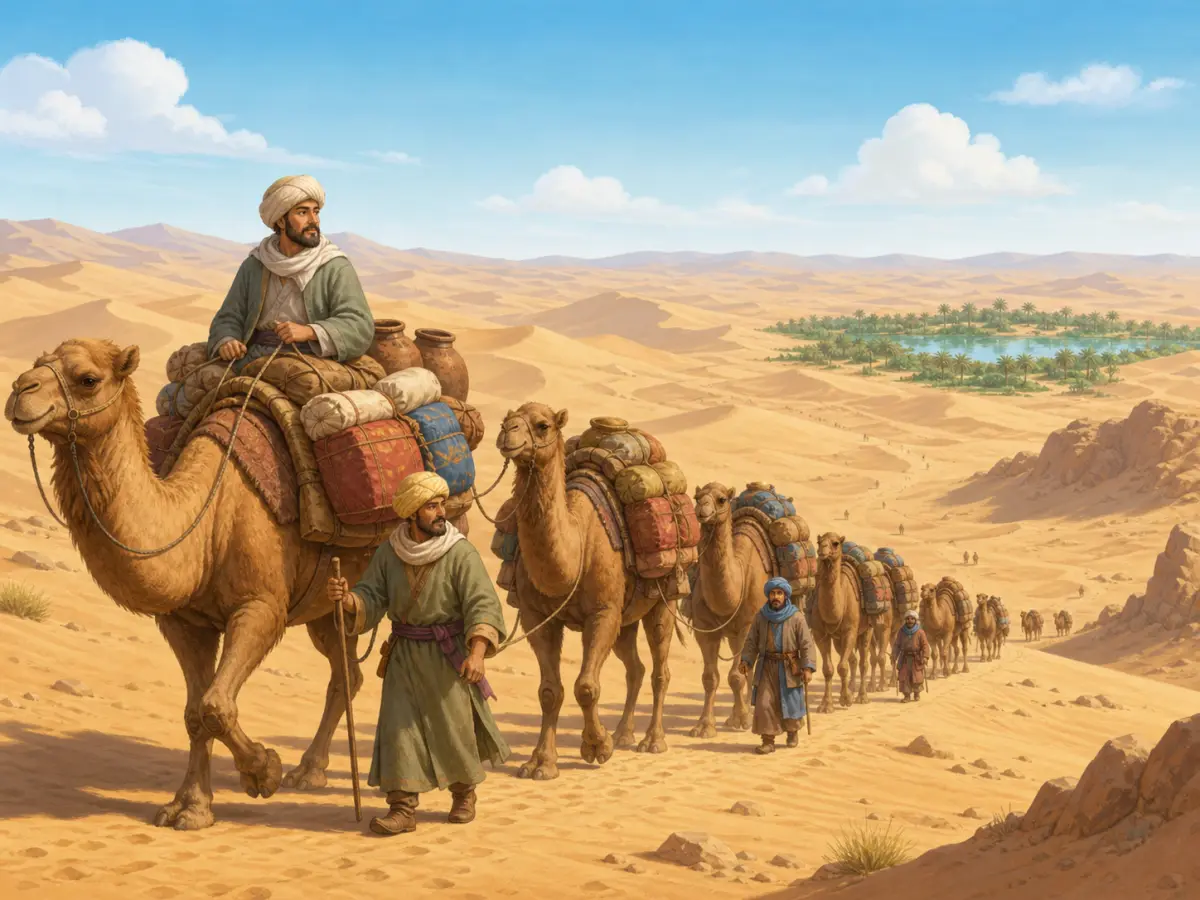
A modern composite of a camel caravan; it shows one kind of travel, not proof that every route crossed a desert or used camels.
“丝绸之路”听起来像一条有起点、有终点的大道,可古代旅行者并不用这个名字。十九世纪,德国地理学家李希霍芬用德文Seidenstrasse - “丝绸之路” - 来描述中国与中亚之间的古代交通。后来,这个很有画面感的词越用越广,人们还常说复数的“丝绸之路”,提醒自己那里从来不只一条线。
这些路线有时穿过河西走廊,绕行塔克拉玛干沙漠两侧的绿洲,再连接中亚、南亚、伊朗高原和地中海附近的市场;另一些路线经过草原、高山,或者从中国沿海进入东南亚和印度洋。战争、政权、天气、港口和市场一变,常走的路线也会跟着改变。
丝绸很重要,却不是路上“最多”的货物,也不是每个年代都一样重要。布匹、马匹、香料、玻璃、金属器、药材、粮食和许多日常用品,也在不同距离上流动。与其想象一条从中国直达罗马的高速公路,不如想象一张会伸缩、会断开、也会重新接起的网。
“The Silk Road” sounds like one highway with a clear beginning and end, but ancient travelers did not use that name. In the nineteenth century, the German geographer Ferdinand von Richthofen used the term Seidenstrasse - “Silk Road” - for ancient traffic between China and Central Asia. The vivid label later expanded in meaning. Scholars often use the plural, Silk Roads, to remind us that the system was never a single line.
Some routes passed through the Hexi Corridor and around oasis towns on either side of the Taklamakan Desert, then connected with markets in Central Asia, South Asia, the Iranian Plateau, and lands near the Mediterranean. Other routes crossed grasslands and mountains or sailed from Chinese ports into Southeast Asia and the Indian Ocean. When wars, governments, weather, ports, and markets changed, the busiest routes changed too.
Silk was important, but it was not necessarily the most common cargo, and its role was not the same in every century. Textiles, horses, aromatics, glass, metalwork, medicines, grain, and everyday supplies moved over different distances. Instead of imagining an ancient highway from China straight to Rome, picture a web that could stretch, break, and reconnect.
Page 2
真正把路接起来的是一座座有人生活的城
Inhabited Towns, Not Empty Desert, Held the Network Together
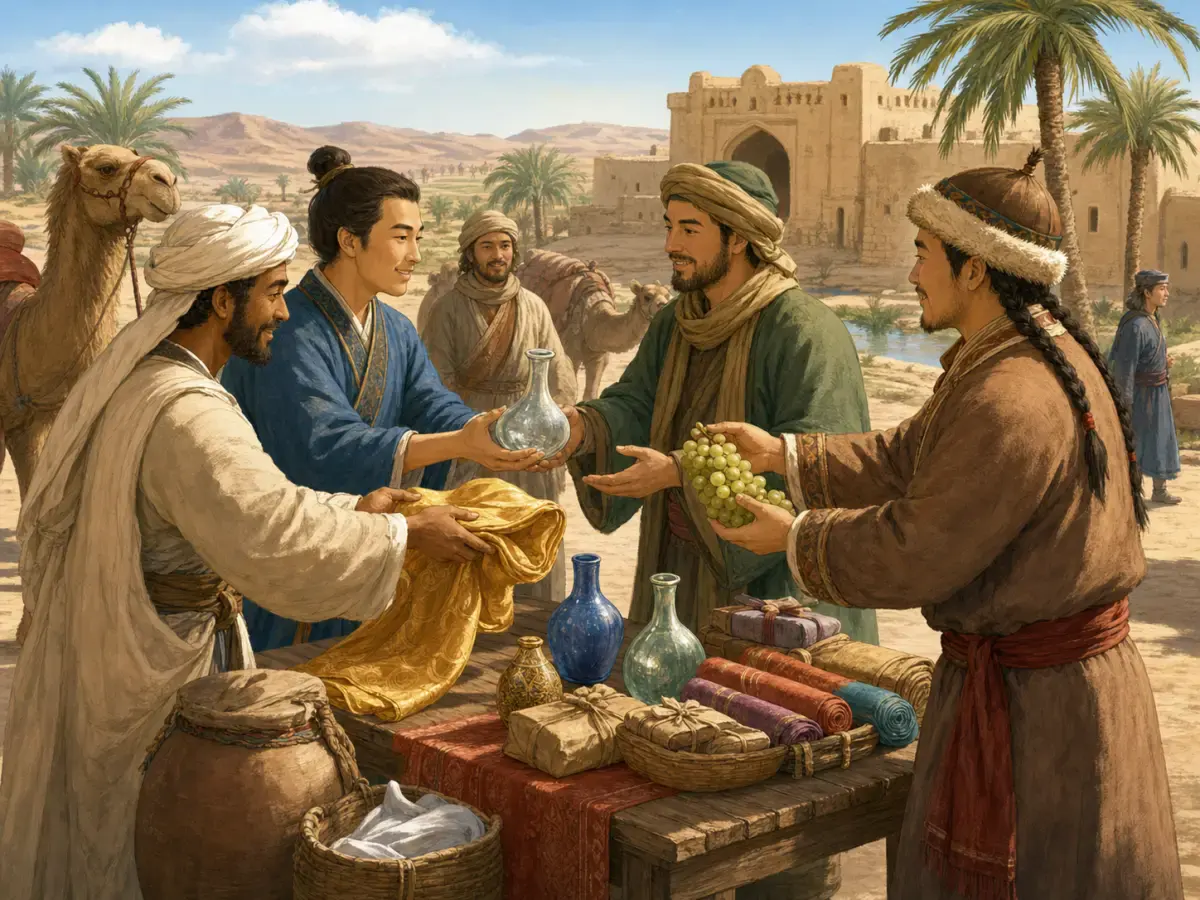
This modern market composite brings silk, glass, and grapes together; its people, clothing, and goods do not represent one verified moment in time.
地图爱画长线,旅行者却必须寻找下一个能喝水、买粮、修装备和换牲畜的地方。像A famous place in northwestern China known for its cave murals.这样的绿洲城市,既有居民、农田和手工业,也可能有驿站、寺院、守军和市场。当地人不是站在路边等待“中国”和“西方”经过的背景人物;他们生产货物、提供向导和翻译、安排住宿,也决定一条支线能不能继续运转。
货物常常在城市里拆包、加价、换主人,再走下一段。许多商人主要熟悉自己的区域,也确实有人跨越很长距离;所以不能说“没有商人走过长路”,也不能把一件到达远方的丝绸想成由同一个人从头背到尾。粟特商人的家乡在今天的乌兹别克斯坦和塔吉克斯坦一带,他们曾把中亚、伊朗地区和中国的市场联系起来,有些人还定居在沿途城市。
旅行的困难也比“忽然来一场沙尘暴”复杂。队伍要计算水、食物和牲畜草料,寻找熟悉道路与语言的人,还要准备通行文书、税费和送给地方统治者的礼物。山口积雪、河水涨落、盗匪或战争都可能让路线改道。骆驼能负重耐旱,却不是会自动导航的沙漠机器;商队真正依靠的是动物、人和沿途社区之间的合作。
Maps love long lines. Travelers needed the next place to drink, buy food, repair equipment, and change animals. Oasis cities such as A famous place in northwestern China known for its cave murals. had residents, farms, workshops, and sometimes postal stations, monasteries, garrisons, and markets. Local people were not background figures waiting for “China” and “the West” to pass by. They made goods, guided and interpreted, arranged lodging, and helped determine whether a route could keep working.
At a city, cargo might be unpacked, repriced, and sold to a new owner before starting its next journey. Many merchants knew one region especially well, while some people really did travel very long distances. It is therefore wrong to say that no merchant ever went far, but also misleading to imagine one person carrying a piece of silk from beginning to end. Sogdian merchants, whose homeland lay around present-day Uzbekistan and Tajikistan, linked markets in Central Asia, the Iranian world, and China. Some settled permanently in cities along the routes.
The difficulties of travel were more complicated than one sudden sandstorm. A group had to calculate water, food, and animal fodder; find people who knew the route and languages; and prepare permits, taxes, or gifts for local rulers. Snow in a mountain pass, changing rivers, robbery, or war could force a detour. Camels could carry heavy loads and endure dry country, but they were not self-guiding desert machines. A caravan depended on cooperation among animals, travelers, and communities along the way.
Page 3
张骞出发时,寻找的不是一条贸易路线
Zhang Qian Set Out to Find an Ally, Not a Trade Route
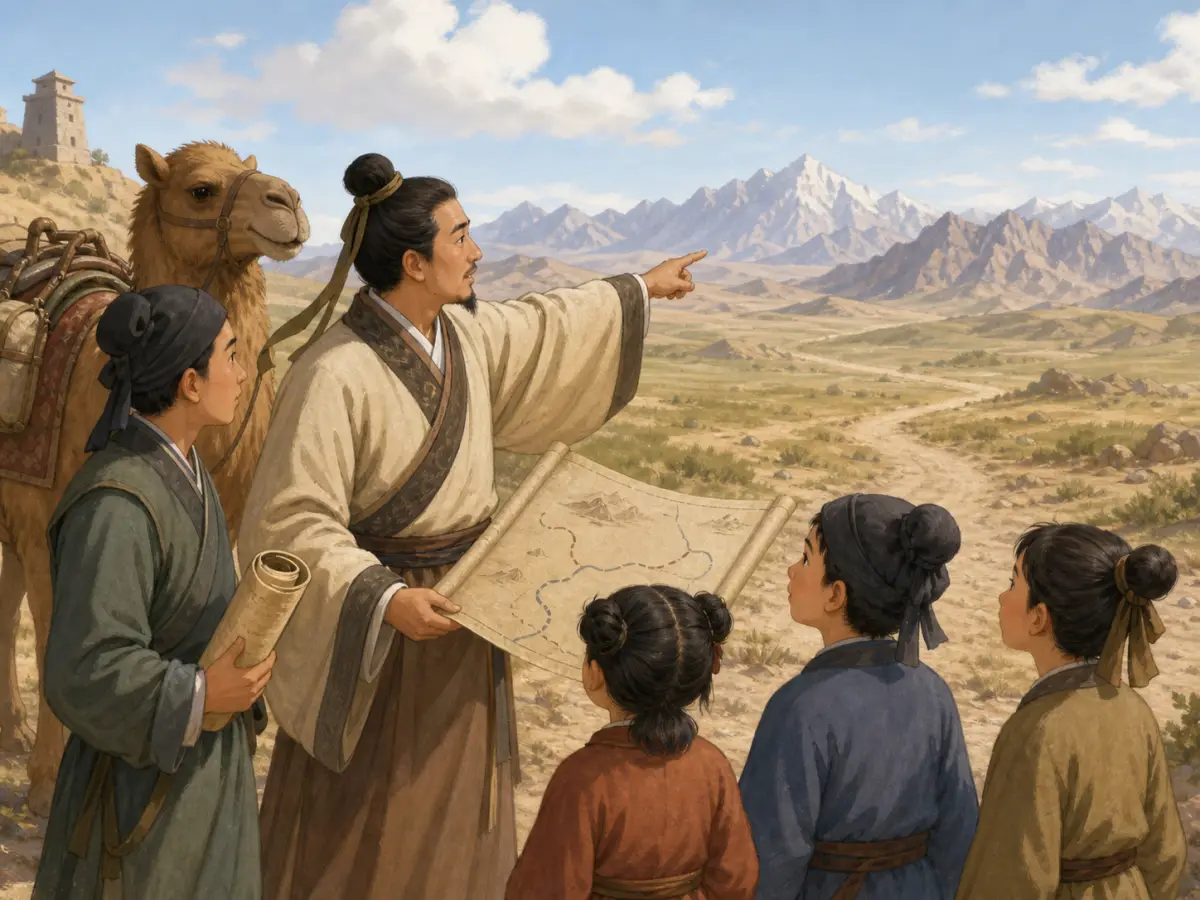
A modern imagining of Zhang Qian's journey; the scroll map and travelers are not eyewitness details preserved in the Shiji.
公元前二世纪,A powerful time in China more than 2,000 years ago.皇帝派张骞去寻找大月氏,希望与他们联合对付A horse-riding people from the northern grasslands.。这是一项外交任务,不是去“开通国际贸易”。《史记》记载,他带着一百多人出发,很快被匈奴扣留,大约十年后才逃出。他仍继续向西,经过大宛,到达大月氏所在的地区;可是大月氏已经安顿下来,不愿按照汉朝的计划回去作战。
张骞没有完成结盟目标。返程时他又被扣留,最后在离开约十三年后回到汉朝,最初的队伍只剩极少数人。他向朝廷报告大宛、大夏、大月氏等地,也转述了自己没有亲自到过的更远地区。这些信息后来影响了汉朝的外交、军事行动和官方往来。
这件事很重要,却不等于张骞在空地上创造了一条路。考古研究显示,在他出发以前,塔里木盆地和中亚已经有区域间交换,丝绸、金属、动物和植物也早已移动。张骞改变的是汉朝朝廷对这些网络的了解与参与程度;道路本身,则是许多更早的社区、牧民、商人和政权共同走出来的。
In the second century BCE, an emperor of the A powerful time in China more than 2,000 years ago. sent Zhang Qian to find the Yuezhi and ask them to join an alliance against the A horse-riding people from the northern grasslands.. This was a diplomatic mission, not a plan to “open international trade.” According to the Shiji, Zhang Qian left with more than one hundred people and was soon detained by the Xiongnu. He escaped after about ten years and continued west through Dayuan to the region where the Yuezhi had settled. They were established there and did not want to return east to fight according to the Han plan.
Zhang Qian did not achieve the alliance. He was detained again on the return trip and finally reached the Han court about thirteen years after leaving, with very few of his original party. He reported on Dayuan, Daxia, the Yuezhi, and other places, including farther regions he had learned about but had not visited himself. This information later influenced Han diplomacy, military campaigns, and official exchange.
That mattered, but it does not mean Zhang Qian invented a road across empty land. Archaeology shows regional exchange in the Tarim Basin and Central Asia before his mission, with silk, metals, animals, and plants already moving. What changed was the Han court's knowledge of and involvement in these networks. The routes themselves had been made over time by many earlier communities, pastoralists, traders, and states.
Page 4
一张市场图,不能把一千年货物都摆在同一天
One Market Scene Cannot Put a Thousand Years of Goods on One Table
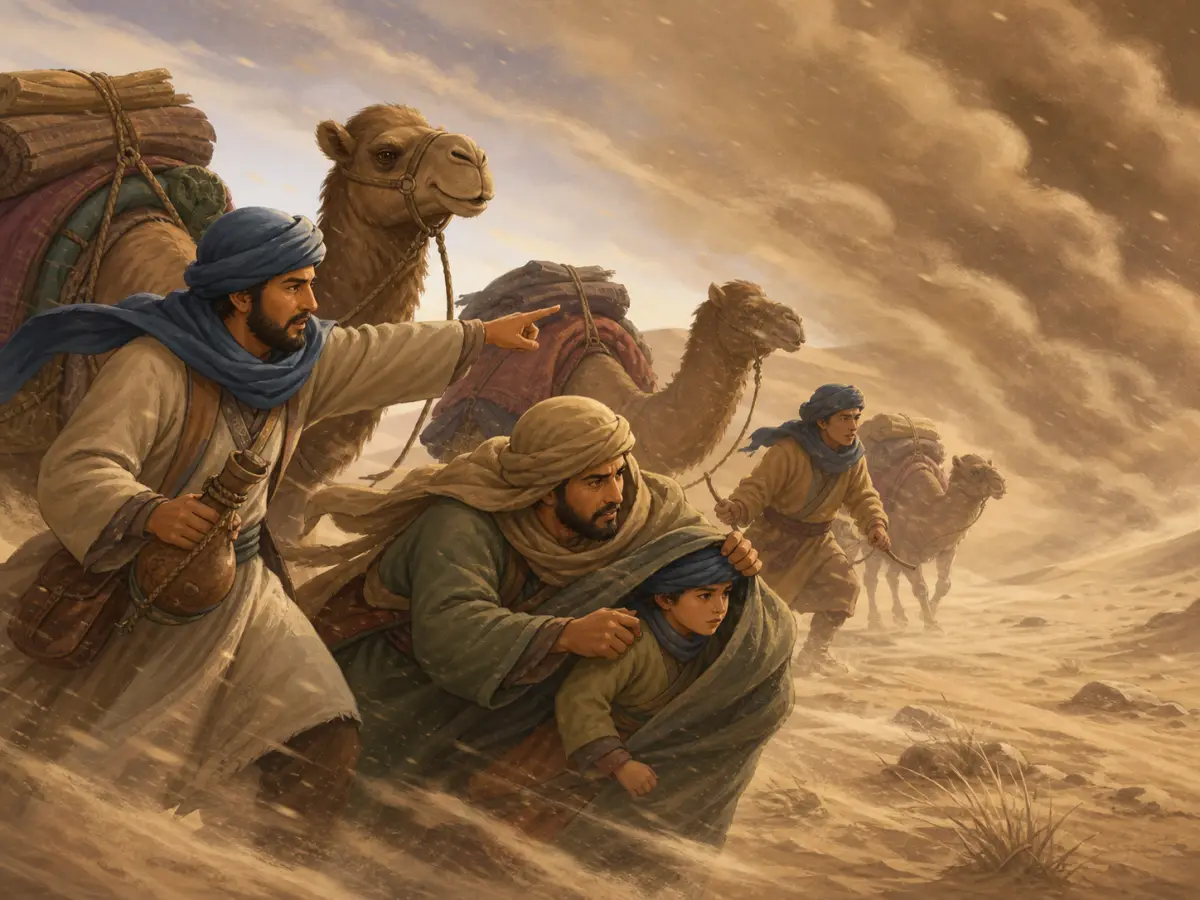
This dramatic modern sandstorm scene represents weather risk only; it does not document people's actions, caravan size, or camel behavior.
如果把“丝绸之路货物”全写成一张清单,时间很容易乱掉。汉代向中亚和更远地区流动的高价值物品包括丝绸、漆器等,汉朝也特别看重中亚马匹;玻璃器和一些植物则向东进入中国。葡萄、苜蓿等作物的传播可以结合古代文字和植物遗存来研究,却不能把今天所有葡萄都讲成张骞亲手带回的一串果实。
到了A powerful and creative time in China about 1,300 years ago.,长安的市场和墓葬材料又显示出另一个时代:粟特人等外来居民和商人带来金银器、玻璃器、香料、葡萄酒、舞蹈和图案,本地工匠也会重新制作、改变外来样式。茶、陶瓷和其他中国货物后来通过陆路与海路广泛流通,但不能把唐宋时期的贸易清单倒放进张骞的汉代行囊。
食物尤其容易产生漂亮却没证据的故事。考古植物学能追踪葡萄、桃、杏、核桃和谷物在不同地区出现的时间;一道饼或面条的做法却可能在许多地方各自发展,也会在人们迁居后不断改变。说“中国人从西域学会面条”没有可靠依据,正如说所有欧洲面食都来自中国一样过分简单。交流是真的,但不代表每种食物只有一张出生证。
If we turn “Silk Roads goods” into one giant list, centuries quickly get mixed together. During the Han period, valuable goods moving toward Central Asia and beyond included silk and lacquerware, while the Han court placed special value on Central Asian horses. Glass vessels and some plants moved east into China. Ancient texts and plant remains can help scholars study the spread of crops such as grapes and alfalfa, but they cannot prove that every grape in China descends from one bunch carried home by Zhang Qian.
By the A powerful and creative time in China about 1,300 years ago., Chang'an's markets and tomb objects reveal a different age. Sogdians and other immigrant residents and merchants brought gold and silver vessels, glass, aromatics, grape wine, dances, and designs. Local craftspeople copied and transformed foreign styles. Tea, ceramics, and other Chinese goods later circulated widely by land and sea, but a Tang- or Song-period trade list should not be packed backward into Zhang Qian's Han baggage.
Food invites especially neat stories with especially weak evidence. Archaeobotany can track when grapes, peaches, apricots, walnuts, and grains appear in different places. A flatbread or noodle recipe may develop in several regions and keep changing as people move. There is no good evidence that people in China simply “learned noodles from the Western Regions,” just as it is too simple to say that every European pasta came from China. Exchange was real, but each food does not have one birth certificate.
Page 5
佛教走来的路,比玄奘一个人的脚印更宽
Buddhism's Journey Was Wider Than Xuanzang's Footprints
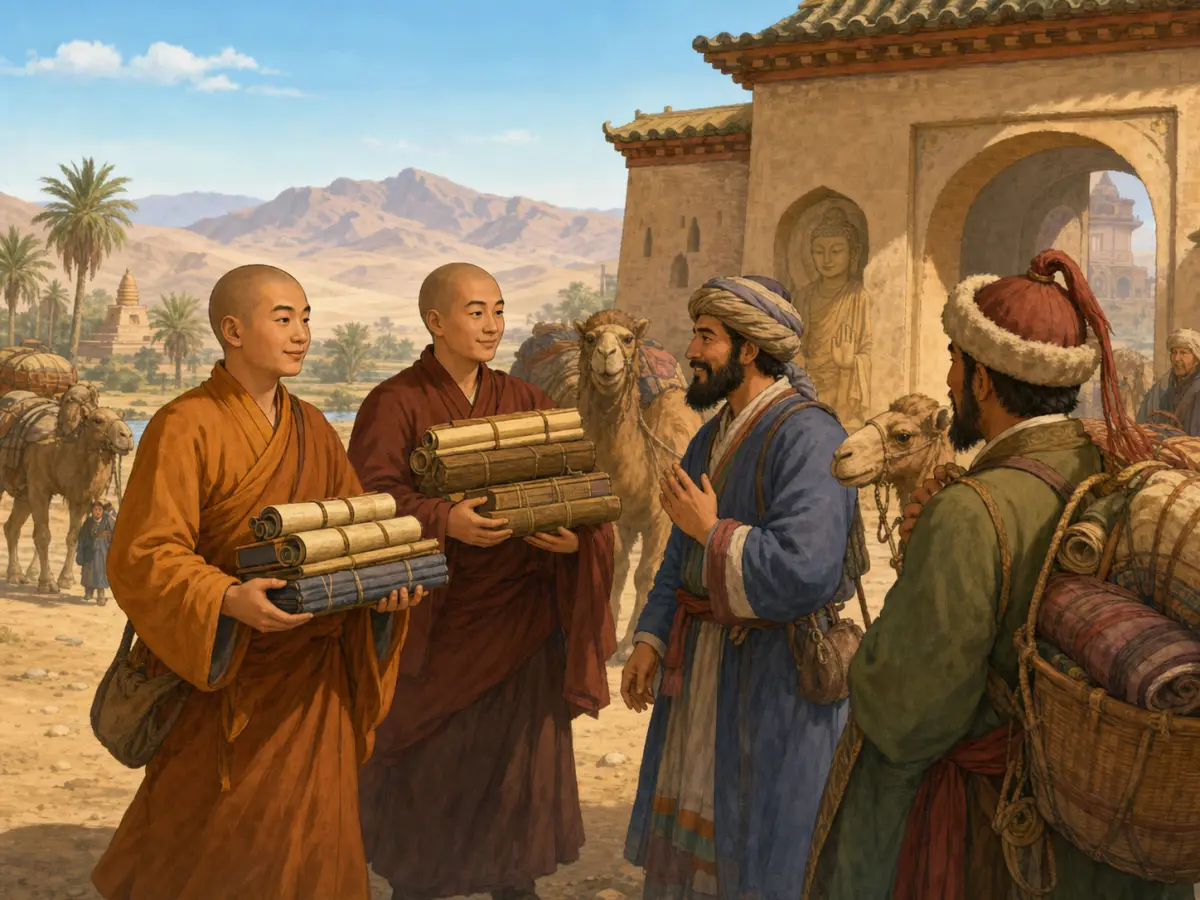
This modern composite places monks, merchants, and scrolls together to suggest a network of cooperation; it is not an actual scene from Xuanzang's travels.
佛教不是装在一辆车上,从印度沿一条路直接送到中国的。几个世纪里,僧人、信徒、商人和使者经过中亚绿洲、高山道路、东南亚与海上航线,把经文、图像、仪式和不同解释带到各地。安息、粟特、龟兹、于阗、印度和中国的译者与助手合作,把陌生的声音和概念变成可以阅读的中文。中亚城市不是传声筒,它们也形成了自己的佛教传统。
七世纪的The real monk whose westward journey later inspired Tang Monk in Journey to the West.之所以远行,正是因为他发现已有汉译佛经之间存在难懂或不一致之处。他从629年前后出发,前往中亚和南亚,在那烂陀等地学习,又收集梵文文本,645年回到长安。传统传记说他带回657部梵文文本;这个精确数字来自历史记载,适合写成“据传记统计”,而不是我们今天重新数过的箱单。
玄奘在旅程的一些危险路段可能独自行进,却不能说十六七年始终“一个人走”。沿途统治者、僧院、向导、翻译、使者、随从和驮运人员都曾帮助他;归国后的翻译工作更由僧俗学者组成团队完成。他不只是“取回经书”,还长期学习、讲解、翻译并口述旅行见闻。一个著名人物的脚印,只有落在许多人的合作网络里,才走得那么远。
Buddhism was not loaded onto one cart and delivered directly from India to China on a single road. Over centuries, monks, believers, merchants, and envoys carried texts, images, rituals, and different interpretations through Central Asian oases, mountain routes, Southeast Asia, and sea lanes. Translators and assistants from Parthian, Sogdian, Kuchean, Khotanese, Indian, and Chinese communities worked together to turn unfamiliar sounds and ideas into readable Chinese. Central Asian cities were not speaking tubes; they developed Buddhist traditions of their own.
The seventh-century monk The real monk whose westward journey later inspired Tang Monk in Journey to the West. traveled partly because existing Chinese translations of Buddhist texts seemed difficult or inconsistent to him. He left around 629, crossed Central and South Asia, studied at places including Nalanda, collected Sanskrit texts, and returned to Chang'an in 645. His traditional biography counts 657 Sanskrit texts in the collection he brought back. That exact number comes from a historical account, so it is best understood as “the biography's count,” not a shipping list that modern scholars have recounted box by box.
Xuanzang may have moved alone through some dangerous stretches, but he was not alone for an entire journey of sixteen or seventeen years. Rulers, monasteries, guides, interpreters, messengers, attendants, and pack handlers helped him along the way. Back in China, teams of monastic and lay scholars helped complete translations. He did more than “fetch scriptures”: he studied, taught, translated, and dictated an account of the places he had encountered. One famous traveler's footprints could reach so far only inside a network of many people's work.
Page 6
纸的传播为什么也不是一个“秘密泄露”的瞬间?
Why Was the Spread of Papermaking More Than One Stolen Secret?
造纸技术从中国向中亚、伊斯兰世界再到更远地区传播,也常被压缩成一个故事:751年怛罗斯战役后,被俘的中国工匠“一次性泄露秘密”。后来的文献确实把俘虏与造纸联系起来,可纸在战役前已经出现在中亚,撒马尔罕也可能更早就会造纸。不同地区还换用当地纤维、破布和工具,做出了自己的纸。
因此,更可靠的图景是:工匠迁居、商品贸易、政府需要、宗教抄经和城市里的学习,让材料与技术经过多条路线逐渐扩散;一场战争或许是其中一段,却不是按下开关,全世界忽然学会造纸。丝绸之路最有趣的地方正是这样 - 没有哪件货物、宗教或技术会自己旅行。每一次传播,都需要具体的人在具体的城市里学会、试做,再把它改成当地能用的东西。
The spread of papermaking from China into Central Asia, the Islamic world, and farther west is often squeezed into one tale: after the Battle of Talas in 751, captured Chinese artisans supposedly revealed the secret all at once. A later written tradition does connect prisoners with papermaking, but paper was present in Central Asia before the battle, and Samarkand may already have produced it. Different regions also changed the fibers, rags, tools, and methods to make paper of their own.
A more reliable picture is gradual: artisans moved, sheets were traded, governments needed records, religious communities copied texts, and people in cities learned through more than one route. A battle may be one part of that history, but it did not work like a switch that suddenly taught the world to make paper. This is what makes the Silk Roads so interesting. No object, religion, or technology traveled by itself. Every transmission required particular people in particular places to learn, test, and reshape something for local use.
把“路”重新看成“人”
Look Past the Road and See the People
张骞的报告、粟特商人的家庭、敦煌居民的市场、翻译团队的争论、玄奘求学的僧院,还有改良造纸方法的工匠,都比一根地图线更接近真实的丝绸之路。这个十九世纪才出现的名字,可以帮助我们谈论跨越欧亚大陆和海洋的交流;只要记得,真正织成网络的不是丝绸,而是许多时代、许多地方的人。
Zhang Qian's report, Sogdian merchant families, Dunhuang's markets, debates within translation teams, the monasteries where Xuanzang studied, and craftspeople adapting papermaking all bring us closer to the real Silk Roads than one line on a map. The nineteenth-century name helps us discuss exchange across Eurasia and the seas - as long as we remember that silk did not weave the network. People in many places and periods did.