古代市场:赶集日、长安城与宋朝夜市
Ancient Markets: Market Days, Chang'an, and the City After Dark
阅读难度 · 困难Reading level · Hard
Page 1
第一件事不是买,而是看日子
First, Check the Calendar
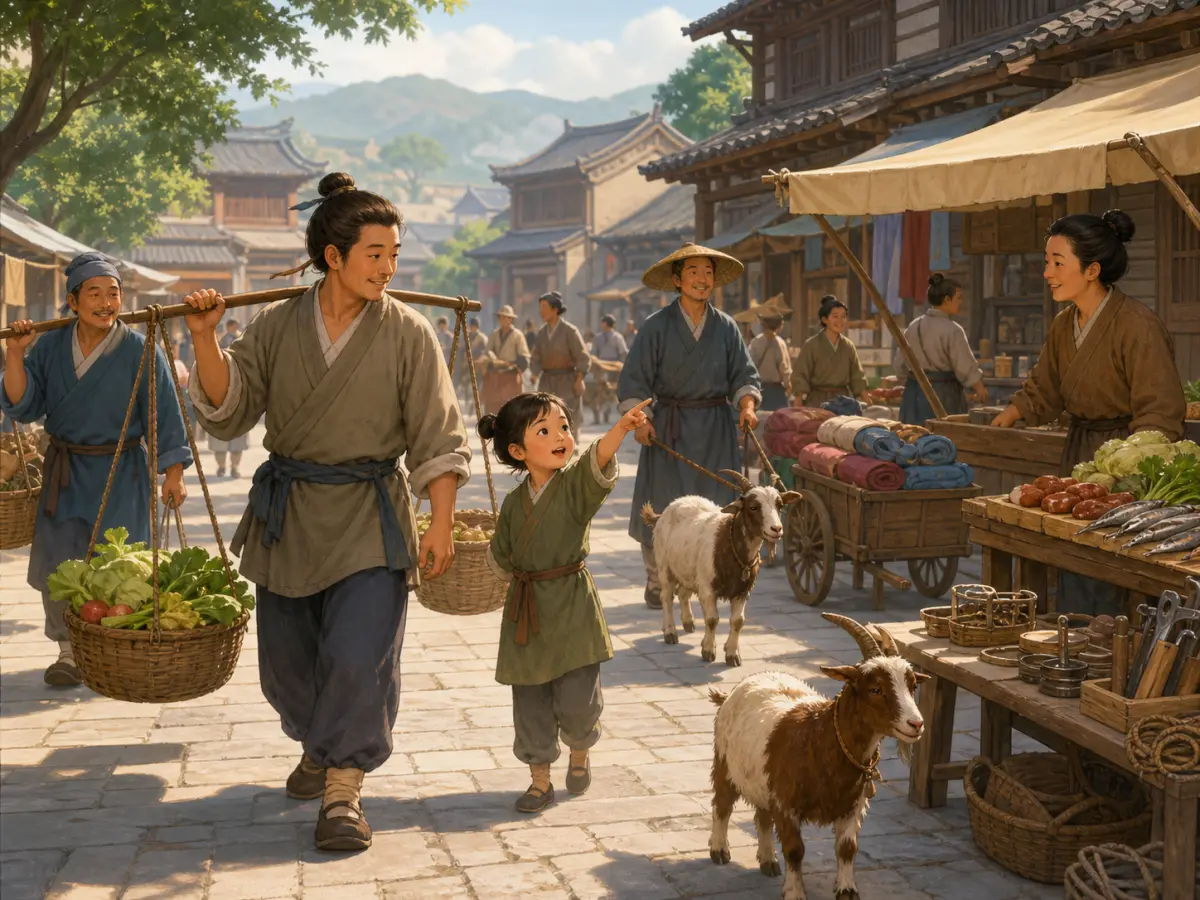
Modern composite illustration: a town market might bring together nearby producers, traders, and customers, but its goods, clothing, and schedule varied by place and period.
如果你得到一张古代的“购物券”,上面只写着“去市场”,你还不能马上出发。你得先问三个问题:哪一个时代?哪一个地方?哪一天? 中国很大,历史也很长,乡村的定期集市、唐朝长安的官方市场和宋朝大城市的街市,并不是同一种地方。
许多乡村没有足够多的顾客让每个商贩天天摆摊,于是人们约定某些日子集中交易。不同地区把这种地方叫作集、市、墟或场,集期也不一样。有的按每旬中的几个日子开集,有的按别的地方习惯轮换;所以不能说中国古代所有集市都是“每五天或每十天一次”。而且,我们今天掌握得最清楚的许多集期资料来自较晚的朝代和近代调查,不能原样搬回一千多年前。
到了约定的日子,附近村庄的农户、手艺人和小商贩才值得走一段路,把少量货物集中到同一处。有人带来自家生产的粮食、菜、蛋或布,有人提供修补、运输等服务;一个平时也许只有几家固定店铺的小镇,会暂时多出许多摊位。妇女也可能把家庭生产的东西拿来卖,流动商贩则可以按不同集期赶往不同城镇。集市因此不只是“热闹”:它把分散的人、货物和消息接进同一张地方网络。
Suppose someone hands you an ancient shopping pass. It says only, “Go to the market.” You still are not ready to leave. First you need three answers: What period? What place? What day? China is enormous, and its history is long. A country market that met only on certain days, an official market in Tang Chang'an, and a commercial street in a Song capital were not the same kind of place.
Many rural communities did not have enough customers for every trader to set up every day. Instead, buyers and sellers gathered on agreed market days. The market might be called a ji, shi, xu, or chang, depending on the region, and its schedule followed local custom. Some met on selected dates in each ten-day period; others used different cycles. That is why “once every five or ten days” cannot be a rule for every market in ancient China. There is another catch: much of our most detailed evidence about rural schedules comes from later imperial records and modern fieldwork. Historians cannot simply copy those schedules into the distant past.
On the appointed day, the trip became worthwhile for farmers, craftspeople, and small traders from nearby villages. Some could sell a small amount of grain, vegetables, eggs, or cloth produced at home. Others offered repair work or transportation. A town with only a few permanent shops might temporarily gain rows of stalls. Women could sell things made or raised by their households, while traveling traders could follow a circuit of towns whose market days did not clash. The market was more than a noisy event. It connected scattered people, goods, services, and news into a local network.
Page 2
长安的两座大市场
Chang'an's Two Great Markets
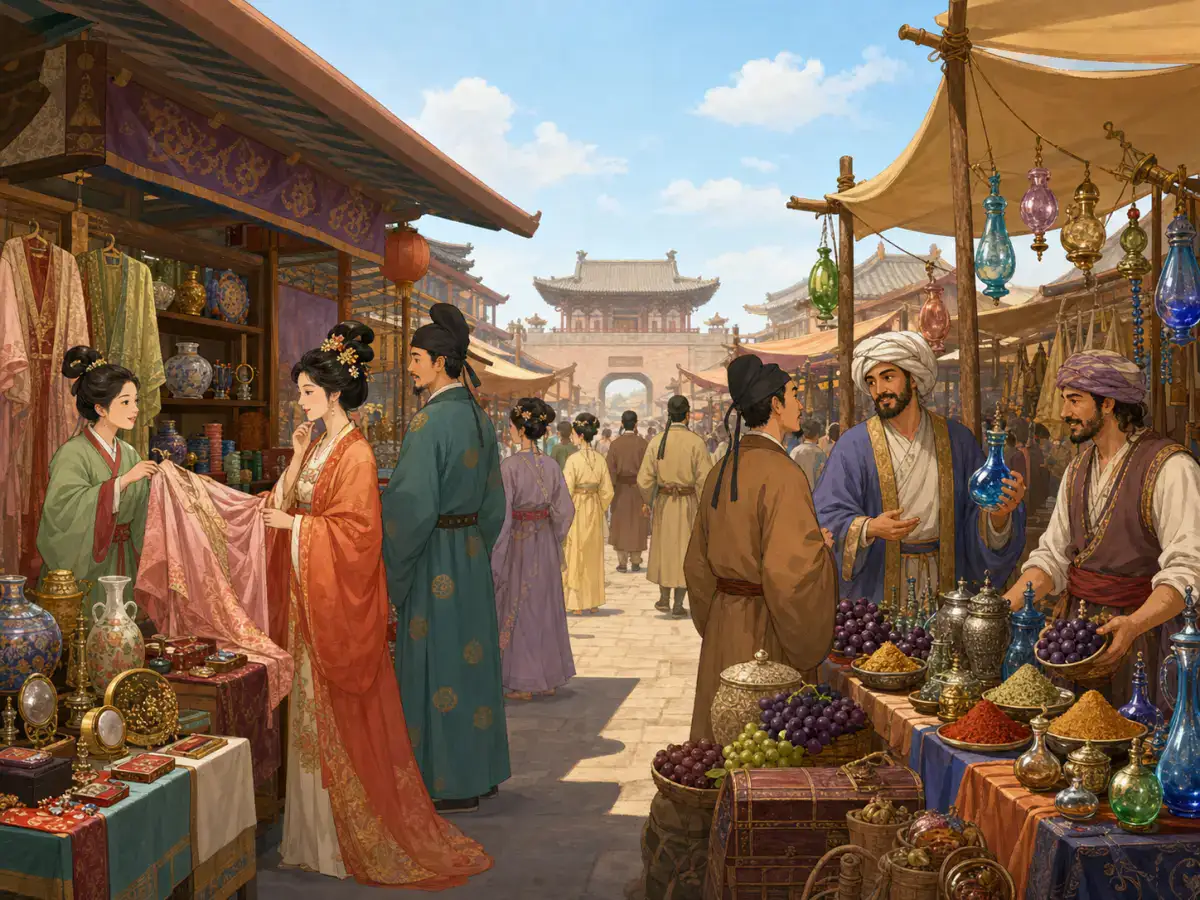
Modern composite illustration: Tang Chang'an did have long-distance traders and imported goods, but these particular stalls, faces, and combinations of goods are not a historical record.
现在把购物券换到唐朝,目的地写成“长安”。这座都城位于今天的西安一带,城内有围墙分隔的居民坊,也有著名的东市和西市。市场设有管理人员,交易地点和时间受到管束,度量工具也需要校准。这样的规则既方便官府维持城市秩序、检查交易,也提醒我们:市场里的热闹从来离不开看守、搬运、记账和管理等不那么显眼的劳动。
旧故事常把东市说成“有钱人的商场”,把西市说成“普通人和外国人的商场”。这抓到了一点城市地理,却说得太整齐。城东确实聚集了较多皇室、官员住宅,西市及附近地区的平民商业和外来商人也很突出;可是两市都面对复杂的城市人群,都有多种商人和货物,并没有一道只凭贫富划出的门槛。到了唐朝后期,商业活动还逐渐越出原先指定的市场,进入一些街道和居民区。城市的规则并非几百年一动不动。
长安也是跨地区交往的中心。文献、墓葬和随葬陶俑都留下中亚、西亚商旅与居民的线索,其中粟特人曾在欧亚贸易网络中扮演重要角色。远方来的玻璃器、香料、织物和其他奢侈品,也影响过唐代生活与审美。不过,陶俑是为墓葬制作的形象,不是市场照片;“外国商人”也不是一种固定长相,更不会全站在同一排摊位上。可靠的讲法是:长安市场连接了本地、全国和远方的贸易,而不是编出一个金发蓝眼商人的讨价还价对白。
Now change the date on your shopping pass to the Tang dynasty and write “Chang'an” as the destination. The capital stood in the area of present-day Xi'an. Its plan included walled neighborhoods as well as the famous East and West Markets. Market officials watched over trading spaces and hours, and measuring tools had to be checked. These rules helped the government manage a huge city and keep an eye on trade. They also point to the less visible work behind every crowd: guarding gates, moving loads, keeping accounts, and settling disputes.
Older retellings often turn the East Market into “the rich people's mall” and the West Market into “the ordinary and foreign people's mall.” There is a little geography behind that picture, but it is much too neat. More imperial and official households were concentrated in the eastern part of the city, while everyday trade and communities of outside merchants were especially noticeable around the West Market. Yet both markets served many kinds of city residents and contained many kinds of traders and goods. There was no doorway that sorted every shopper by wealth. Over the centuries of Tang rule, trade also began to spill beyond the official markets into some streets and neighborhoods. A city's rules do not remain frozen for hundreds of years.
Chang'an was also a center of long-distance contact. Written records, tomb objects, and ceramic burial figures preserve evidence of travelers and residents from Central and West Asia. Sogdians, whose homeland lay around present-day Uzbekistan and Tajikistan, played an important part on trade routes that reached across Asia and into Europe. Imported glassware, fragrant spices, textiles, and other luxury goods influenced Tang tastes. But a burial figure is not a market photograph. “Foreign merchant” did not describe one fixed appearance, and merchants from far away did not all stand in a single exotic row. The careful conclusion is exciting enough: Chang'an linked nearby trade, trade across the empire, and trade with distant lands. There is no need to invent a blond, blue-eyed merchant bargaining in broken Chinese.
Page 3
城墙退后,街灯亮起来
Commerce Moves into the Streets
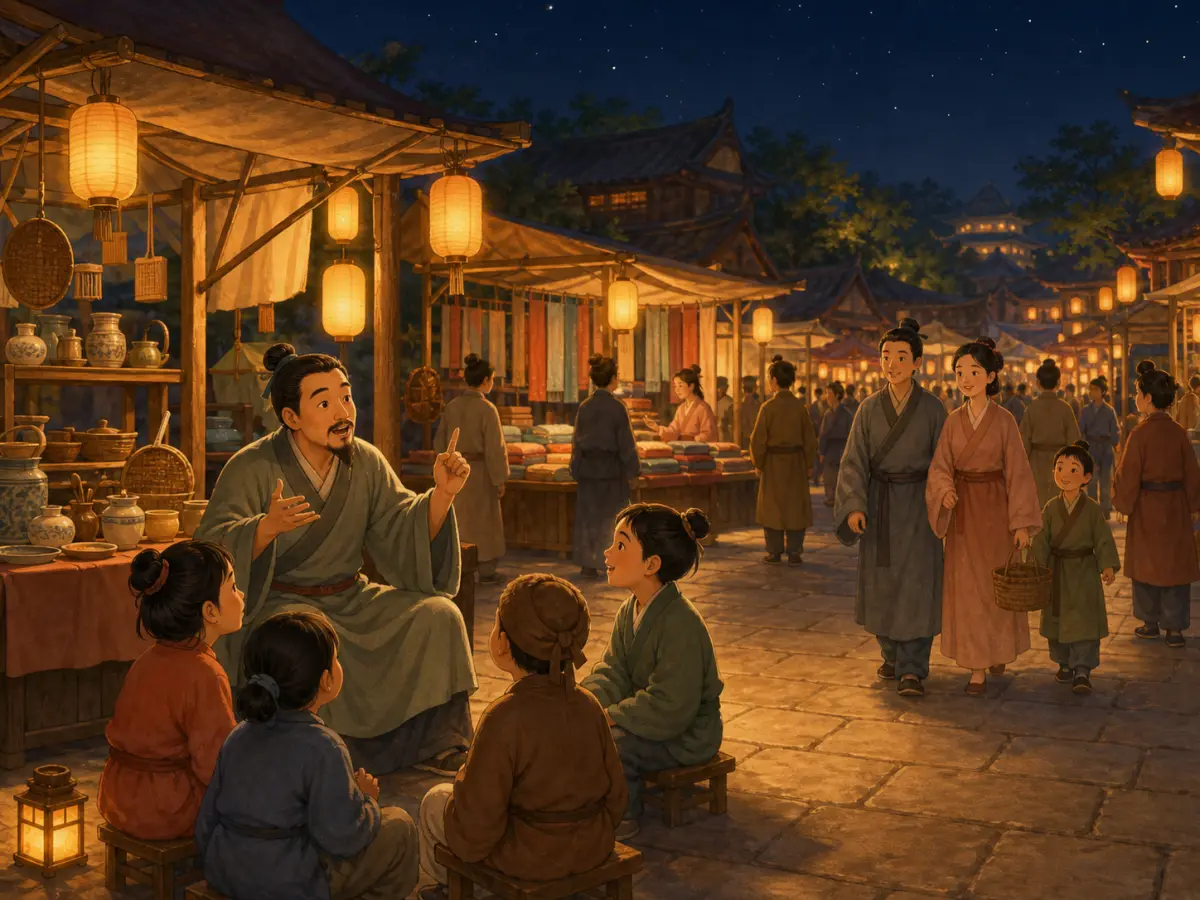
Modern composite illustration: Song texts describe busy night markets, but this orderly lantern-lit street is not a reconstruction of one recorded evening.
再把购物券换到宋朝的开封或杭州,市场地图会明显改变。商业不再只挤在两座围墙大市场里,店铺和摊贩沿街展开,繁华地段还出现了夜市和很早开张的早市。这种变化不是某一天突然发生的:唐代中后期已有商业越出坊市限制,夜间交易也不是宋人才“发明”的;只是到了宋代大城市,做生意的街道更多,开张更早,收摊也更晚。
写北宋开封的孟元老回忆,有些夜市到三更才收,五更又重新开张,最繁忙的地方甚至通宵有人做生意。写南宋杭州的吴自牧也记录了夜市、早市、沿街叫卖和上门服务。这里的“三更”“五更”是当时把夜晚分段的报时方法,并不等于所有宋代商店全年二十四小时营业。作者写的是特定都城和特别繁华的街区;季节、天气、地点、治安和城市规定,都会改变一间店真正开多久。
灯下的繁荣也需要供应链。船夫和脚夫把粮食、燃料与日用品送进人口密集的城市,外地商人和迁居者寻找生计,店家雇人烧火、洗碗、记账,官府则征收商税并管理某些货物流通。顾客中有官员,也有普通家庭、妇女和儿童。夜市不是一座没有规则的现代购物中心,而是许多不同身份的人在有限空间里共同维持的城市生活。
Change the pass again, this time to Song-dynasty Kaifeng or Hangzhou, and the market map looks very different. Trade was no longer squeezed mainly into two walled market compounds. Shops and stalls spread along city streets, and busy districts supported night markets as well as markets that opened before dawn. This did not happen in a single dramatic moment. In the later Tang, trade had already been pushing beyond the walls meant to separate neighborhoods and markets, and people had traded after dark before the Song. What stood out in major Song cities was how many streets commerce filled, how early it began, and how late it lasted.
Meng Yuanlao, writing from memory about Northern Song Kaifeng, said that some night markets lasted until the third watch and opened again at the fifth. In the busiest districts, business could continue through the night. Wu Zimu's account of Southern Song Hangzhou also describes night markets, early markets, street calls, and workers who brought goods or services to people's doors. The “watches” were how people then divided the hours of the night. These passages do not mean that every Song shop stayed open twenty-four hours a day, every day of the year. The authors were describing particular capitals and especially active streets. Season, weather, location, safety, and city rules still shaped how long a real shop could operate.
Lighted streets also depended on a long chain of work. Boat crews and porters brought grain, fuel, and daily necessities into crowded cities. Out-of-town traders and newcomers searched for work. Shop owners hired people to tend fires, wash bowls, move goods, and keep accounts. Officials collected taxes on trade and controlled the movement of some goods. Customers included officials, ordinary households, women, and children. A Song night market was not a rule-free modern shopping mall. It was city life maintained by many people with different jobs and different amounts of power.
Page 4
一座市场怎样“说话”?
How Did a Market Speak?
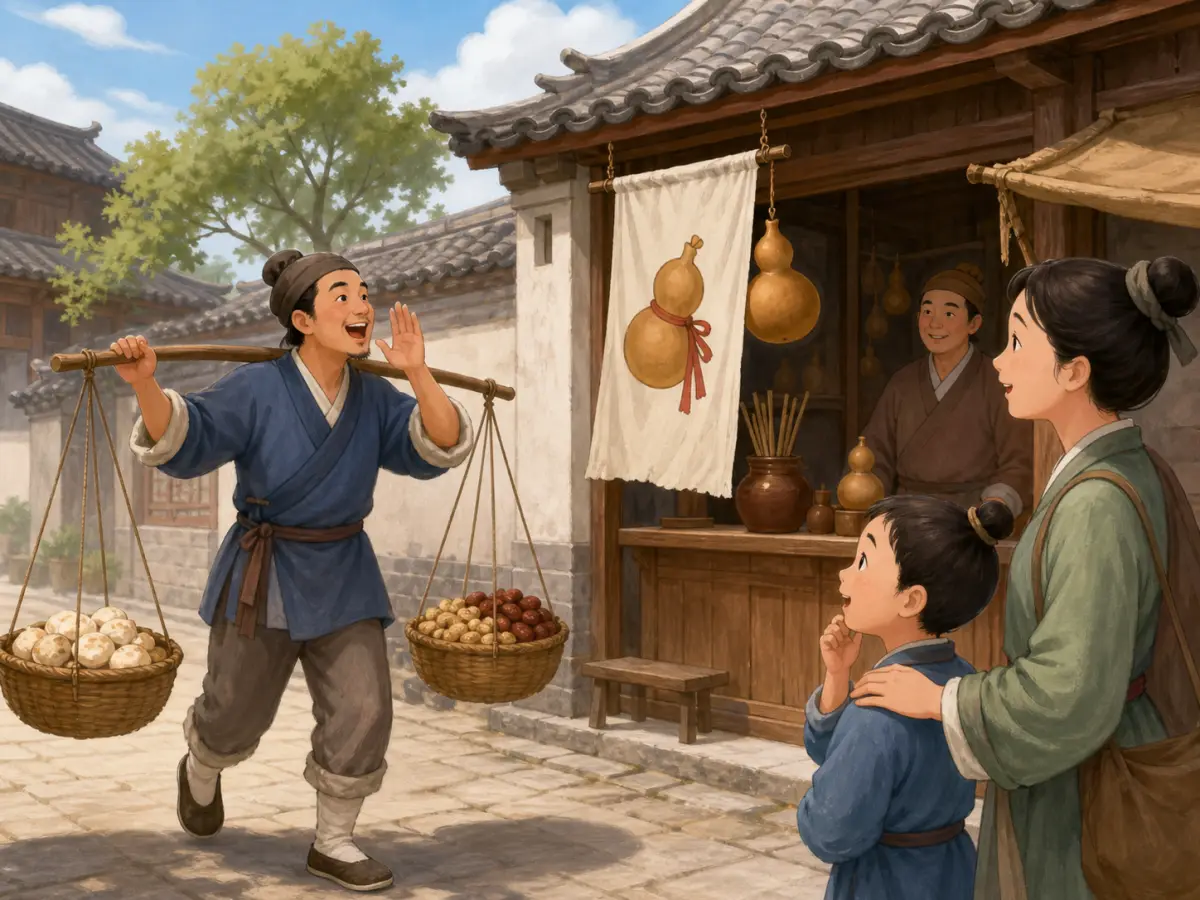
Modern composite illustration: period texts record street calls, but this peddler, cloth sign, and basket of food were designed by the illustrator.
站在街口,就算不识字,你也可能从声音和图形判断附近卖什么。宋代城市笔记记下了沿街“吟叫”的商贩、写着店名的招牌,以及以灯饰、陈设和名号吸引顾客的店铺。这说明城市有自己的“声音地图”和“视觉地图”。不过,旧稿里“糖葫芦一定这样喊、豆腐一定那样喊,某种铁器一定属于某个行业”的整套对白和声音,没有可靠来源就不该当成古代事实。我们可以说叫卖声确实存在,却不能替一位没有留下声音的商贩写台词。
买卖还需要解决一个安静却重要的问题:陌生人怎样互相信任?不同朝代和城市办法不尽相同,但市场管理、校准过的秤和量器、经纪或中间人、账本、契约与赊欠,都可能帮助人们说清数量、价格和付款时间。官员征税和查验,既可能维持秩序,也会增加商人的负担;富商、固定店主、流动小贩和偶尔卖几篮鸡蛋的人,面对规则的能力并不一样。市场的故事因此不只有“卖了什么”,还有“谁定规则、谁承担风险、谁的劳动容易被忽略”。
《清明上河图》给我们一条特别好的线索。张择端的长卷描绘北宋都城开封一带的河运、街道、店铺和人群,后世又画过许多不同版本。我们可以放慢眼睛,观察招牌、车船和人流怎样组织城市;但画家会选择、安排和想象画面,它仍然不是摄像机。读古代市场最好的方法,正像检查那张购物券:先问时间和地点,再问证据来自法律、城市笔记、考古遗物,还是一幅画。这样听见的市场,也许没有编出来的叫卖声那么整齐,却更丰富、更真实。
Even if you could not read, sounds and pictures might help you guess what was nearby. Song urban accounts mention peddlers “singing out” along the streets, written shop names, and businesses using lights, displays, or memorable names to attract attention. The city had a sound map and a visual map. But an old retelling may go too far when it gives every candied-fruit seller one exact call, every tofu seller another, and every trade its own perfectly known noisemaker. If no reliable source preserves those details for the period, they should not be presented as fact. We can say that street calls existed without writing a script for a seller whose voice was never recorded.
Trade also raised a quieter question: How could strangers trust one another? The answer changed across periods and places. Market supervision, checked scales and measuring vessels, brokers, account books, contracts, and credit could all help people agree on quantity, price, and the time of payment. Tax collectors and inspectors could support order, but they could also add to a trader's burden. A wealthy wholesaler, a permanent shopkeeper, a traveling peddler, and someone selling two baskets of eggs did not meet the rules with equal power. A market's history is therefore not only about what people sold. It is also about who made the rules, who carried the risk, and whose work was easy to overlook.
Along the River During the Qingming Festival gives us an especially valuable clue. Zhang Zeduan's long handscroll depicts river transport, streets, shops, and crowds around Northern Song Kaifeng. Many later artists created their own versions. We can look slowly at signs, boats, carts, and streams of people to ask how the city worked. Yet an artist selects, arranges, and imagines; a painting is not a video recording. The best way to read an ancient market is the same way we checked our shopping pass: ask when and where, and then ask whether the evidence comes from a law, a city memoir, an object dug up by archaeologists, or a painting. The result may be less tidy than an invented sales call, but it is far richer - and far more real.
离开市场前
Before You Leave
古代中国没有一座能代表所有时代的“标准市场”。乡村集日让附近村庄周期性相遇;唐代长安的两市显示都城怎样把贸易纳入规划;宋代开封和杭州的街市,则让我们看到商业怎样进入街巷、清晨与夜晚。真正有趣的不是把它们都写成同一条热闹街,而是看清城市、规则和人的生活怎样一起改变。
There was no single “standard market” for every place and period in Chinese history. Rural market days brought nearby communities together at intervals. Chang'an's two great markets show how a Tang capital built trade into its plan. The streets of Song Kaifeng and Hangzhou reveal commerce reaching into lanes, early mornings, and the night. The most interesting story is not one timeless, noisy street. It is how cities, rules, and people's lives changed together.