只看帽子,能认出一个唐朝人吗?
Can a Hat Identify a Man from the Tang Dynasty?
阅读难度 · 困难Reading level · Hard
Page 1
第一条线索:它究竟是巾、帽、冠,还是幞头?
Clue One: Is It a Cloth Wrap, a Cap, a Crown, or a Futou?
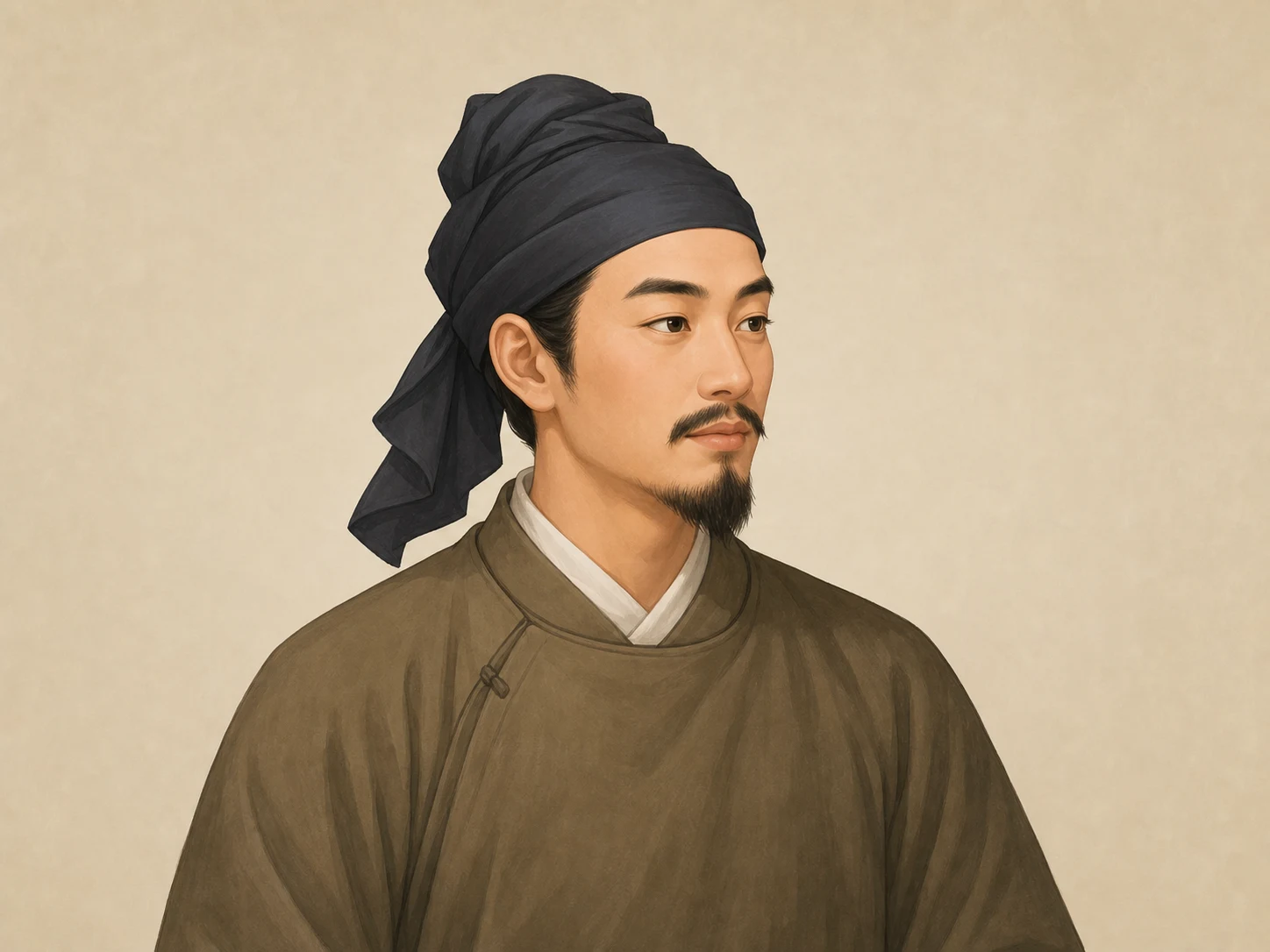
This is a modern image of soft cloth wrapped around the head, not an exact reconstruction of an excavated futou. It helps us imagine a wrapped cloth, but it cannot establish the date, wearer, or tying method.
假设考古队交给你一张人物图,只让你看头顶。你会说那是头巾、帽子,还是官员的冠?这些词在古代并不是永远分得整整齐齐。一般来说,巾让人想到可以包裹的布,帽比较像缝好或做成固定形状的头衣,冠常和礼仪、身份及正式场合有关。可是名称和形状都会随时代改变,不能拿今天的字典给每件古物贴死标签。
A powerful and creative time in China about 1,300 years ago.男子最有代表性的日常头饰之一叫幞头。它在唐朝以前已经出现,早期更像用纱罗或布帛裹住发髻,再把布角系好。唐代工匠又在里面加入叫“巾子”的支撑,使头顶能保持高低、圆尖不同的轮廓。脑后剩下的两个部分常被叫作“脚” - 当然不是真的脚,而是布角或由它发展出的延长部分。
图中人戴着一块柔软的黑布,正好可以让我们提出问题,却不能替我们回答问题。我们看不见布的裁剪、里面有没有巾子,也不知道画家参考了哪个年代。因此,比较诚实的说明不是“这就是初唐男子”,而是“这是一种现代想象的软裹效果”。侦探遇到的第一条规则是:看起来像,不等于已经证明。
Imagine that an archaeology team hands you a picture and lets you see only the top of the person's head. Would you call the object a cloth wrap, a cap, or a formal crown? Historical categories did not always fit into neat boxes. In general, a jin was associated with wrapped cloth, a cap was sewn or formed into shape, and a crown-like headpiece often belonged to ritual, rank, or formal dress. But words and shapes changed over time. A modern dictionary cannot permanently label every old object.
One of the best-known kinds of everyday headwear for men in the A powerful and creative time in China about 1,300 years ago. was the futou. It had appeared before the Tang. Early forms were closer to gauze or cloth wrapped around a hair knot, with the corners tied in place. Tang makers also used an inner support called a jinzi. It could give the top a low, tall, rounded, or pointed outline. The two parts at the back were often called the futou's “feet.” They were not real feet, of course, but cloth corners or extensions that developed from them.
The man in the picture wears soft black cloth, so the image gives us a good question - but not an answer. We cannot see the cloth pattern or the support inside, and we do not know which date the artist used. The honest caption is not “This is an early Tang man.” It is “This is a modern idea of a soft wrapped form.” That is the detective's first rule: looking similar is not the same as being proved.
Page 2
第二条线索:三顶帽子不是一条简单的进化线
Clue Two: Three Hats Are Not a Simple Evolution Line
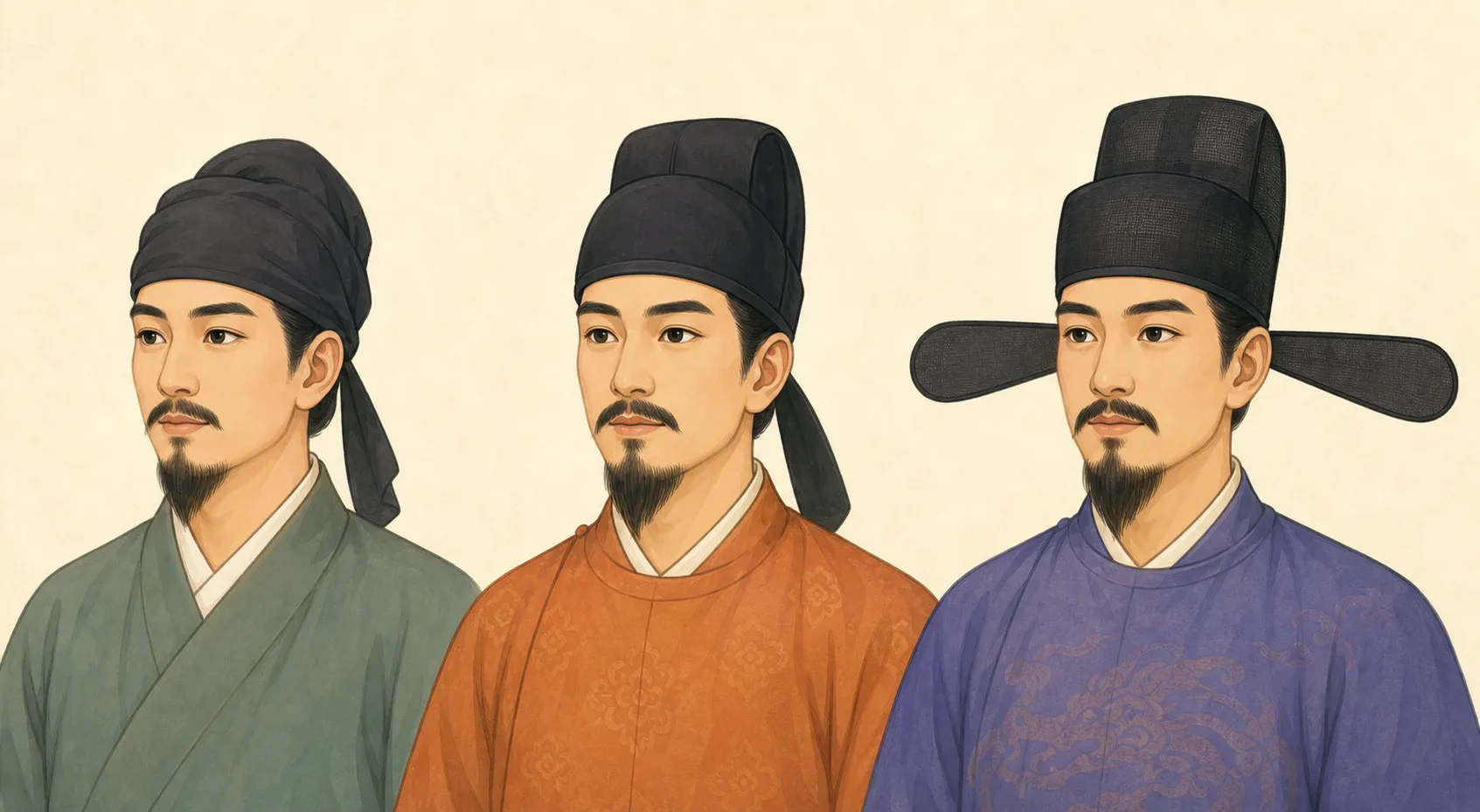
This is a modern diagram, not three securely dated artifacts. The left and center borrow features of softer and stiffer futou. The long horizontal “wings” on the right are more strongly associated with Song and later official hats, not the standard dress of every Tang man.
现在看第二张图:左边柔软,中间硬挺,右边伸出两根很长的“帽翅”。它很容易让人讲出一个顺顺当当的故事 - 唐初人人戴软布,唐中期人人换硬帽,唐末人人长出帽翅。真实历史却更像一棵分叉的树。同一时期可以有不止一种做法,旧式样也不会在新式样出现的那天集体消失。
唐初常见的幞头顶部比较低,脑后的脚可以自然下垂。后来有些式样把内部支撑做高,也用绳、丝或较硬材料帮助两脚抬起。到晚唐,一些幞头已经加上更坚硬的帽架,可以直接戴取,不再只靠现场包裹。接下来的A short, unsettled time after the Tang dynasty when rulers changed quickly.继续试验向上、交叉和其他方向的脚,到了A time in China about 1,000 years ago.,硬而平伸的展脚幞头和许多变化才变得特别醒目。
所以,右边那顶极长的横翅帽更适合帮助我们比较宋代及后世,不能倒过来成为“唐朝官员都这样”的证据。连“脚”也不是永远同一种东西:有的软垂,有的上翘,有的变硬,有的伸展。形状的确能帮助断代,但只有作品的年代、出土地点和人物场合也对得上时,这条线索才有力量。
Now examine the second picture. The left form is soft, the middle one is stiff, and the right one has two very long “wings.” It invites a smooth story: everyone wore soft cloth in the early Tang, everyone changed to a hard cap in the middle, and everyone grew wings by the end. Real history looks more like a branching tree. Several forms could exist at the same time, and an older style did not vanish the day a new one appeared.
Early Tang futou often had a lower top, and the feet at the back could hang softly. Later, some styles used taller inner supports. Cord, silk, or firmer materials could help lift the feet. By the late Tang, some futou had a much harder frame and could be put on like a cap instead of being wrapped each time. Makers in the A short, unsettled time after the Tang dynasty when rulers changed quickly. continued experimenting with upward, crossed, and other arrangements. In the A time in China about 1,000 years ago., stiff futou with horizontal extended feet - and many variations on them - became especially noticeable.
The extremely long horizontal wings on the right therefore work better as a comparison with Song and later hats. They are not evidence that every Tang official looked that way. Even the “feet” were not always the same: they could droop, rise, stiffen, cross, or extend. Shape can help date an image, but the clue becomes strong only when the artwork's date, findspot, and setting agree with it.
Page 3
第三条线索:骑马的人一定是将军吗?
Clue Three: Is Every Rider a General?
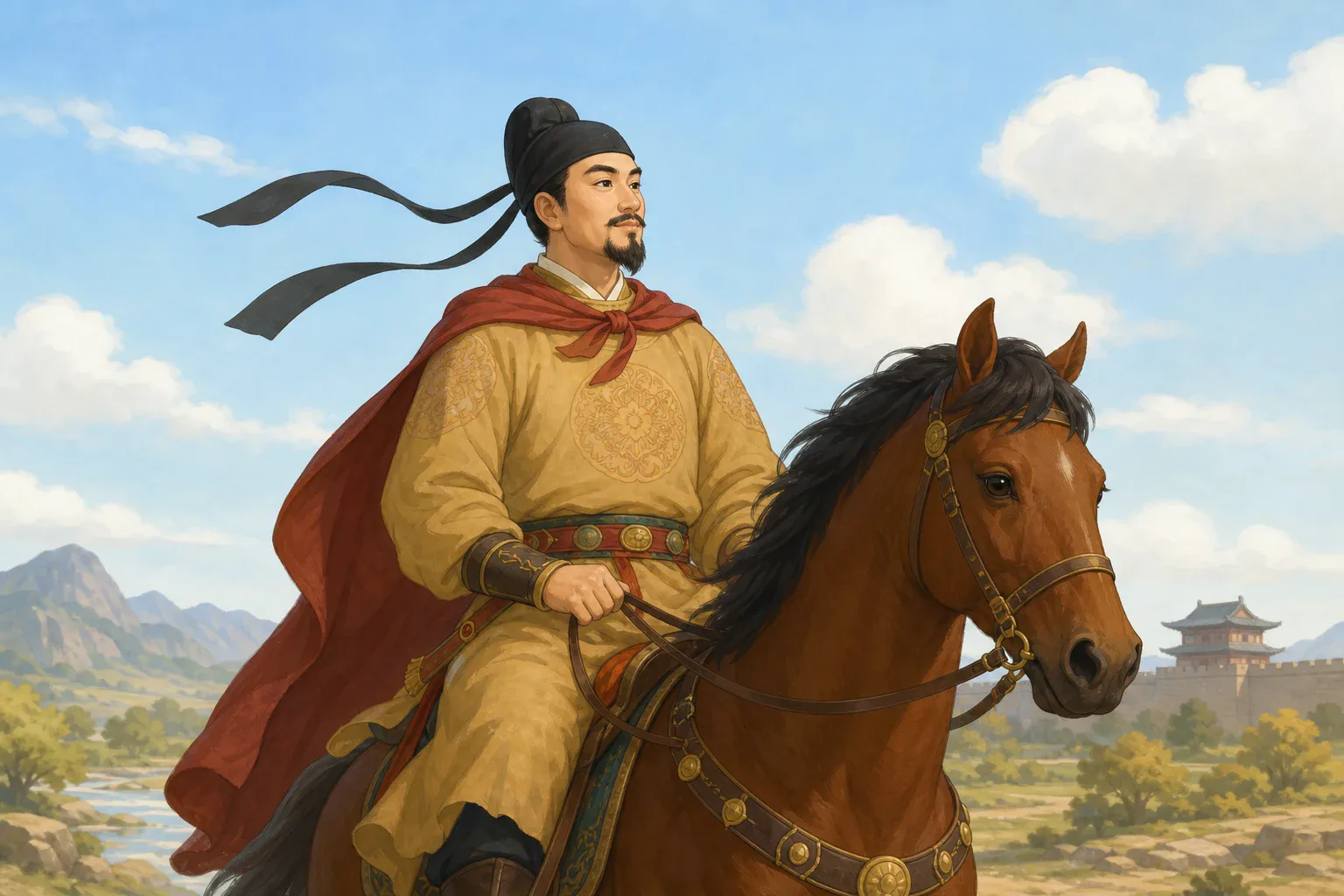
This is a dramatic modern riding scene. Its exaggerated flying streamers do not prove that Tang generals wore them in battle, and a horse, cloak, and hat cannot establish a military rank by themselves.
第三张图里,骑手的长带在风里飞舞,好像一出场就带着将军的气势。可是如果他真在作战,头上更需要的可能是保护头部的盔。唐墓出土的武士俑就有戴盔、穿甲的形象。幞头也许出现在军人不披甲的时候,却不能让我们看见一顶黑帽就喊:“将军来了!”
幞头在唐代使用很广,并不只属于官员。国家博物馆的一件牵马俑戴幞头、穿便于活动的窄袖衣;绘画和俑像里,官员、侍从、表演者和其他男子也可能戴它。反过来,参加礼仪的人可能戴规定的冠,披甲武士可能戴盔,不同地区的人还可能戴软巾、毡帽、卷沿帽或尖顶帽。儿童、劳动者和普通家庭能得到什么材料、正在做什么事,也会影响他们是否包头、怎样包头。
朝廷确实写过冠服规定,用颜色、材料和式样区别身份与场合。但规定告诉我们“应该怎样穿”,不是一张拍下所有街道的照片。有人照办,有人越过限制,有人只在典礼时换装。要猜身份,侦探必须一起看袍服、腰带、鞋、武器、姿势和周围的人物;一顶帽子只能排除一些答案,不能独自宣布答案。
In the third picture, long streamers fly behind a rider and give him the dramatic entrance of a general. In a real battle, however, a soldier might need a helmet to protect his head. Warrior figures from Tang tombs do show helmets worn with armor. A military man might wear a futou when he was not armored, but one black hat is not enough reason to shout, “The general has arrived!”
Futou were used widely in the Tang and did not belong only to officials. One horse-handler figure in the National Museum of China wears a futou with a narrow-sleeved outfit suited to movement. Officials, attendants, performers, and other men may also wear futou in paintings and figures. On the other hand, a participant in a formal ceremony might wear a regulated crown, an armored warrior might wear a helmet, and people in different regions might use soft wraps, felt caps, rolled-brim hats, or pointed caps. What children, workers, and ordinary households could obtain - and what they were doing - also affected whether and how they covered the head.
The court did write dress regulations that connected colors, materials, and forms with rank and occasion. But a regulation tells us how people were supposed to dress. It is not a photograph of every street. Some people obeyed, some crossed the rules, and some changed clothes only for ceremonies. To guess an identity, a detective must also inspect the robe, belt, shoes, weapons, pose, and nearby figures. A hat can remove a few answers, but it cannot announce the answer alone.
Page 4
第四条线索:“胡帽”能证明一个人的族群吗?
Clue Four: Can a “Foreign-Style Hat” Prove Someone's Identity?
唐代的长安和洛阳聚集了来自许多地区的商人、使者、工匠、乐人和军人。随人旅行的还有帽子、布料与做法。墓葬图像里能看到尖顶、卷沿、毡质或其他常被研究者归入“胡帽”的样式;同时,一件被称为“胡人”的骑驼俑也可能戴着唐代常见的软巾幞头。衣服早已在互相借用,不能把帽子当作血统检测器。
古代“胡”字可能笼统指向中原以北、以西或从更远地方来的人和事物,并不是今天一个边界清楚的民族名称。画师和制俑工匠还会使用熟悉的脸形、胡须、姿势与帽子来表现“远方来客”。这些特征可能保留历史信息,也可能经过简化、夸张或套用。
因此,看见尖帽,比较好的问题是:“这种形状还在哪里出现?墓葬在什么地方?有没有题记、随葬品或织物一起作证?”不好的做法是只看帽子或脸,就替一个沉默了一千多年的人决定民族。唐代头饰最有趣的地方,恰恰不是每群人都有永不改变的制服,而是不同做法会旅行、相遇,再被当地人重新制作。
Tang Chang'an and Luoyang brought together merchants, envoys, craftspeople, musicians, and soldiers from many regions. Hats, fabrics, and making techniques traveled with them. Tomb images show pointed, rolled-brim, felt, and other styles that researchers may group under the broad label “foreign-style hats.” At the same time, a camel rider described as a foreign visitor might wear a soft futou common in Tang China. Clothing had already crossed boundaries. A hat is not an ancestry test.
The historical Chinese label hu could refer broadly to people and things from north, west, or much farther away. It was not one modern ethnic group with a clear border. Painters and figure makers also used familiar faces, beards, poses, and hats to represent visitors from distant places. Such details may preserve useful information, but they could also be simplified, exaggerated, or repeated as artistic types.
When we see a pointed cap, the better questions are: “Where else does this shape appear? Where was the tomb? Is there an inscription, another object, or surviving cloth that supports the identification?” The poor method is to use one hat or face to assign an identity to someone who has been silent for more than a thousand years. The most interesting part of Tang headwear is not that every community had an unchanging uniform. It is that styles traveled, met, and were remade by local people.
Page 5
最后一条线索:陶俑和壁画不是街拍
Final Clue: Tomb Figures and Murals Are Not Street Photos
我们今天认识唐代幞头,很大程度上要感谢陶俑、墓室壁画、敦煌壁画和供养人画像。可它们各有自己的任务。墓里的文官俑、武士俑和侍从俑被安排来表现队伍、身份或守护力量;敦煌供养人像画的是资助洞窟和宗教活动的人。工匠会追求好看、庄严或容易识别,不一定把每一条布缝都画下来。
出土地点和画面位置因此非常重要。一顶帽子来自有纪年的墓,还是后来收藏家买来的散件?人物站在墓道入口,还是跟在墓主身后?颜料褪色以后,看似黑色的部分原来是什么颜色?同一种形状如果同时出现在有年代的壁画、俑像和文字里,判断才会越来越稳。
现代复原图又多了一层选择:创作者要猜看不见的背面、材料和系法,还可能为了画面效果放大帽翅或飘带。复原可以帮助我们提出问题,却不能反过来证明自己的猜想。真正可靠的“帽子侦探”会在答案旁边写上把握程度:可能、很可能,或证据还不够。
Much of what we know about Tang futou comes from clay tomb figures, tomb murals, Dunhuang paintings, and portraits of donors. Each source had a job of its own. Civil officials, warriors, and attendants in a tomb could form a procession, display status, or provide symbolic protection. Dunhuang donor portraits showed people who supported a cave and its religious activities. An artist might aim for beauty, dignity, or an easily recognized role without recording every seam in a piece of cloth.
The findspot and position inside an image therefore matter. Did the hat come from a dated tomb, or is it an object later purchased without context? Is the figure guarding an entrance or following the tomb owner? After pigments faded, was a section that now looks black originally another color? A conclusion becomes stronger when the same shape appears in dated murals, figures, and written sources.
A modern reconstruction adds another layer of choices. Its maker must guess at hidden backs, materials, and tying methods, and may enlarge wings or streamers for dramatic effect. A reconstruction can help us form questions, but it cannot prove its own guesses. A careful “hat detective” writes a confidence label beside every answer: possible, probable, or not enough evidence yet.
侦探的答案:帽子是线索,不是身份证
The Detective's Answer: A Hat Is a Clue, Not an ID Card
只看帽子,我们有时能缩小年代范围,也能猜到人物正在参加什么场合;但我们不能稳稳认出他的官职、职业、族群,更不能把宋代的长帽翅倒装给所有唐朝男子。
一顶幞头背后藏着布角、帽架、流行、制度和文化交流。把它和全身服装、出土环境、文字记录及作品用途放在一起,历史才从“黑帽子的故事梗概”变成一场真正有证据的调查。
A hat may help us narrow a date or guess the occasion. It cannot securely identify a person's office, job, or community - and it certainly cannot place the long wings of a Song official's hat on every Tang man.
Behind one futou lie cloth corners, frames, fashion, regulations, and cultural exchange. Only when we combine it with the whole outfit, archaeological context, written records, and the purpose of the artwork does a “story about a black hat” become a real investigation supported by evidence.