一把泥土,怎样烧成会“唱歌”的碗?
How Does Earth Become a Bowl That Rings?
阅读难度 · 困难Reading level · Hard
Page 1
先听一声,再问它为什么会响
First Hear the Ring - Then Ask Why
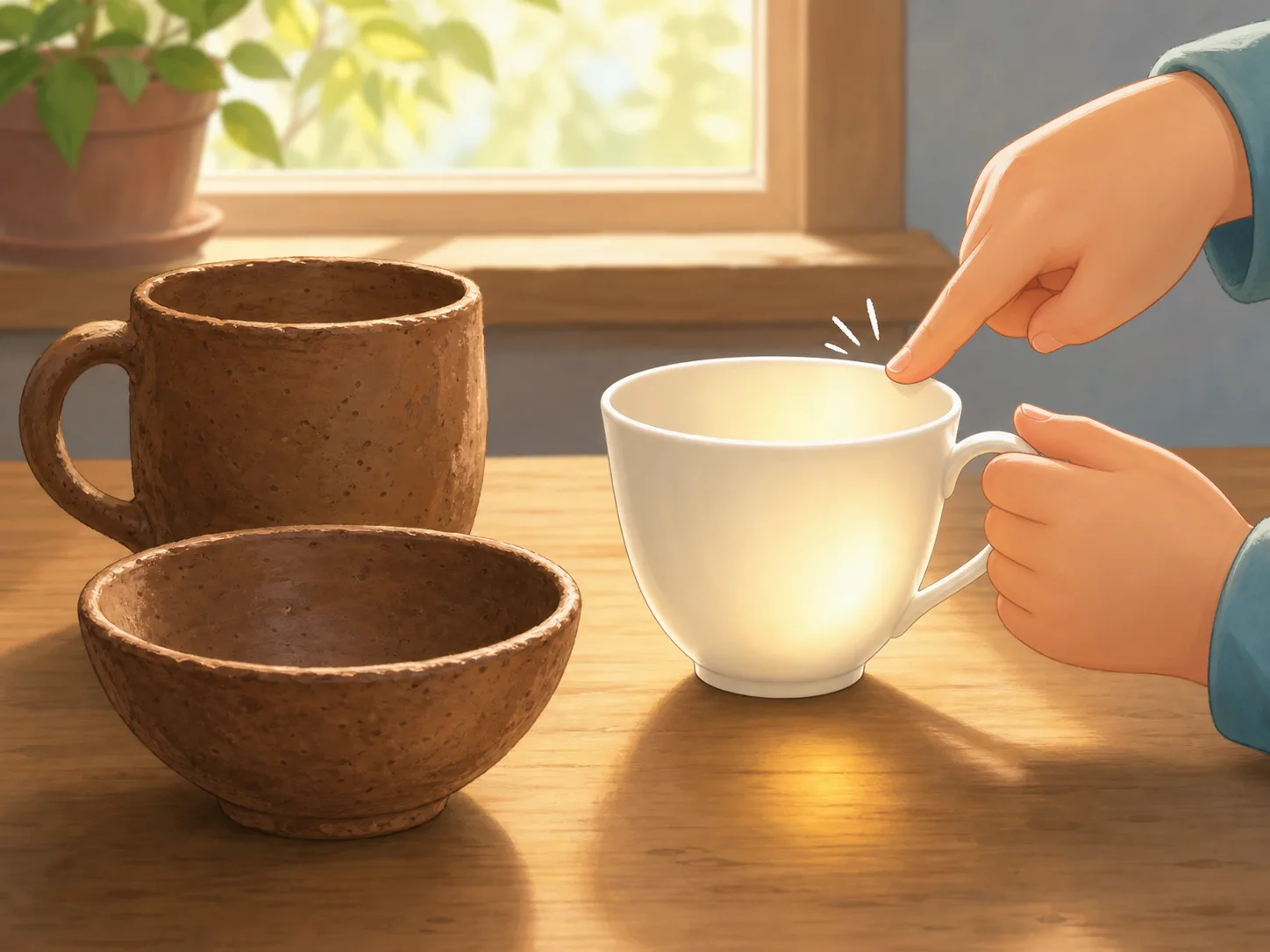
This is a modern illustration, not a scientific test or a photograph of ancient objects. Real ceramics vary in material, thickness, and firing, so color or sound alone cannot identify them.
老师把两只现代教学样品放在桌上:一只胎体较粗,另一只薄而洁白。她轻敲白碗的边缘,叮 - ,声音短短地亮了一下。“它为什么会响?”小安问。“因为它叫瓷器吗?”
“陶器”和“瓷器”并不是两盒永远分得清清楚楚的东西。它们都属于陶瓷,也都要把含有矿物的原料塑形、干燥,再经过烧制。不同原料、温度和窑内气氛,会让成品的硬度、吸水性、颜色与透光程度不同。许多瓷器胎体细密、吸水率低,薄处可能透光,轻敲现代样品时也常有清脆声音;但有的瓷器厚、不白,也不透明,有些高温陶器同样很坚硬。博物馆不会只听一声“叮”就下结论,还要检查胎、釉、烧成痕迹和出土背景。
所以,真正的问题不是“哪一种泥最神奇”,而是:许多代工匠怎样学会挑选原料、控制火候,让松软的土发生连肉眼都看不见的改变?
A teacher sets two modern study pieces on a table. One has a coarse body. The other is thin and pale. She taps the edge of the pale bowl, and a quick, bright ting sounds. “Why does it ring?” asks An. “Is it just because we call it porcelain?”
Pottery and porcelain do not sit in two boxes with a perfectly sharp line between them. Both are ceramics: mineral-rich materials are shaped, dried, and fired. Different ingredients, temperatures, and kiln conditions change a piece's hardness, color, porosity, and translucency. Many porcelains have a dense body that absorbs little water. A thin wall may let light through, and a modern sample may ring when tapped. Yet some porcelain is thick, colored, or opaque, while some high-fired pottery is also extremely hard. A museum does not identify an object from one ting. Specialists examine its body, glaze, firing marks, and archaeological setting.
So the real question is not “Which clay is magical?” It is this: how did generations of craftspeople learn to choose materials and control fire until soft earth changed in ways our eyes cannot even see?
Page 2
没有一位“瓷器发明家”,只有很长的试验路
No Single Inventor - Just a Very Long Trail of Experiments
故事要从青铜时代说起,但不能编出一位突然想通所有步骤的发明家。商周时期,一些工匠已经用含瓷质成分较多的原料制坯,在表面施石灰釉,再用约一千二百度的高温烧制。成品坚硬、吸水较少,已经有后来瓷器的一些特点。今天常把这类器物叫“原始瓷”,意思是它处在早期高温釉陶向成熟瓷器发展的过程中,并不是说工匠“原始”或手艺简单。
可是,陶、原始瓷和成熟瓷之间究竟怎样分类,研究者并非在每个细节上都同意。中国国家博物馆的一件东汉晚期青瓷罐使用高岭土质胎、施釉,并在约一千三百度的高温中烧成;博物馆认为它已经具备成熟瓷器的条件。也有研究把“真正瓷器”放在东汉晚期,把工艺进一步成熟放到三国时期。名称的边界会讨论,实物告诉我们的长线索却很清楚:从商周的原始瓷,到东汉晚期及其后的成熟青瓷,材料配方、釉和控火能力是一步步改善的。
这比“一天发明瓷器”的故事更有意思。每一次成功都建立在以前的窑、以前的失败和工匠传下来的观察上。
The trail begins in China's Bronze Age, but there is no evidence for one inventor who suddenly solved every step. During the Shang and Zhou periods, craftspeople shaped bodies from materials rich in porcelain-making minerals, coated them with a lime glaze, and fired them at temperatures around 1,200°C. The results were hard and absorbed little water. They already had some qualities of later porcelain. Today these wares are often called proto-porcelain. The word describes an early stage in a developing technology; it does not mean the craftspeople were crude or unskilled.
Researchers do not agree on every boundary between pottery, proto-porcelain, and mature porcelain. One late Eastern Han celadon jar in the National Museum of China has a kaolin-rich body, glaze, and a firing temperature around 1,300°C. The museum considers it mature porcelain. Other scholarship places “true porcelain” in the late Eastern Han but says the technology became more fully mature during the Three Kingdoms period. The labels remain open to discussion, but the objects reveal a clear long pattern. From Shang and Zhou proto-porcelain to mature celadon in and after the late Eastern Han, recipes, glazes, and control of the kiln improved step by step.
That is more interesting than a one-day invention story. Each success rested on earlier kilns, earlier failures, and observations passed from craftsperson to craftsperson.
Page 3
一只碗里,藏着石头、水、空气和火
A Bowl Holds Stone, Water, Air, and Fire
来到后来的景德镇,小安看见原料并不像一团现成的白泥。工人先开采、敲碎和淘洗瓷石;在明清时期,许多配方还把瓷石和高岭土混合。瓷石中有受热后能帮助胎体熔合的矿物,高岭土则能扩大可用的烧成温度范围,让较大、较复杂的器物更不容易在高温中变形。但各地、各时代的配方不同,不能说瓷器只等于“纯高岭土”,更不能说世界上只有中国有这些原料。
淘洗后的细料要沉淀、脱水和练泥,再由不同工匠拉坯、印坯或雕塑。坯体必须慢慢干燥;水分不均,碗就可能开裂。接着施釉。釉不是泥土自己长出的“天然外皮”,而是另外配制、涂在胎体表面的材料。高温下,胎中的一些矿物彼此熔合,形成玻璃质与晶体交织的致密结构;釉也熔成覆盖表面的玻璃质层。冷却以后,一团会被水泡软的泥,才变成不容易吸水的坚硬器物。
每一步都有风险:坯可能歪,釉可能流,器物还可能粘上灰或彼此粘住。工匠常把器物装进耐火的“匣钵”再入窑,像给它套上保护盒。窑工还要安排位置、添燃料、看火与通风,并判断何时停火。真正的变化发生在专业高温窑中;孩子不能用家用烤箱试烧,也不要自己靠近正在工作的窑。
In later Jingdezhen, An discovers that the raw material does not arrive as ready-made white clay. Workers mine, crush, and wash porcelain stone. During the Ming and Qing periods, many recipes combined that stone with kaolin. Some minerals in porcelain stone melt enough to help the body fuse. Kaolin widens the useful firing range, allowing larger or more complicated forms to hold their shape at high heat. Recipes differed by place and period, however. Porcelain is not simply “pure kaolin,” and these useful minerals do not exist only in China.
The fine washed material must settle, lose water, and be kneaded before different specialists throw, press-mold, or sculpt it. The body then dries slowly; uneven moisture can make a bowl crack. Next comes the glaze. Glaze is not a “natural skin” that grows out of clay. It is a separately prepared material applied to the body. In the kiln, some minerals in the body fuse into a dense structure of glassy material and crystals. The glaze melts into a glassy surface layer. Only after cooling has mud that water could soften become a hard object that absorbs very little water.
Every step carries risk. A body may warp. Glaze may run. Ash may land on a piece, or two objects may stick together. Craftspeople often place wares inside heat-resistant containers called saggars before loading the kiln, rather like giving each piece a protective box. Kiln workers arrange the load, add fuel, manage airflow, read the fire, and decide when firing should stop. This transformation belongs in a professional high-temperature kiln. Children should never try it in a kitchen oven or approach a working kiln on their own.
Page 4
青花的蓝,是跨过山海的颜色
The Blue in Blue-and-White Crossed Mountains and Seas
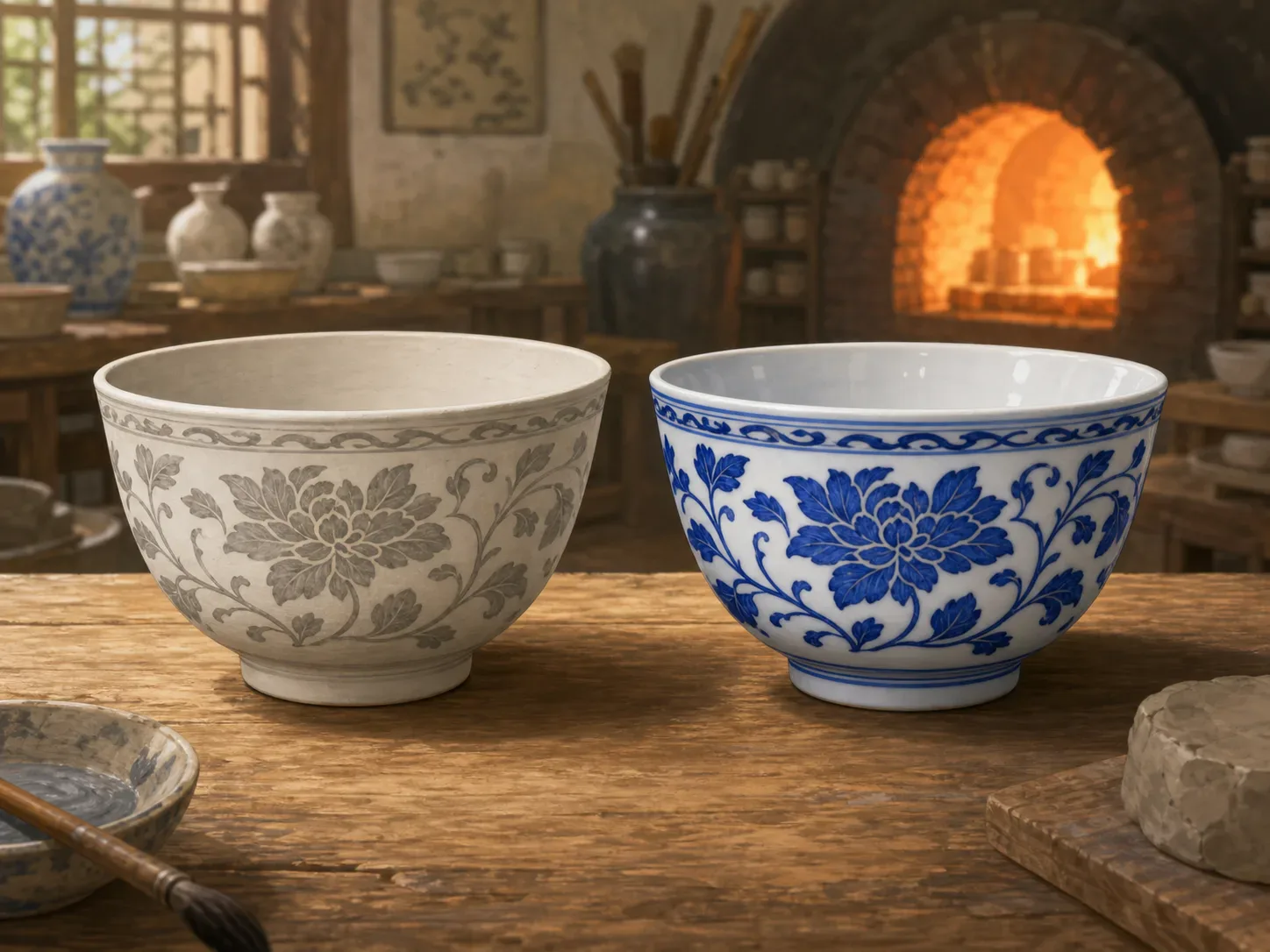
This is a modern imagined workshop, not a photograph of a Yuan kiln. Cobalt pigment may look gray or dark before firing, and its fired blue varies with the material, recipe, and kiln conditions.
画工在干燥的白坯上落下一笔颜色。它现在灰暗,隔着透明釉进窑以后,却可能显出深蓝。这就是许多青花瓷的基本方法:用含钴的颜料在胎上绘画,再罩透明釉烧成。火不是把普通蓝颜料“叫醒”,而是让钴在特定材料和窑内条件下呈色;温度、氧气和钴料成分不同,蓝色可能鲜亮,也可能发灰、发黑,甚至出现浓重斑点。
唐代已经有少量早期青花器物。到了元代,景德镇工匠改进胎、釉和烧制方法,大型青花瓷生产迅速发展。十四、十五世纪使用的一部分钴料来自西亚,而许多元代青花又是为西亚市场制作的。于是,一只碗会同时带着江西工匠的技术、跨越陆路和海路而来的材料,以及远方顾客喜爱的尺寸和图案。西亚工匠也在自己的石英质陶胎上重新创造蓝白器物,加入当地的形状和纹样。这是一场来回的交流,不是一条只从中国向外走的单行路。
青花很有名,却不等于全部中国瓷器。青瓷、白瓷、黑釉瓷、彩釉瓷,以及釉下或釉上绘彩,都讲着不同的材料和审美故事。要认识中国瓷器,不能只记住一种蓝。
A painter lays a dark stroke on a dry pale body. After it enters the kiln beneath a clear glaze, it may emerge deep blue. That is the basic method behind much blue-and-white porcelain: paint the body with a cobalt-bearing pigment, cover it with transparent glaze, and fire it. The kiln is not “waking up” ordinary blue paint. Cobalt produces color through particular materials and firing conditions. Changes in temperature, oxygen, and the pigment itself can make the blue bright, grayish, almost black, or heavily spotted.
A small number of early blue-and-white wares survive from the Tang period. In the Yuan dynasty, Jingdezhen craftspeople refined bodies, glazes, and firing, and large-scale blue-and-white production expanded. Some cobalt used in the fourteenth and fifteenth centuries came from West Asia, while many Yuan blue-and-white objects were made for West Asian customers. One bowl could therefore hold Jingdezhen knowledge, material carried across land and sea, and sizes or designs desired far away. West Asian potters also recreated blue-and-white effects on their own quartz-rich stonepaste, adding local shapes and patterns. This was an exchange moving in several directions, not a one-way road leading out of China.
Blue-and-white became famous, but it is not all Chinese porcelain. Celadon, white wares, black glazes, colored glazes, and painting under or over the glaze tell different stories about materials and taste. To know Chinese porcelain, we need to see more than one blue.
Page 5
景德镇不是一座窑,而是一张会合作的网
Jingdezhen Was Not One Kiln but a Network of Hands
景德镇也不是从古至今唯一的“瓷都”。唐宋时期,越窑、邢窑、定窑、龙泉窑等许多窑场各有名声。景德镇的制瓷业在宋代继续发展,元代因青花等产品更加重要;到明清时期,它成为全国影响力极大的生产中心,朝廷还在那里设置为宫廷制瓷的御窑。它的重要地位是逐渐形成的,不是皇帝说一句话就突然出现。
御窑之外,还有庞大的民窑与作坊。历史上,官府订制和监督的器物有时也会借民窑的窑位烧成;民窑则为本地生活、国内市场和海外订单生产各种器物。二者不是永远隔开的两个世界,也不能把所有精美瓷器都说成皇帝专用。
小安这才发现,一只碗没有唯一的“作者”。有人采石、淘洗原料,有人练泥和制坯;修坯工把碗壁削匀,画工有人勾线、有人填色,另有人施釉、做匣钵、搬运和装窑。烧窑工守着火和气流,商人、船工与码头工人再把成品送往别处。精细分工可以提高技术,却也提醒我们:器底即使只有一个年号或窑名,背后仍有许多没有留下姓名的劳动者。没有可靠记录时,我们不能编出“每烧一千件才成功一件”这样的数字;真实的损耗会随窑、器形、时期和质量要求改变。
Jingdezhen was not China's one and only “porcelain capital” for all time. In the Tang and Song periods, many centers - including Yue, Xing, Ding, and Longquan kilns - were celebrated for different wares. Jingdezhen's industry continued to grow during the Song and became increasingly important for products such as blue-and-white in the Yuan. During the Ming and Qing periods, it developed into a production center with enormous influence across China, and the court established imperial kilns there. Its importance grew over time; it did not appear suddenly because an emperor spoke one sentence.
Beyond the imperial works stood a vast world of private kilns and workshops. At times, officially ordered and supervised wares were fired in space rented from private kilns. Private businesses made objects for local households, markets across China, and overseas customers. The two systems were not always sealed apart, and fine porcelain was not made only for emperors.
An now realizes that a bowl has no single author. People mined stone and washed raw materials. Others kneaded clay and formed bodies. Trimmers thinned and evened the walls. Some painters drew outlines while others filled in color. Still more people glazed, made saggars, carried loads, and packed kilns. Fire crews watched heat and airflow, while merchants, sailors, and dockworkers moved finished pieces onward. Specialization could raise skill, but it also reminds us that one reign mark or kiln name may hide many workers whose names were never recorded. Without dependable records, we should not invent claims such as “only one piece in a thousand survived.” Real losses changed with the kiln, shape, period, and standard of quality.
Page 6
当瓷器出海,“中国制造”也在远方改变
As Porcelain Traveled, It Changed Far from China Too
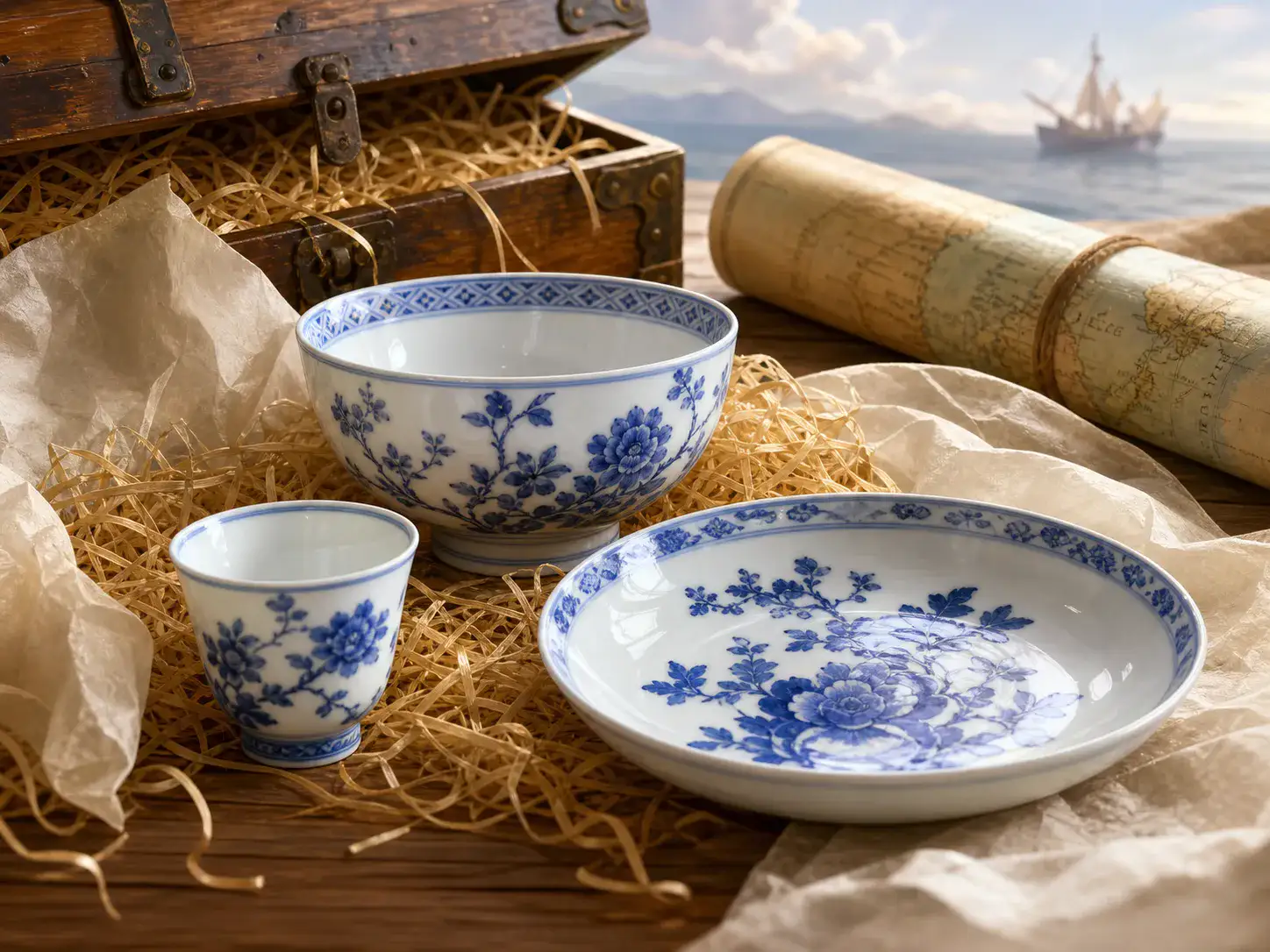
This modern imagined scene combines porcelain, a chest, a map, and a sailing ship. It does not record one real voyage. Actual trade crossed many periods and involved merchants, sailors, colonial companies, and customers in many places.
英语中,小写的 china 可以指瓷器。这个词让人看到,中国外销瓷曾经深深影响英语世界的日常生活。不过,瓷器出海并不只是“外国人惊叹中国宝物”的故事。工匠会按订单改变尺寸、纹样和器形;一件十六世纪为葡萄牙市场制作的景德镇执壶,借用了西亚器形,还画上葡萄牙纹章 - 纹章甚至被倒着画了。误读、试做和混合,也属于全球艺术史。
十七、十八世纪,欧洲的特许贸易公司用庞大的海上网络运送中国和日本瓷器。贸易带来利润、收藏热和新餐具,也和欧洲殖民扩张及不平等权力纠缠在一起。欧洲工匠不断试验自己的配方;1709年前后,德国迈森成功制出硬质瓷,1710年建立工厂。此后,各地工匠并没有只做“较差的中国复制品”,而是把学来的材料、形状和图案重新组合,发展出本地产品。西亚、中国、日本、欧洲以及其他地区的制作者和顾客,都在这张交流网中改变了瓷器。
故事回到桌边。小安不再敲第二次,因为老师提醒他:练习样品可以在允许时观察,古董和博物馆藏品却不能随便触碰。他改为迎着灯看碗壁,再找釉面、足底和画笔留下的线索。那一声“叮”只用了半秒,背后的答案却穿过几千年的试验、许多双手和很远的海。
In English, lowercase china can mean porcelain. The word hints at how deeply exported Chinese wares entered everyday life in the English-speaking world. Yet overseas porcelain is not simply a tale of foreigners marveling at Chinese treasure. Workshops changed sizes, patterns, and shapes to fit orders. One sixteenth-century Jingdezhen ewer made for the Portuguese market borrowed a West Asian form and carried a Portuguese coat of arms - which the painter placed upside down. Misreading, testing, and mixing are part of global art history too.
In the seventeenth and eighteenth centuries, European chartered trading companies carried Chinese and Japanese porcelain through vast maritime networks. The trade created profit, collecting crazes, and new tableware, but it was also entangled with European colonial expansion and unequal power. European makers kept testing their own recipes. Around 1709, Meissen in Germany succeeded in making hard-paste porcelain, and a factory was founded there in 1710. Makers elsewhere did not simply produce “worse Chinese copies.” They recombined materials, forms, and designs into local wares. Producers and customers in West Asia, China, Japan, Europe, and beyond all changed porcelain within this web of exchange.
Back at the table, An does not tap again. The teacher explains that a study piece may be examined with permission, but antiques and museum objects must never be handled casually. Instead, An holds the bowl toward a lamp and looks for clues in the glaze, foot, and brush lines. That first ting lasted half a second. Its answer stretches across thousands of years of experiments, many pairs of hands, and a very wide sea.
小结:一只碗不是一个人的魔法
In Summary: A Bowl Is Not One Person's Magic
瓷器从来不只是“白泥加大火”。它来自长期发展的材料知识、制坯和施釉技术、专业窑炉里的高温控制,也来自采料工、画工、匣钵工、窑工、搬运者与商人的合作。商周原始瓷和东汉以后成熟瓷器之间没有一个简单的发明瞬间;景德镇的地位也在宋、元、明、清不同阶段逐渐变化。
青花瓷把中国技术、钴料与跨地区市场连在一起,却只是中国瓷器众多传统中的一种。瓷器越过海洋以后,各地工匠继续模仿、误读、改造和创新。真正会“唱歌”的,不只是一只碗,也是许多时代和许多人的故事。
Porcelain was never just “white clay plus a hotter fire.” It grew from long-developed knowledge of materials, forming, glazing, and high-temperature kiln control. It also depended on miners, painters, saggar makers, fire crews, carriers, and merchants working together. There was no single invention moment between Shang and Zhou proto-porcelain and mature porcelain in and after the Eastern Han. Jingdezhen's place in the story also changed across the Song, Yuan, Ming, and Qing periods.
Blue-and-white joined Chinese technology, cobalt, and markets across regions, but it was only one of China's many porcelain traditions. Once porcelain crossed the sea, makers elsewhere continued to imitate, misunderstand, reshape, and invent. The thing that truly “rings” is not only one bowl. It is a story made by many people across many times.