四根弦,为什么像藏着一支乐队?
How Can Four Strings Sound Like a Whole Band?
阅读难度 · 中等Reading level · Medium
Page 1
先别猜故事,先数一数声音
Before Guessing the Story, Count the Sounds
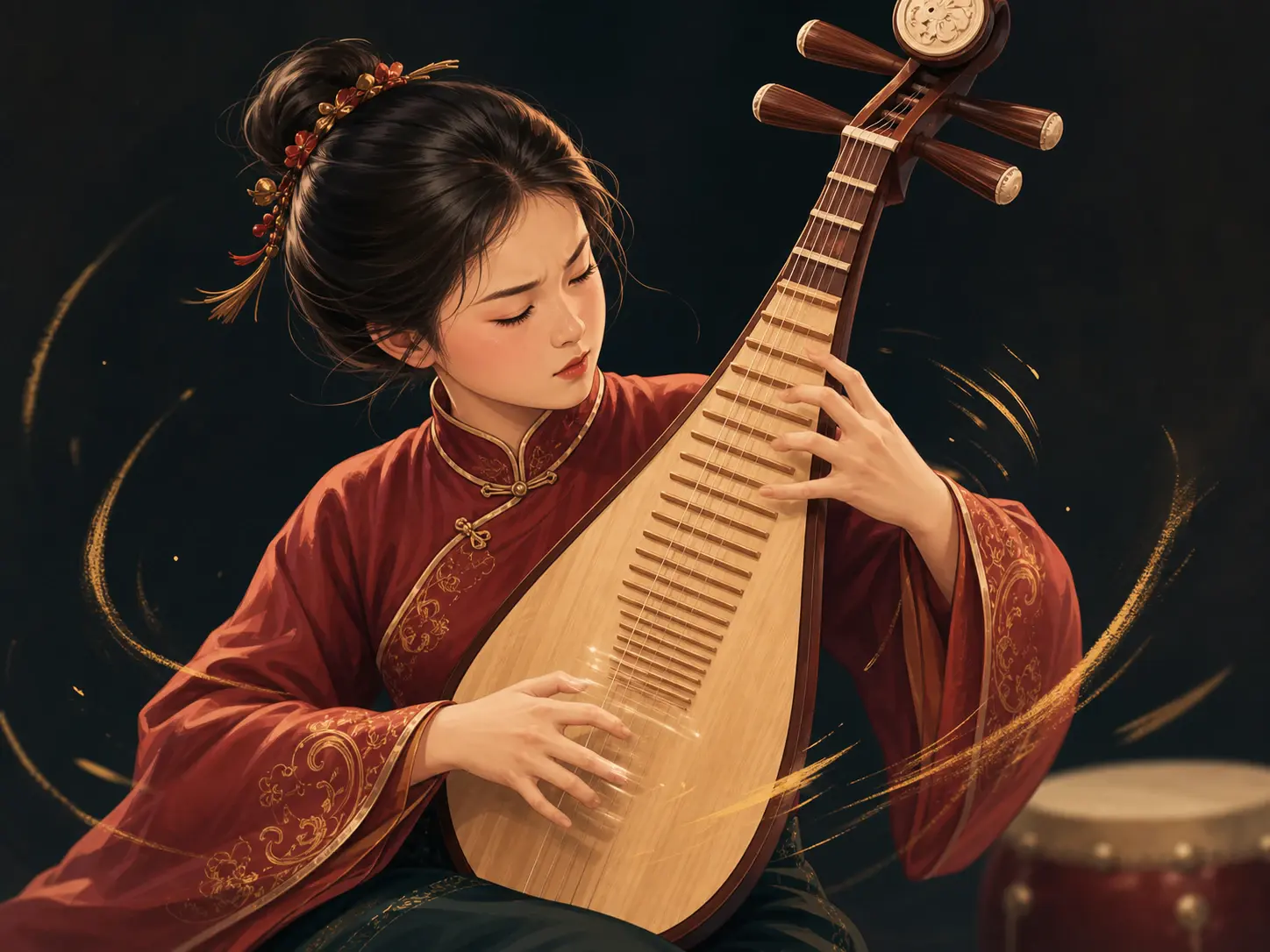
This is a modern generated stage scene, not a photograph of a particular musician. The instrument and hands are artistically simplified; use it only to notice the upright position, raised frets, and the different jobs of the two hands.
听一小段琵琶录音,先不要看曲名。你能数出几种声音?也许有一颗颗清楚的单音,一串几乎连成线的轮指,一下掠过几根弦的扫拂,还有被左手推高、拉低或揉动的音。某些曲子甚至会让人联想到鼓点、金属碰撞、流水或风,但这些画面来自演奏方法和听者联想,不是琴里真的藏了鼓和马。
现代琵琶通常有四根弦。右手可以弹、挑、滚、轮、扫、拂,让声音一颗一颗出现,也能让同一个音快速重复,仿佛拉长了;左手在凸起的相和品之间按弦,还能推、拉、揉、滑,改变音高和音色。四根弦配上十个手指,组合已经很多。
可以做一个安全的听觉记录:每听见一种新音色,就在纸上画一种线 - 短点、长线、锯齿或波浪。不要触碰别人的乐器,也不要模仿大力扫弦;钢弦张力高,琴面、相品和假指甲都需要正确方法。这个活动不是猜“标准答案”,而是训练耳朵分辨同一把琴怎样换角色。
Listen to a short pipa recording without looking at the title. How many kinds of sound can you count? You may hear separate, sparkling notes; a finger roll that turns into one long stream; a sweep across several strings; and pitches that the left hand bends, slides, or gently shakes. Some music may remind listeners of drums, clashing metal, water, or wind. Those pictures come from playing techniques and imagination - not from real drums or horses hidden inside the instrument.
A modern pipa usually has four strings. The right hand can pluck outward and inward, repeat notes, roll the fingers, or sweep several strings. It can make sounds appear one by one or repeat a note so quickly that it seems to stretch. The left hand presses between raised frets and can push, pull, shake, or slide a string to change pitch and tone color. Four strings plus ten fingers already make a huge number of combinations.
Try a safe listening record. Each time you hear a new tone color, draw a different kind of mark on paper: a dot, long line, zigzag, or wave. Do not touch someone else’s instrument or imitate a forceful sweep. Steel strings are under tension, and the soundboard, frets, and artificial nails require proper technique. This activity is not about guessing one “correct answer.” It trains your ears to notice how one instrument keeps changing jobs.
Page 2
“琵琶”先是一个大名字,后来才越来越专指今天这把琴
Pipa Began as a Broad Name Before It Meant Today’s Instrument
早期文献用“批把”等写法解释向前、向后拨弦的动作,“琵琶”也曾泛指不止一种弹拨乐器。与此同时,带曲颈、梨形琴身的四弦弹拨乐器沿中亚交通路线进入中国。人员迁徙、宫廷和城市演出、贸易往来以及乐师相互学习,让外来的形制和曲调在本地不断改变。现代琵琶不是某个人在某一天“发明”的,也不能简单说成一位异国客人换了中国衣服。
早期曲项四弦琵琶常横抱,右手拿拨片弹丝弦。唐代前后,横抱和斜抱的图像仍很多,同时用手指拨弦、把琴抱得更直的做法逐渐发展。后来琴背变得较平,琴身上增加更多品位,左手可用的音域扩大,右手指弹也形成许多细致技法。变化不是整齐地在一个朝代交界处同时完成,各地传统还可能保留不同形制和抱法。
相和品就是琴颈与面板上凸起的音位。古代和近现代琵琶的相品数量并不一样;20世纪的常见专业琵琶进一步增加到六相二十四品左右,并按现代乐队需要调整音位。看一幅唐代乐伎图时,不能把画中横抱、拨片和较少音品的琴,悄悄换成今天竖抱、戴假指甲的舞台琵琶。
Early texts used forms of the word pipa to describe forward and backward plucking. The name could also refer broadly to more than one kind of plucked instrument. Meanwhile, a four-stringed lute with a bent neck and pear-shaped body traveled into China along routes through Central Asia. Migration, trade, court and city performances, and musicians learning from one another changed both instruments and music. The modern pipa was not “invented” by one person on one day. Nor was it simply a foreign visitor dressed in Chinese clothes.
Early bent-neck, four-stringed pipas were often held across the body and played with a plectrum on silk strings. Around the Tang period, images still show many horizontal and slanted instruments, while finger plucking and a more upright position gradually developed. Over time, the back became flatter, more frets were added to the body, the left hand gained a wider range, and right-hand finger playing grew more detailed. These changes did not all happen neatly at one dynasty line. Regional traditions could keep different shapes and playing positions.
The raised stops on the neck and soundboard are called xiang and pin. Their number changed across historical and modern pipas. During the twentieth century, a common professional form developed with about six xiang and twenty-four pin, with pitch positions adjusted for modern ensemble needs. When we look at a Tang image, we should not quietly replace its horizontal instrument, plectrum, and fewer stops with today’s upright concert pipa and artificial nails.
Page 3
敦煌的“反弹琵琶”,首先是一幅宗教乐舞图像
Dunhuang’s Backward Pipa Is First of All a Religious Dance Image
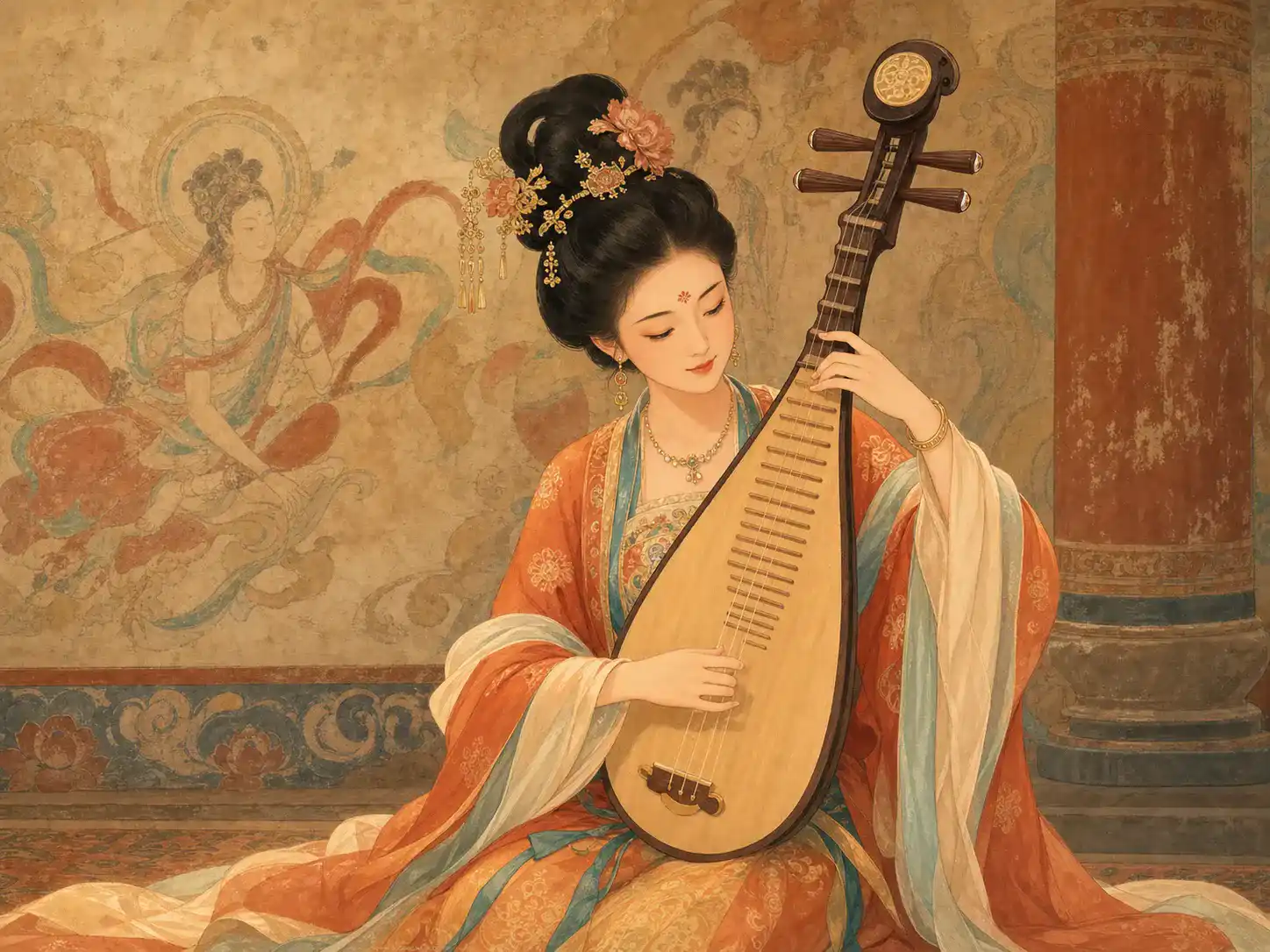
This is a modern generated image. The foreground player holds something close to a modern upright pipa, while the background only imagines a Dunhuang-mural style. It is not a copy of the mural in Mogao Cave 112.
莫高窟第112窟的中唐壁画里,中央舞者把琵琶举到背后,左右还有两组乐师。整幅乐舞位于佛教经变画中,用音乐、舞蹈与华丽建筑表现佛国净土的庄严和欢乐。画中动作首先属于宗教艺术与舞蹈形象,不是一页分步骤教人演奏的课本。
现代舞台把这个姿势发展成“反弹琵琶”的敦煌舞形象。人当然能在背后碰到琴弦,舞者也能训练出有控制的动作;可是壁画本身不能证明唐代乐师经常用这种姿势完成复杂琵琶曲。最稳妥的读法是:画工把乐器、身体和飘带组织成一个有速度感的瞬间,而现实演奏与艺术夸张之间的界线仍值得研究。
壁画也让我们看见,音乐史不只有作品名和男性大师。女性乐伎在宫廷与大众娱乐之间传递和创造音乐;寺院画工把乐舞画进信仰空间;无名制琴工匠选择木料、安装弦轴和音品;城市与地方艺人把曲调教给下一代。到了近现代,失明的无锡民间音乐家阿炳还留下三首琵琶录音。身体障碍不是天才来源,但录音保存了一个过去常被文字忽略的演奏者声音。
In a mid-Tang mural in Mogao Cave 112, the central dancer lifts a pipa behind the body while two groups of musicians sit on either side. The music and dance belong to a Buddhist transformation painting. Together with splendid buildings, they help picture the dignity and joy of a Pure Land. The pose is first of all part of religious art and dance imagery - not a step-by-step lesson in how to play.
Modern theater has developed this pose into a famous image in Dunhuang-inspired dance. A person can certainly reach strings behind the body, and dancers can train the movement carefully. But the mural itself cannot prove that Tang musicians regularly performed difficult pipa pieces this way. A responsible reading says that workshop artists organized instrument, body, and flowing ribbons into one energetic moment. The boundary between practical playing and artistic exaggeration remains a question.
The mural also reminds us that music history is more than titles and famous men. Female musicians carried and created music between court and popular entertainment. Temple painters placed music and dance inside sacred spaces. Unnamed instrument makers selected wood and fitted tuning pegs and frets. Urban and regional performers taught music to the next generation. In modern times, Abing, a blind folk musician from Wuxi, left recordings of three pipa pieces. Disability did not create his talent, but the recordings preserved the voice of a performer whom written history might otherwise have missed.
Page 4
《琵琶行》让我们听见比喻,不等于给了录音
The Song of the Pipa Player Gives Us Metaphors, Not a Recording

This is a modern imagined scene inspired by The Song of the Pipa Player. It is not a portrait of Bai Juyi or the musician, and it does not reconstruct a river meeting in 816. The pipa shown is close to a modern form.
白居易的长诗《琵琶行》把一场江边听琴写得非常具体:粗弦“如急雨”,细弦“如私语”,密集声音又像“大珠小珠落玉盘”。这些句子厉害的地方,不是准确测出古琴弦的分贝或速度,而是把听觉变成雨、谈话和滚动珠子的触感,让没有听过现场的人也能在脑中建造声音。
诗中还让一位技艺高超的女性乐人讲述人生起落,诗人再把她的漂泊与自己的贬谪相照。它能帮助我们讨论唐代社会怎样想象和书写职业女乐人的劳动、年龄与处境,却不能直接当成法院笔录或现场录音。学者甚至会讨论序文和相遇情节有多少文学建构;儿童文章不该擅自确定月色、座位、表情和每一句对话。
不过,文学不是“假的所以没用”。《琵琶行》真实保存了诗人怎样用语言理解音乐,也深深影响后人听琵琶的方式。我们可以沿着比喻再回到声音:轮指真的像雨吗?低弦一定比高弦“粗声”吗?不同演奏者会给同一句诗怎样不同的答案?
Bai Juyi’s long poem The Song of the Pipa Player makes a riverside performance feel wonderfully specific. Thick strings sound “like sudden rain,” thin strings “like whispered words,” and mixed notes become “large and small pearls falling on a jade plate.” The lines are powerful not because they measure an old instrument’s speed or loudness. They turn hearing into the touch and motion of rain, speech, and rolling pearls, letting readers build sound in their minds.
The poem also gives a highly skilled woman musician a story of changing fortune, then compares her displacement with the poet’s own demotion. It can help us discuss how Tang literature imagined the work, aging, and social position of professional women musicians. But it is not a court transcript or field recording. Scholars even debate how much of the preface and meeting is literary construction. A children’s article should not invent the exact moon, seats, faces, and dialogue.
That does not make literature “false and useless.” The poem truly preserves how Bai Juyi used language to understand music, and it has deeply influenced the way later listeners hear the pipa. We can follow its metaphors back to sound. Does a finger roll really remind you of rain? Must a low string sound “thicker” than a high one? How might two performers give different answers to the same line of poetry?
Page 5
《十面埋伏》讲战争,却不是汉代战场录音
Ambush from Ten Sides Tells of War - but It Is Not a Han-Era Recording
《十面埋伏》和《霸王卸甲》都以楚汉战争为题材。扫弦、绞弦、快速弹挑和模拟锣鼓的音型,能让听者联想到列阵、交战和奔逃;段落标题还会提示故事进展。可是公元前202年的战场没有留下琵琶录音,今天的梨形四弦琵琶当时也尚未形成。音乐表现的是后人记忆和想象中的战争。
我们较早能核对到的印刷曲谱,是1818或1819年前后出版的华秋苹《琵琶谱》。《十面埋伏》当时题作《十面》,《霸王卸甲》也收入其中,但作品的最初作者和准确创作年代并不清楚。此后不同流派、师徒和演奏家增删段落、选择指法、调整速度,形成多个版本。曲名古老、故事发生得更古老,都不等于今天的每一个音符直接从汉代传来。
人们常用“文曲”和“武曲”帮助听者比较:有些曲子偏重细腻旋律、推揉余韵,有些强调节奏、力度和戏剧场面。《十面埋伏》常称武曲,但这不是把所有琵琶音乐切成绝对两半的自然法则。同一首曲子可以有安静与激烈段落,同一种技法也能服务完全不同的情绪。
Ambush from Ten Sides and The Warlord Removes His Armor both take the Chu - Han war as their subject. Sweeps, bent strings, rapid plucking, and patterns that resemble gongs or drums can suggest armies forming, fighting, and fleeing. Section titles help guide the story. But no pipa recording survives from the battlefield of 202 BCE, and today’s pear-shaped four-stringed pipa had not yet taken form. The music presents a war remembered and imagined by later people.
The earliest printed score that we can examine closely comes from the pipa collection edited by Hua Qiuping and published around 1818 or 1819. Ambush from Ten Sides appeared there as Ten Sides, alongside The Warlord Removes His Armor. Their first composers and exact dates are not securely known. Later schools, teachers, students, and performers added or removed sections, chose fingerings, and adjusted speed, creating several versions. An old title - and an even older story - does not mean that every note traveled unchanged from the Han era.
People often compare “civil” and “martial” pieces. Some music gives more attention to delicate melody, bent notes, and fading sound, while other music emphasizes rhythm, force, and dramatic scenes. Ambush from Ten Sides is usually called martial, but these labels are not a law of nature dividing every pipa piece into two perfect boxes. One work may contain both quiet and violent moments, and the same technique can serve very different feelings.
Page 6
换一根弦,也会改变整套声音
Change a String, and the Whole Sound System Changes
过去琵琶与“丝竹”中的“丝”有关,常用捻制丝弦。20世纪中期以后,专业舞台常见的琵琶普遍改用钢丝弦或尼龙缠钢弦,声音更明亮、音量更大,也更适合大型音乐厅和现代民族管弦乐队。金属弦较硬,天然指甲不容易承受,演奏者便把塑料等材料制成的假指甲固定在右手指上。
相品也增加并按十二平均律排列,使演奏者更方便与现代乐队合作,扩展新曲目的音域。可是改变不是简单的“新的一定更好”。丝弦较柔和的触感、旧式相品的音高关系和地方演奏味道,也可能随着标准化而改变。今天已有研究者重新试验丝弦和旧琴,比较材料怎样影响轮指、按音与听觉习惯。
现代琵琶可以独奏、重奏、进入民族管弦乐队,也会和弦乐四重奏、电子声响或世界各地乐器合作。声音变大,背后仍有许多人:演奏者、作曲家、记录旧谱的人、修琴与制琴工匠,以及负责扩声的工作人员。现在回到开头:四根弦像一支乐队,不是因为琵琶拥有魔法,而是材料、结构、十个手指、传承和听者想象一起工作。
The “silk” in the old phrase “silk and bamboo music” included twisted silk strings on instruments such as the pipa. After the mid-1900s, professional concert pipas commonly changed to steel or nylon-wound steel strings. The sound became brighter and louder, which helped in large halls and modern Chinese orchestras. Metal strings are hard on natural fingernails, so players began fastening artificial nails made from plastic and similar materials to the fingers of the right hand.
More raised stops were added and arranged for the twelve-tone equal-tempered system, making it easier to work with modern ensembles and widening the range for new pieces. But change is not simply a story in which “new is always better.” The softer touch of silk, the pitch relationships of older frets, and regional styles can shift when instruments become standardized. Some researchers and musicians are now testing silk strings and older instruments again to compare how materials change finger rolls, bent notes, and listening habits.
The modern pipa can play alone, in small groups, or in a Chinese orchestra. It can also meet a string quartet, electronics, or instruments from many parts of the world. Behind the louder sound are still many people: performers, composers, score collectors, repairers, instrument makers, and audio workers. Now return to our first question. Four strings can sound like a whole band not because the pipa contains magic, but because materials, structure, ten fingers, musical traditions, and listeners’ imaginations work together.
小结
In Summary
琵琶从一个与拨弦动作和多种弹拨乐器有关的名字,逐渐成为今天这把曲项、梨形、四弦的乐器。中亚交通带来的琴、唐代横抱与拨片、后来竖抱指弹、不断增加的相品,以及现代钢弦和假指甲,都是它变化中的一段,不是一次完成的发明。
听琵琶还要分清证据:《琵琶行》给我们文学比喻,敦煌壁画给我们宗教乐舞图像,古谱和录音给我们不同年代的声音线索。把它们放在一起而不混成一段电影,我们才真正听见四根弦背后的许多人和许多时代。
Pipa began as a name connected with plucking motions and several kinds of plucked instruments. Over time, it came to mean today’s bent-neck, pear-shaped, four-stringed lute. Instruments moving through Central Asian routes, Tang horizontal playing and plectrums, later upright finger playing, added frets, and modern steel strings and artificial nails are all chapters in its change - not one moment of invention.
Listening also means separating kinds of evidence. The Song of the Pipa Player gives us literary metaphors. Dunhuang murals give us Buddhist music-and-dance imagery. Old scores and recordings give us sound clues from different periods. When we connect them without melting them into one movie, we can finally hear the many people and many centuries behind four strings.