剪一刀,为什么能变成一圈花?
How Can One Cut Become a Ring of Flowers?
阅读难度 · 中等Reading level · Medium
Page 1
展开以前,图案藏在哪里?
Where Does the Pattern Hide Before the Paper Opens?
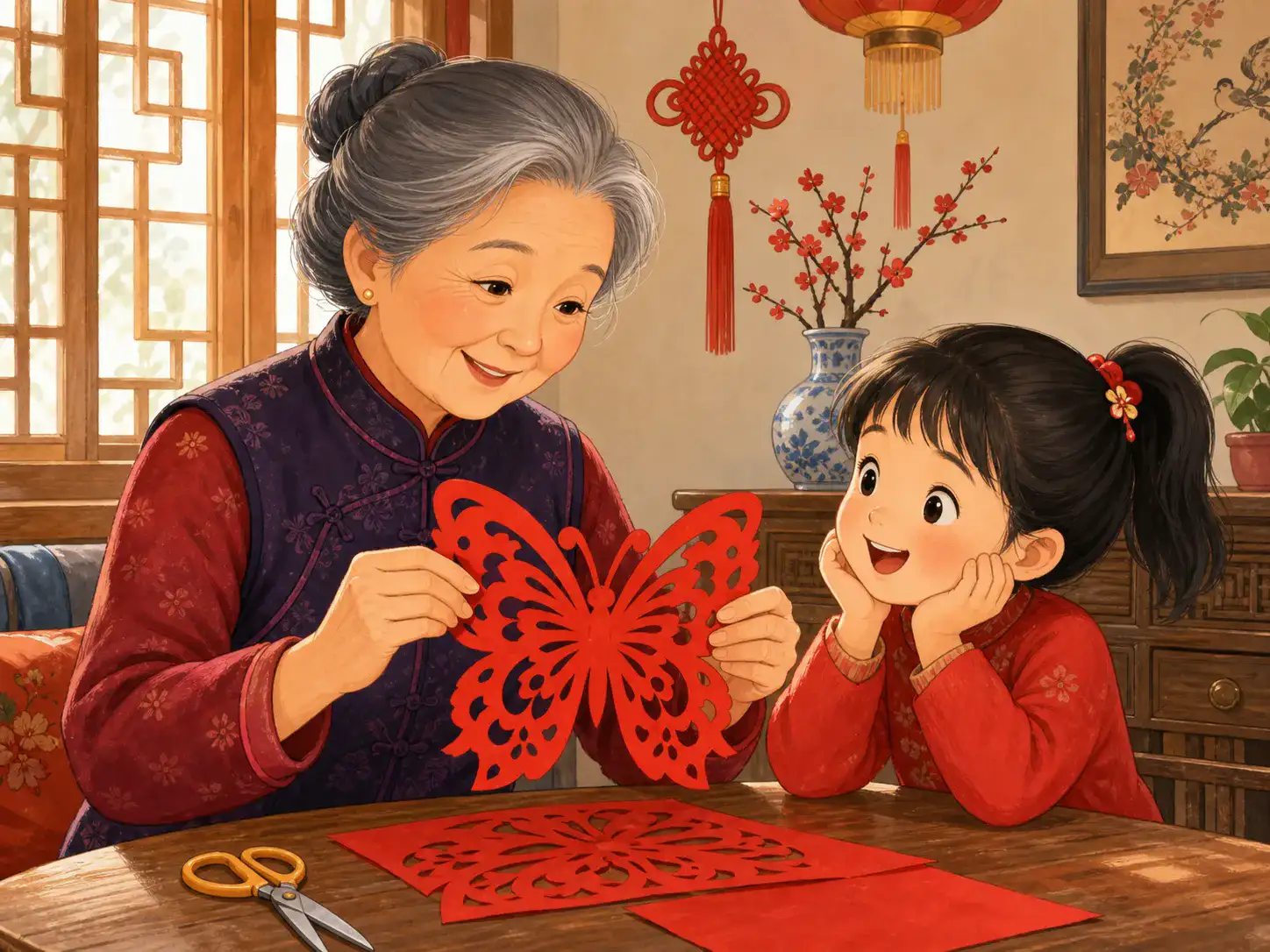
This is a modern imagined family scene, not a photograph of a particular tradition bearer. Children should use child-safe scissors with adult supervision; craft knives are for trained users.
拿一张干净的新手工纸,对折一次,再用儿童安全剪刀在折边旁剪出半颗心。打开纸,两边竟然合成了一颗完整的心。秘密不是魔法,而是折痕像一面镜子:剪刀只走了一次,同样的边线却在纸的两半上同时出现。再把纸折成四层或八层,一个缺口就会重复成一圈花纹。不过,不能把连接各部分的“小桥”全剪断,不然展开时只会掉出许多碎片。
这只是剪纸的一种办法。有些人拿着剪刀,一边剪一边转动纸张,可以做出不对称的人物、动物和生活场景;有些人把几层纸固定在软垫上,用刻刀沿画稿刻出细线,一次做出多张。还有人先刻出主要轮廓,再在背后贴上不同颜色的纸,叫套色;也有人在浅色纸上点染颜色。剪、刻、折、染和贴可以互相组合,所以“剪纸”并不一定只用剪刀,也不一定都是红色、对称的图案。
Take a clean sheet of new craft paper, fold it once, and use child-safe scissors to cut half a heart beside the fold. Open the paper, and the two sides join into one complete heart. The secret is not magic. The fold works like a mirror: the scissors travel once, but the same edge appears on both halves. Fold the sheet into four or eight layers, and one notch can repeat into a ring. Just do not cut every little “bridge” that holds the parts together, or the design will open as a pile of scraps.
That is only one method. Some artists use scissors while turning the paper to create people, animals, or scenes that are not symmetrical. Others fasten several sheets on a soft cutting surface and follow a drawing with a knife, producing several detailed copies at once. An artist may cut a main outline and paste colored papers behind it, a method called color lining, or brush dyes onto pale paper. Cutting, carving, folding, dyeing, and layering can work together. “Paper-cut” does not always mean scissors, red paper, or a symmetrical design.
Page 2
纸以前有镂空,纸以后才有真正的剪纸
Cutout Traditions Came First; Paper-Cuts Required Paper
纸出现以前,人们已经会在金属薄片、皮革、丝织物和树叶上剪、刻出镂空花纹。这些做法和后来的剪纸有亲缘关系,却不能直接叫“纸剪”。中国在西汉已经有植物纤维纸;到了东汉,蔡伦扩大原料来源、改进制作技术,使纸更实用。可是没有证据证明蔡伦改进造纸以后,某个人立刻“发明了剪纸”。材料、工具、价格、节日和日常需要一起变化,这门手艺才慢慢形成。
纸怕水、火、虫和反复触摸,早期作品很难保存。目前所知较早的一批真正纸剪,是新疆吐鲁番阿斯塔那墓地出土的北朝团花,距今约一千五百年。其中有花朵以及马、猴、蝴蝶等重复图案,说明当时的制作者已经会多次折纸,再剪出均衡的环形纹样。它们能保存下来,与当地干燥环境和墓葬条件有关。没有留下来的作品也许曾经很多,所以“目前发现最早”不等于“剪纸就是那一天开始的”。
Before paper existed, people already cut openwork patterns into thin metal, leather, silk, and leaves. Those practices are related to later paper-cutting, but they are not literally paper-cuts. Plant-fiber paper existed in China during the Western Han period. In the Eastern Han, Cai Lun expanded the range of raw materials and improved papermaking, helping make paper more useful. But no evidence shows that someone “invented paper-cutting” immediately after Cai Lun's work. Materials, tools, cost, celebrations, and daily needs changed together as the craft slowly took shape.
Paper is easily damaged by water, fire, insects, and handling, so early examples rarely survive. Some of the earliest known physical paper-cuts in China are Northern Dynasties rosettes excavated from tombs at Astana near Turpan in Xinjiang, dating from about 1,500 years ago. Their repeated designs include flowers, horses, monkeys, and butterflies. They show that makers already knew how to fold paper several times and cut a balanced circular pattern. The dry climate and sealed tombs helped them survive. Many earlier works may have disappeared, so “earliest yet found” does not mean “the craft began on that day.”
Page 3
一张窗花,到底在说什么?
What Is a Window Paper-Cut Actually Saying?
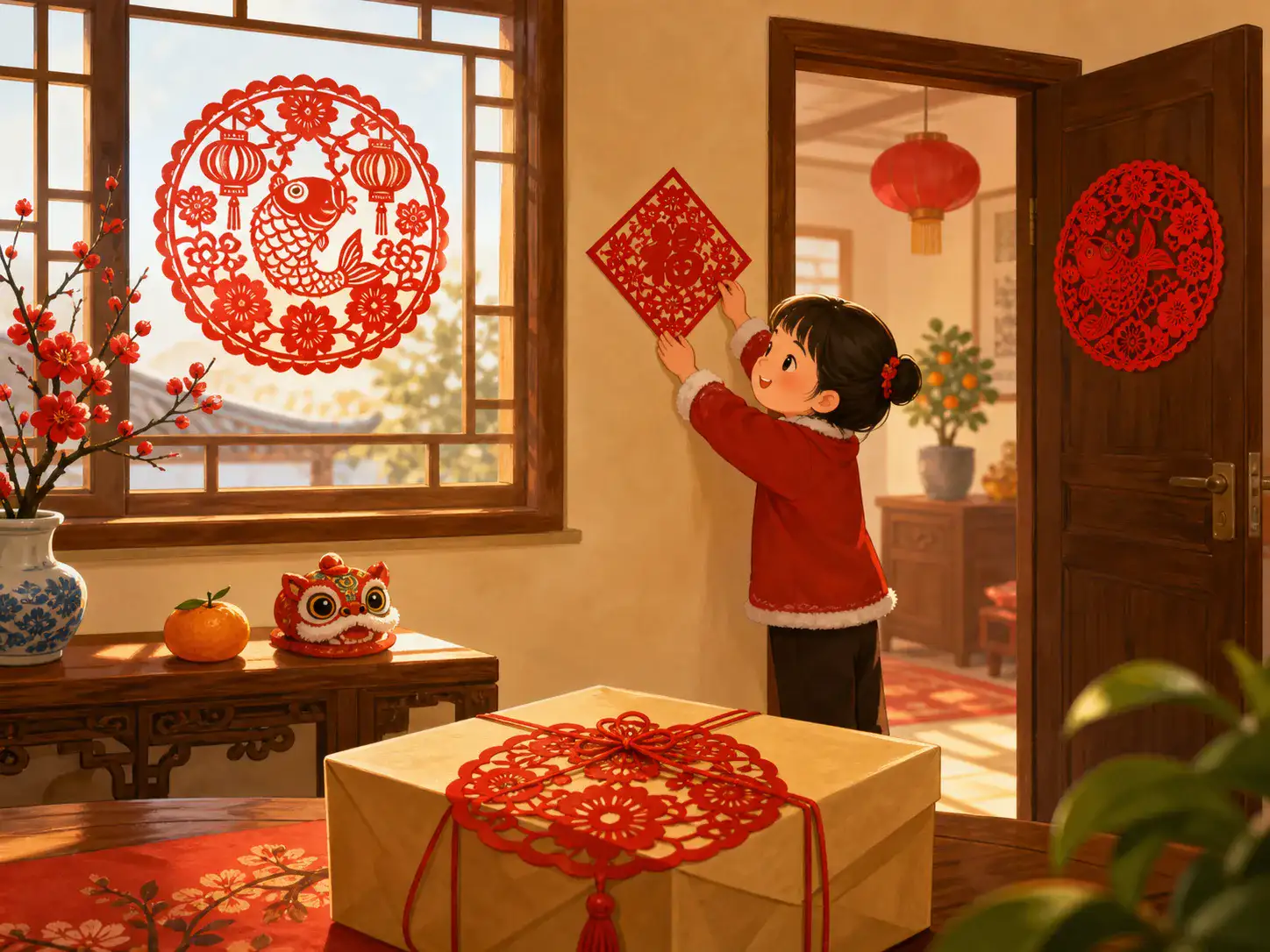
This modern holiday scene mixes window, doorway, and gift decorations. It is not one region's required arrangement, and its red fish is only one possible festive design.
剪纸的名字常常来自用途。贴在窗上的可以叫窗花;婚礼或其他喜庆场合使用的有喜花;有些小花样不是最后的装饰,而是贴在鞋面、枕套或衣服上,给刺绣者当底样。还有灯花、礼花、门笺以及配合地方仪式使用的纸花。同一种图案换了颜色、位置或场合,意思可能就不一样,不能看见红纸便一律翻译成“春节好运”。
图案也不是一本全国通用的密码字典。在一些吉祥组合中,“鱼”和“余”同音,可以表示生活有富余;“蝠”和“福”声音相近,蝙蝠可以借来表示福气;莲和鱼放在一起,有时借“莲 - 连、鱼 - 余”的音表达“连年有余”;多籽的石榴也常和家族兴旺的愿望相连。可是鱼也可以只是河边生活的记忆,莲花可以与宗教、季节或地方审美有关。要读懂一幅剪纸,还得问是谁做的、给谁用、在哪里、什么日子使用,不能只查一个“图案寓意表”。
Paper-cuts are often named for their use. A design pasted on a window can be called a “window flower.” Weddings and other celebrations may use “happiness flowers.” Some small patterns are not final decorations at all. They are guides placed on shoes, pillowcases, or clothing for an embroiderer to follow. There are also lantern decorations, gift papers, doorway hangings, and paper forms used in local ceremonies. Change the color, location, or occasion, and the meaning may change. Red paper does not always translate as “good luck for Lunar New Year.”
Motifs are not a single codebook for all of China, either. In some lucky combinations, the word for fish, yu, sounds like a word for having extra, so a fish can suggest plenty. The word for bat, fu, sounds like the word for good fortune. Lotus and fish may work together through the sounds “lotus - continuous” and “fish - extra” to wish for plenty year after year. A pomegranate full of seeds may express hopes for a growing family. Yet a fish can also remember life beside a river, and a lotus may carry religious, seasonal, or local meanings. To understand one paper-cut, ask who made it, for whom, where, and for what occasion. A motif chart is not enough.
Page 4
“北方粗、南方细”为什么不够?
Why “Bold North, Delicate South” Is Not Enough
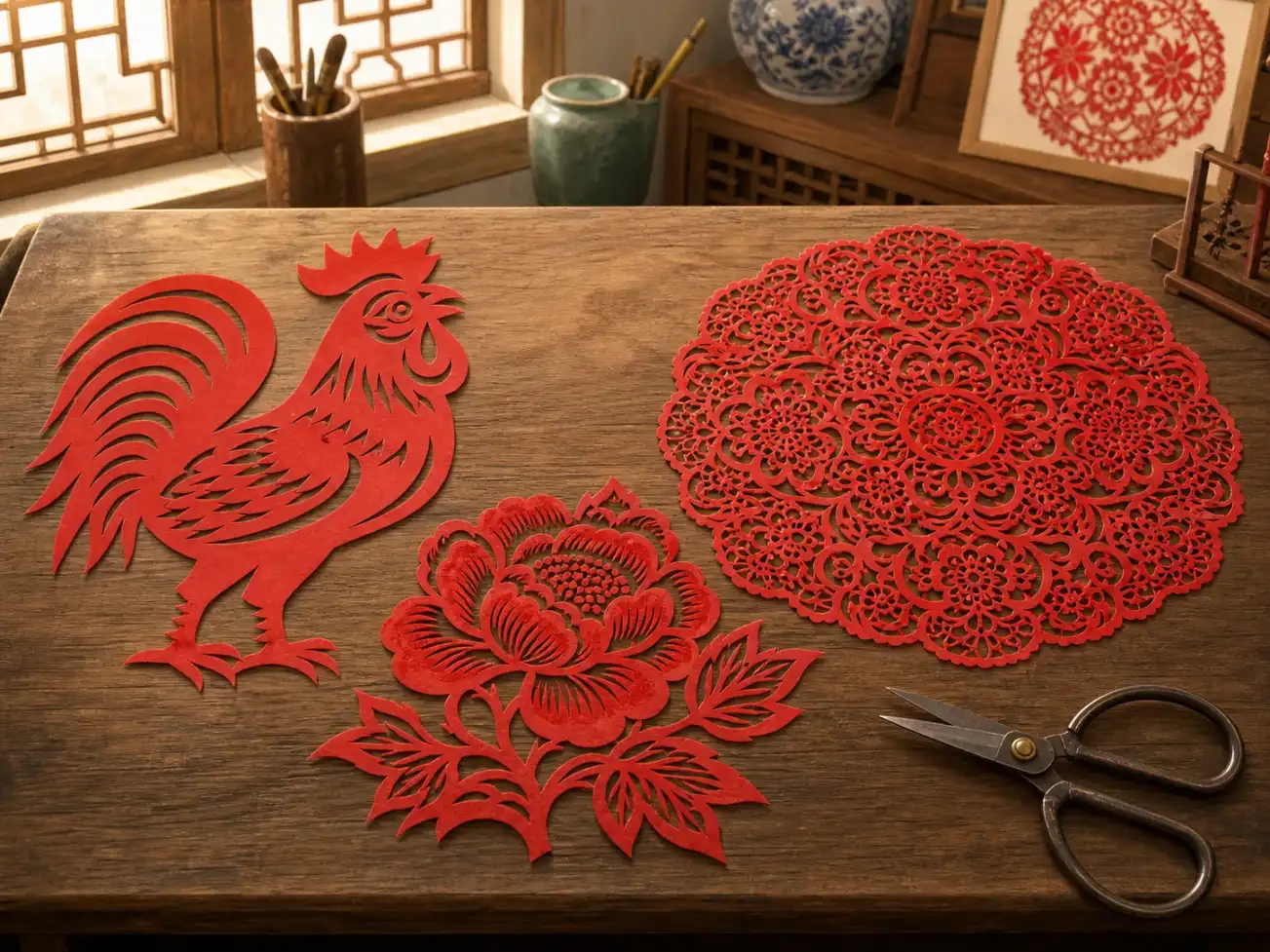
These are modern imagined designs comparing broad and fine lines, not authentic works from a named region, community, or artist. Line width alone cannot identify where a paper-cut came from.
人们有时说北方剪纸粗犷、南方剪纸细密。这可以帮助我们发现一些常见倾向,却不能当成规则。北方也有精细的刻纸:河北蔚县艺人把纸叠好,用小刻刀刻出戏曲人物的头发和衣纹,再点染鲜明颜色。南方各地也不只有一种细巧样式。气候、纸张、工具、用途、师承和个人选择都在影响作品;一位艺人还可能学习别处的方法,创造新的组合。
传统乡村剪纸常由女性从小学习,再在家庭和邻里间传授。正是许多没有在作品上签名的农村女性,把婚礼、节日、刺绣和生活观察剪进了纸里。但故事不能停在“老奶奶”:历史上也有靠剪纸谋生的职业艺人,中国许多少数民族社区保存了各自的剪纸传统,今天还有男性和女性传承人、学校里的孩子、职业艺术家与平面设计师使用手剪、刻刀、激光切割或数字设计。承认新工具,不等于忘记老手艺;重要的是说明作品怎样做、向谁学习,又为今天的生活表达什么。
People sometimes say northern paper-cuts are bold while southern ones are delicate. That can point to broad tendencies, but it is not a rule. Northern China has extremely fine knife-cut work, too. In Yuxian, Hebei, artists stack paper, carve hair and costume lines for opera figures with tiny knives, and then brush on brilliant colors. Southern traditions are not all one delicate style, either. Climate, paper, tools, purpose, teaching lineages, and personal choices all shape a work. An artist may also study methods from elsewhere and create a new combination.
In many rural traditions, girls learned paper-cutting early and women passed it through families and neighborhoods. Countless rural women whose names were never signed onto their work cut weddings, festivals, embroidery, and daily observations into paper. But the story cannot end with “grandmothers.” Historical records also describe professional paper-cut artists. Many of China's ethnic minority communities maintain distinct traditions, and today's makers include women and men, schoolchildren, professional artists, and graphic designers. They may use scissors, knives, laser cutters, or digital design. New tools do not have to erase old skills. What matters is explaining how a work was made, who taught the maker, and what it expresses in life today.
Page 5
让纸活下去,不是把样式冻住
Keeping the Craft Alive Does Not Mean Freezing Its Style
2009年,中国剪纸列入联合国教科文组织人类非物质文化遗产代表作名录。这里要保护的不只是几张老纸,更是人会设计、剪刻、染色、讲解和传授的能力。剪纸本来就在适应新房屋、新节日、新观众和新工具;如果只能复制旧花样,它反而会失去与生活的联系。保存老作品、记录地方知识和鼓励当代创作,可以同时进行。
如果你也想试,先问成年人,使用儿童安全剪刀,从新的手工纸开始。刻刀、锋利剪刀和一次切多层纸的工作要交给受过指导的成年人。也不要顺手拿旧信、旧书页、家里不明来历的纸或博物馆物品来剪 - 它们可能保存着不能重新做出的信息。折一下,剪一刀,再打开:重复图案出现时,你不只完成了一个小魔术,也加入了一门仍在变化的活手艺。
In 2009, Chinese paper-cut was placed on UNESCO's Representative List of the Intangible Cultural Heritage of Humanity. What needs safeguarding is not only a group of old sheets. It is people's ability to design, cut, carve, color, explain, and teach. Paper-cutting has always adjusted to new homes, celebrations, audiences, and tools. If makers could only copy old patterns, the craft would lose its connection to life. Preserving older work, recording local knowledge, and encouraging contemporary creation can happen together.
If you want to try, ask an adult first, use child-safe scissors, and begin with new craft paper. Knives, sharp scissors, and thick stacks of paper belong in the hands of trained adults. Do not grab an old letter, a book page, an unidentified sheet at home, or anything in a museum. It may hold information that can never be replaced. Fold, make one cut, and open the sheet. When a repeated pattern appears, you have done more than a small trick. You have joined a living craft that is still changing.
一刀会重复,意义却不会自动复制
A Cut Can Repeat; Meaning Does Not Copy Itself
折纸能让一刀重复成一圈花,但图案的意义不会自动复制。它要和地方、场合、使用者与创作者放在一起,才开始说话。
剪纸也因此不只是“一张红纸加一把剪刀”。它是容易损坏的历史证据,是许多普通人的手上知识,也是每一代人仍可以重新设计的视觉语言。
A fold can repeat one cut into a ring, but meaning does not copy itself. A design begins to speak only when we place it with its region, occasion, user, and maker.
That is why paper-cutting is more than “red paper plus scissors.” It is fragile historical evidence, knowledge held in many ordinary hands, and a visual language that each generation can keep designing anew.