一片花瓣为什么要画很多遍?
Why Paint One Petal More Than Once?
阅读难度 · 困难Reading level · Hard
Page 1
第一眼:画得很细,就一定是在“照相”吗?
First Look: Does Fine Detail Make a Painting a Photograph?
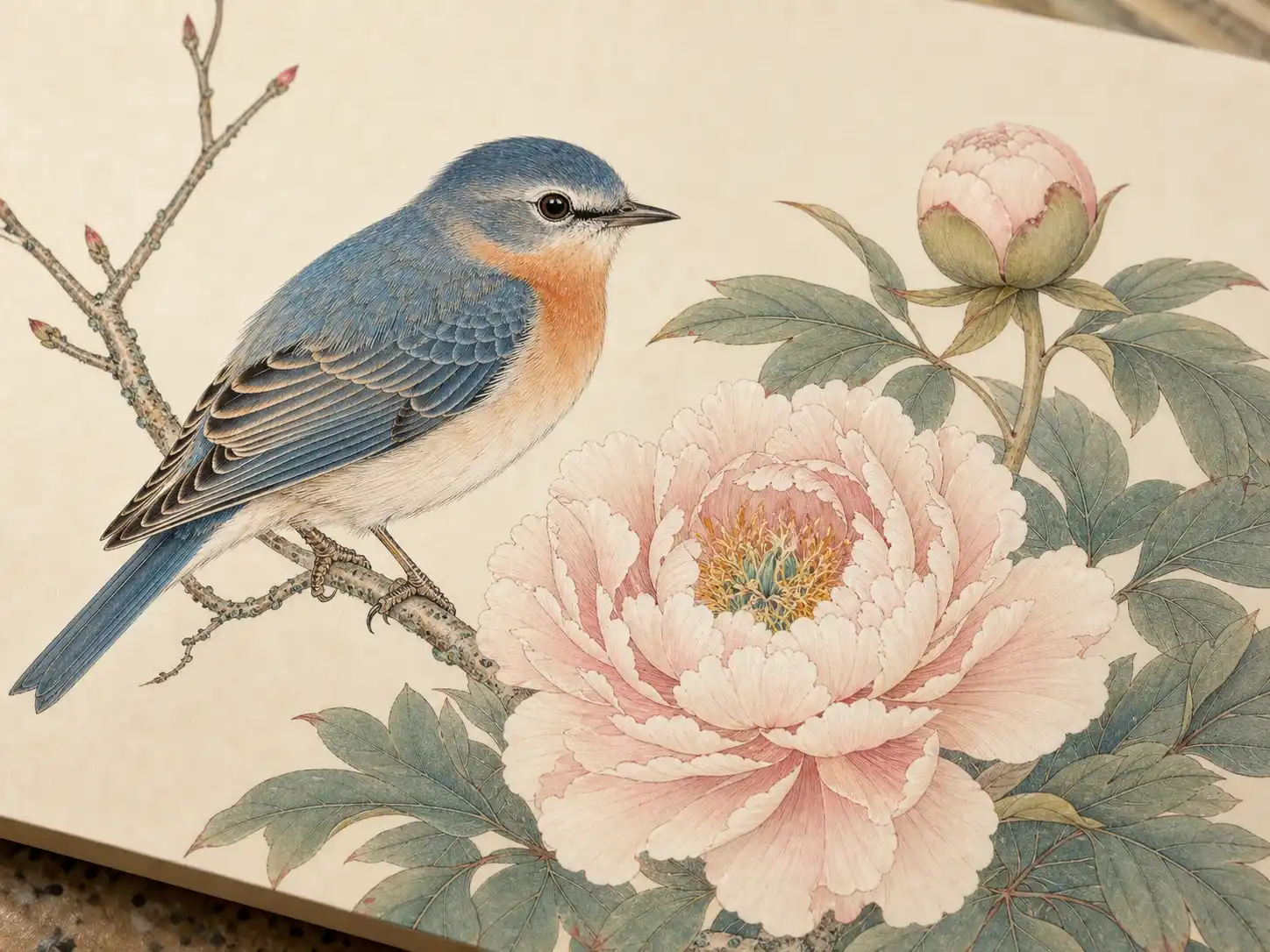
This is a modern AI-generated image in a gongbi-like style, not an ancient original or a detail from one. Its bird, feathers, and peonies are generated combinations and cannot identify an artist or dynasty.
先盯住图中的一片牡丹花瓣。边缘有线,里面有浅红,靠近花心的地方更深,细细的纹路又顺着花瓣生长。画师为什么不拿粉红色一笔涂满,偏要画很多遍?因为他不只想说“这里有一朵花”,还想安排花瓣怎样卷起、哪一层在前、光和颜色怎样慢慢转过去。
今天说的工笔,通常指一种细密、谨严、重视造型与制作步骤的绘画方法。“工”不是“工厂生产”,也不保证作品像照片。画家会选择哪些边缘要清楚、哪些颜色要加深、哪些细节应该省略。图中鸟的眼睛大而明亮,羽片整齐得近乎一套花纹,正说明细节也可以是设计和想象,不一定是自然科学记录。
工笔也不是中国画的一半,写意则是另一半,所有作品必须站队。有人用细线画人物,却让山石比较放松;有人精细染花,却不用墨线围住花瓣,这叫“没骨”;也有人在同一张画里把工整与简放放在一起。工笔和写意可以帮助我们描述方法与效果,却不是两堵永远不能跨过的墙。
Begin with one peony petal. A line marks its edge. Pale pink fills the inside, the color deepens near the center, and fine veins follow the petal's growth. Why not fill it with one stroke of pink? The painter wants to do more than say, “Here is a flower.” The work must show how the petal curls, which layer sits in front, and how light and color change across it.
Today, gongbi usually names a meticulous and disciplined approach that values careful form and a planned process. Gong does not mean “made in a factory,” and the method does not promise a photograph. The artist chooses which edges to sharpen, which colors to deepen, and which details to leave out. In this image, the bird has an unusually bright, round eye, and its feathers form an almost perfect pattern. Fine detail can be designed or imagined; it is not automatically a scientific record of nature.
Nor is every Chinese painting required to choose between two permanent teams called gongbi and xieyi, or “writing the idea.” An artist might use fine lines for figures but looser marks for rocks. Another might carefully shade a flower without surrounding every petal in an ink outline, a method called “boneless” painting. One work can place disciplined and freer passages together. Gongbi and xieyi help us describe methods and effects. They are not two walls that no painter may cross.
Page 2
第二遍:勾线是在描边,还是在搭骨架?
Second Pass: Is the Outline an Edge or a Framework?
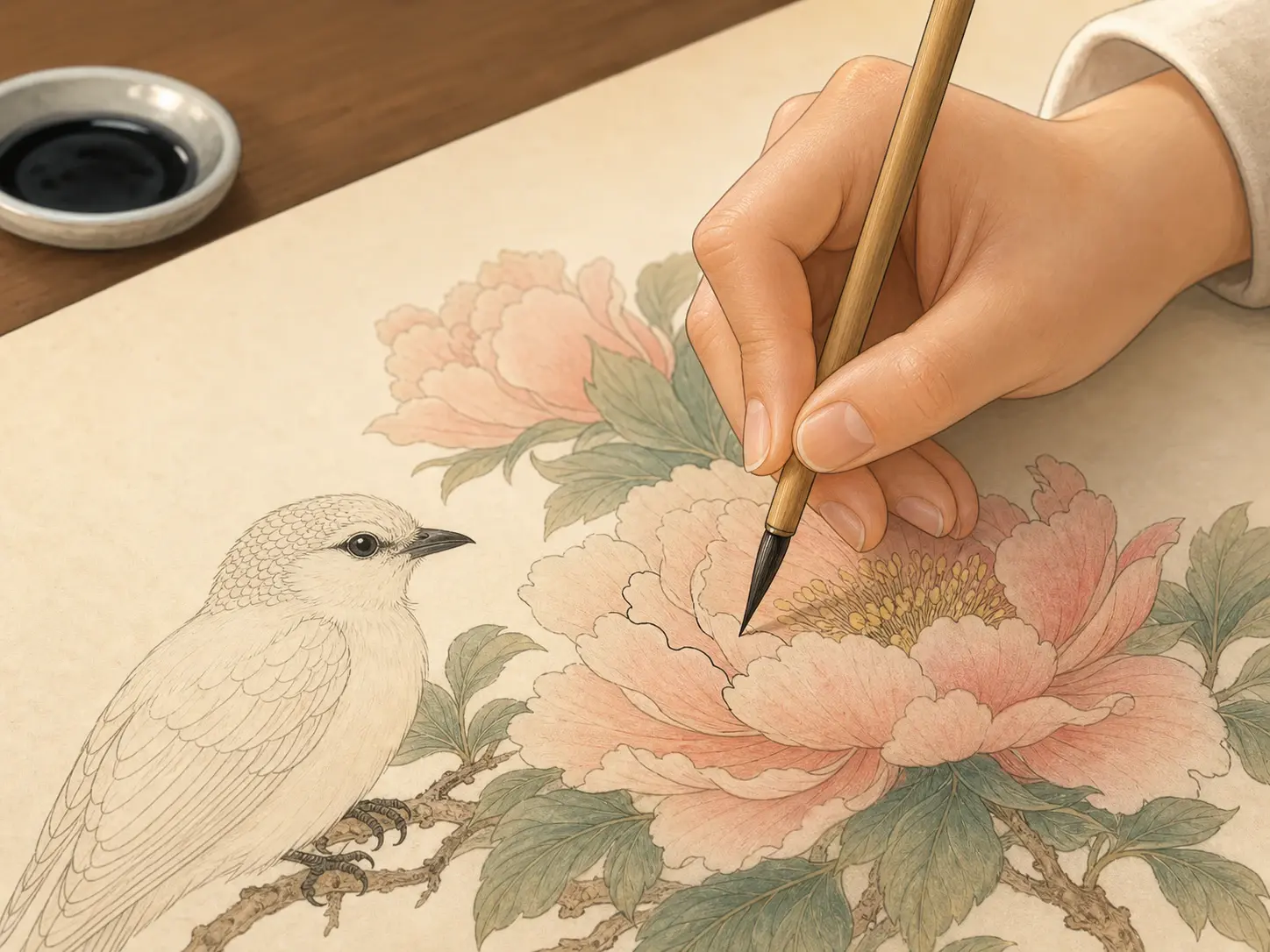
This is an AI-generated modern outlining scene, not a photograph of a historical painter at work. Its grip, drawing, bird feet, flowers, and leaves are not the one correct gongbi process or a reliable teaching model.
很多工笔作品会先准备底稿,再把主要形状转到熟纸或熟绢上,用细笔勾线。线不只是给颜色围一圈篱笆。轻、重、快、慢和转折能提示花瓣软硬、衣褶方向、羽毛叠压与人的动作。线若处处一样粗,画面反而可能像剪纸;同一根枝条也需要有向前、退后和转身的感觉。
但“先勾黑线,再填颜色”不是唯一公式。白描主要用线造型,可以几乎不设色;没骨会直接用色墨塑造形体,不一定先有清楚轮廓。画楼阁、桥梁和船只时,画家还可能借界尺画出准确直线,这类精细建筑画称为界画。人物、花鸟、宗教壁画和宫廷画中都能找到细密方法,却不表示它们属于同一种题材或同一套工序。
底稿本身也提醒我们:一件画常常不是“一口气凭灵感跳出来”。古代壁画工匠会用粉本、透稿或扑粉把图样转上墙;卷轴画家也会临摹旧作、调整构图。设计者、勾线者、敷色者有时可能不是同一个人。画面上没有签名,不等于没有技术;留下名家姓名,也不代表每一步都只由他一人完成。
Many gongbi works begin with a preparatory drawing. The main shapes may then be transferred to sized paper or silk and outlined with a fine brush. A line does more than build a fence for the color. Changes in weight, speed, and direction can suggest a soft petal, a folding sleeve, overlapping feathers, or a moving body. If every line has exactly the same thickness, the picture may feel cut out. Even one branch needs to come forward, move back, and turn.
But “draw black outlines first, then fill them with color” is not the only formula. Baimiao, or plain line drawing, builds forms mostly with line and may use little or no color. “Boneless” painting shapes forms directly with ink and color, without necessarily enclosing them in outlines. For palaces, bridges, and boats, artists may use a ruler to create exact architectural lines. This specialized genre is called ruled-line painting. Meticulous methods appear in figure, bird-and-flower, religious, court, and architectural painting, but these subjects do not all follow one process.
A preparatory design also reminds us that a painting does not always leap from one moment of inspiration. Mural workshops could use patterns, tracing, or pounced dots to transfer images to walls. Scroll painters copied older works and adjusted compositions. The designer, outliner, and colorist might not always be the same person. No signature does not mean no skill. A famous name on a label does not prove that one person completed every step alone.
Page 3
第三遍、第四遍:淡颜色怎样让花瓣鼓起来?
Third and Fourth Passes: How Does Pale Color Give a Petal Volume?
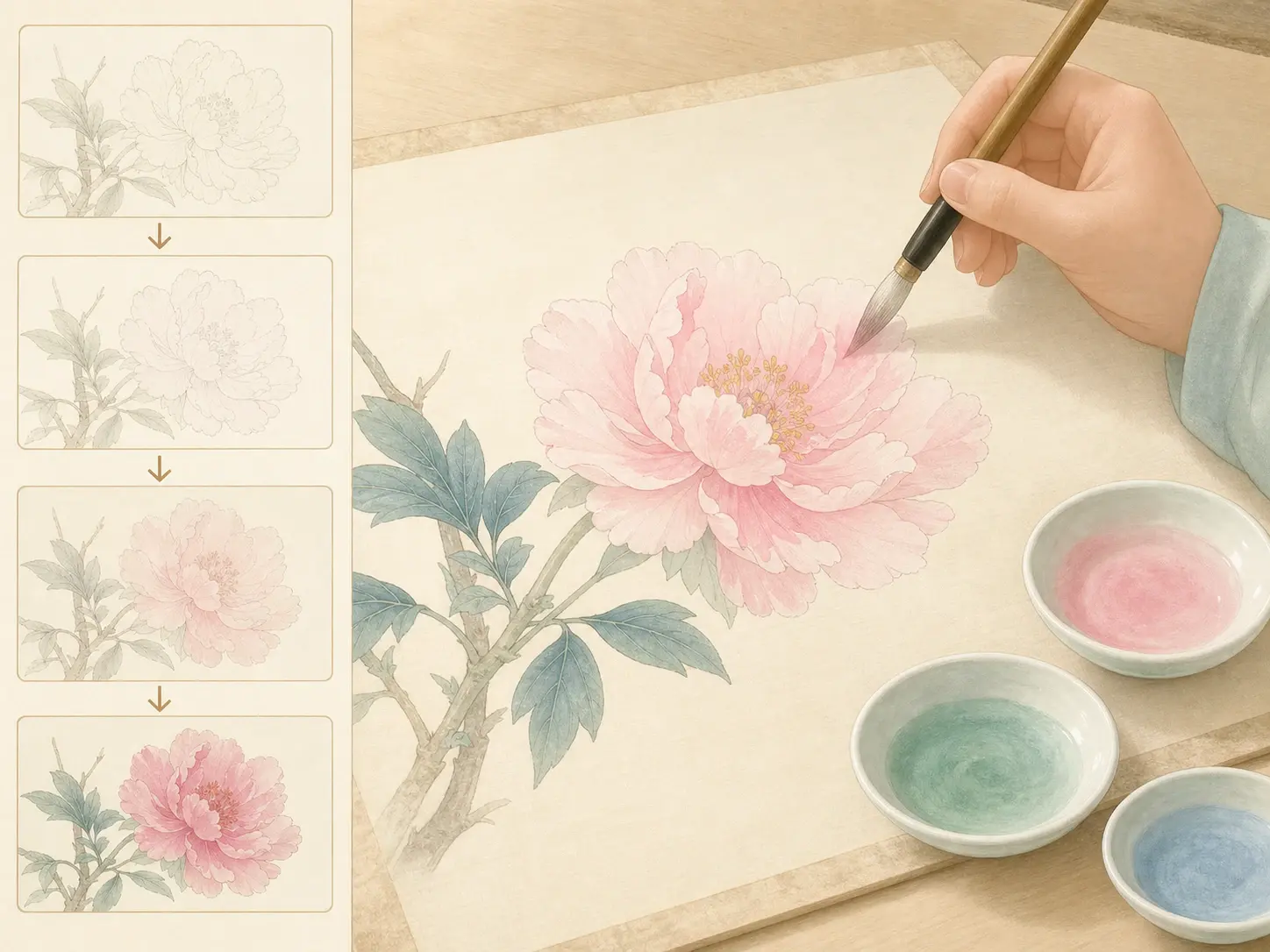
This is an AI-generated modern process diagram, not four photographed stages from one real artwork. It suggests a move from line to layers of color, but it does not prove that gongbi has four fixed steps, a set number of washes, or one correct grip.
线稿准备好以后,有些画会先铺底色,再做分染:一支笔蘸色,另一支清水笔把颜色慢慢带开,形成从浓到淡的过渡。干后可以再染,让花瓣根部变深、边缘仍然透亮。罩染是在已经画好的区域上覆盖一层较统一的薄色,使几块颜色靠近或改变整体气氛;最后还可能提亮、点花蕊,甚至从绢背面托色。
这就是一片花瓣会“画很多遍”的原因,但没有“每朵花必须四十层”的规定。透明的植物色、较有覆盖力的矿物色、墨与白粉性质不同;石青、石绿、朱砂等矿物颜料常要研磨分级,并和胶、水调和,才能附着在纸绢上。纸绢若经过胶矾处理,颜色不容易一下渗散,画家才便于一次次调整。材料、尺寸、题材和目标不同,步骤与次数也不同。
图中左边把过程整齐画成四格,很适合提醒我们观察色层,却过分干净。真实的纸会吸水,矿物颗粒会沉降,胶多了可能发亮或变脆,颜色太厚还可能在卷收时脱落。古画今天显得柔和,可能来自画家的选择,也可能来自褪色、污渍、修复和时间。不能看到浅色就断定古人原来只爱“淡雅”。
After the drawing is ready, some painters lay down a base color and then use fenran, or graded shading. One brush carries color while a clean, damp brush draws it outward, making a change from dark to pale. After it dries, another pass can deepen the base of a petal while leaving its edge bright. Zhaoran, or an overall glaze, places a thin wash over an area that already has color, bringing several colors closer or shifting the mood. Later steps may add highlights, dot the stamens, or even place supporting color on the back of silk.
That is why one petal may be “painted many times,” but there is no rule that every flower needs forty layers. Transparent plant colors, more opaque mineral colors, ink, and shell white behave differently. Minerals such as azurite, malachite, and cinnabar may be ground and sorted into grades, then mixed with binder and water so they attach to paper or silk. When paper or silk has been sized with glue and alum, liquid does not spread immediately, giving the artist more control over repeated adjustments. Materials, size, subject, and purpose change the number and order of steps.
The four tidy boxes at the left of the image are useful reminders to look for layers, but real work is less clean. Paper absorbs water. Mineral particles settle. Too much binder can look shiny or become brittle, and thick color can flake when a scroll is rolled. An old painting may look pale because of the artist's decision - or because of fading, dirt, repair, and time. Pale color alone cannot prove that ancient people preferred only quiet, delicate tones.
Page 4
名画标签上的“传”,为什么不能跳过去?
Why Does the Word “Attributed” Matter on a Museum Label?
讲中国人物画时,人们常提顾恺之和吴道子,可他们的著名画面大多不是经确认的亲笔原作。大英博物馆的《女史箴图》传统上归于顾恺之,馆方把它断在大约公元400至700年之间,更适合看作依据失传早期画本形成的古代摹本;北京故宫另藏一卷宋人摹本。它们能研究早期人物画怎样被后世保存和理解,却不能当作顾恺之的手在绢上刚刚停下。
吴道子的情况也相似。他以寺观壁画和人物线描闻名,可那些壁画大多没有保存下来。传为他的《送子天王图》常被说明为后世摹本或吴派传承作品,具体年代和作者仍有争论。摹本不是“没用的假画”:它可能保存构图和线条传统,本身也有自己的制作年代与画工。错误在于为了故事好听,把“传为”“摹”“佚名”三个词擦掉。
博物馆还会写“原作”“摹本”“传某人”“某人款”“局部”“修复后”等词。有某人的题款只说明画上出现了这个名字或书写,不自动等于整幅由他亲画。判断还要看绢纸年代、颜料、笔法、印章、收藏记录、旧装裱和同类作品。仔细读标签,是欣赏的一部分,不是破坏美感。
Histories of Chinese figure painting often celebrate Gu Kaizhi and Wu Daozi, but their famous images are usually not securely identified originals from their own hands. The British Museum's Admonitions Scroll is traditionally associated with Gu Kaizhi, yet the museum dates it broadly between about 400 and 700. It is better understood as an early copy connected to a lost model. The Palace Museum in Beijing holds another version copied in the Song period. These works help us study how early figure painting was preserved and understood. They are not wet ink left moments ago by Gu Kaizhi's hand.
Wu Daozi presents a similar problem. He was famous for temple murals and figure drawing, but most of those walls have not survived. The Presentation of the Buddha, traditionally linked to him, is often described as a later copy or a work carrying his school's tradition. Its date and maker remain debated. A copy is not a “useless fake.” It may preserve a composition and a line tradition, and it belongs to the history of its own makers. The mistake is erasing the words “attributed,” “copy,” and “anonymous” to make a smoother tale.
Museum labels may also say “original,” “copy,” “attributed to,” “bearing the signature of,” “detail,” or “after conservation.” A person's inscription or signature on a painting does not automatically prove that the whole picture was painted by that hand. Researchers also examine the age of silk or paper, pigments, brushwork, seals, collecting records, old mounts, and related works. Reading the label carefully is part of looking. It does not spoil the beauty.
Page 5
宋徽宗画的,还是宋徽宗看过的?
Painted by Emperor Huizong - or Approved by His Court?
A time in China about 1,000 years ago.宫廷画院留下许多细密的花鸟、人物和山水形象,所以“院体”常让人想到工整、写实、华丽的画风。不过,画院跨越不同时期,画家各有专长,院画也不是一套不许变化的制服。界画需要处理建筑,花鸟画关心羽毛与草木,人物画又要安排动作、服饰和故事;“工致”只是它们可能共享的方法之一。
A Song dynasty emperor named Zhao Ji who was famous for painting birds and flowers.既是皇帝、收藏者和书画实践者,也是画院的重要支持者。麻烦在于,“御画”可能指皇帝亲笔,也可能与宫廷生产、认可和题署有关。北京故宫《听琴图》上有徽宗题字,研究者却认为绘画可能出自画院画家;台北故宫一幅带徽宗花押与“御书”印的山水,也因画风被断为南宋作品。只凭皇帝的字、印或旧标签,不能完成鉴定。
把每一片漂亮羽毛都归给皇帝,还会遮住画院里的职业画家、学徒、装裱者、制笔制色工匠和无名助手。大型壁画和宫廷项目尤其可能分工。女性同样参与细密绘画:她们的教育机会和作品保存受到限制,却仍有宫廷女性与女画家的作品进入收藏。历史不应只有皇帝和少数文人名家,细密的画面背后还有许多没有被标签记下的手。
The A time in China about 1,000 years ago. court academy left many finely worked images of birds, flowers, figures, and landscapes. “Academy style” can therefore suggest polished, realistic, and richly colored painting. Yet the academy existed across different periods, and its painters had different specialties. Academy painting was not one unchanging uniform. Ruled-line painting had to construct architecture. Bird-and-flower painting studied feathers and plants. Figure painting arranged movement, clothing, and story. Meticulous finish was one method they might share, not the whole definition.
A Song dynasty emperor named Zhao Ji who was famous for painting birds and flowers. was an emperor, collector, practicing calligrapher and painter, and an important supporter of the academy. The difficulty is that “imperial painting” might refer to the emperor's own hand, or to production, approval, and inscription at court. Huizong wrote on the Palace Museum's Listening to the Zither, but researchers now think an academy painter may have made the picture. A landscape in Taipei bears Huizong's cipher and an imperial seal, yet its style leads the museum to date it to the Southern Song. An emperor's writing, seal, or old label cannot settle attribution by itself.
Giving every beautiful feather to the emperor also hides professional academy painters, apprentices, mounters, brush and pigment makers, and unnamed assistants. Large murals and court projects were especially likely to involve divided labor. Women also practiced meticulous painting. Their educational opportunities were limited and their work was less likely to survive, yet paintings by court women and women artists still entered collections. Art history should not contain only emperors and a few male scholar-celebrities. Many unrecorded hands stand behind a finely worked surface.
Page 6
画得像,还不够;“神”究竟在哪里?
Looking Accurate Is Not Enough - So Where Is the “Spirit”?
古人常称赞绘画“形神兼备”。如果只解释成“外形加上一股神秘能量”,这句话几乎什么都能说,也什么都没有说明。我们可以把它变成可观察的问题:鸟爪怎样抓住树枝,身体重量落在哪里?花瓣的方向是否围绕花心生长?人物转头时,肩膀和衣纹有没有跟着改变?画家选择的一两个动作,能不能让我们猜到下一秒会发生什么?
形画得准确也不等于必须复制所有细节。画家可能数过鸟的飞羽,却故意简化背景,让视线集中;也可能把花开得比真实季节更齐,组成吉祥寓意。所谓“神”可以来自姿势、节奏、视线和关系,是画面组织出来的生命感,不需要假装画里的鸟真的会呼吸。这样谈审美,孩子可以拿证据讨论,而不是只能回答“我感受到古人的精神”。
现代工笔也没有冻结在古代花鸟和宫女里。艺术家仍在纸绢上使用细线、墨和矿物色,也会加入新的纸材、综合色层、摄影式构图与数字草图,描绘城市公寓、地铁、塑料物品、个人记忆和社会问题。传统延续的不是一份禁止修改的旧配方,而是一套可以被学习、质疑和重新组合的方法。
Older critics often praised painting that joined form and spirit. If “spirit” means only a mysterious energy added to accurate shape, the phrase can claim everything while explaining nothing. We can turn it into questions we can observe. How do a bird's claws grip the branch, and where does its weight rest? Do the petals grow around the center? When a figure turns the head, do the shoulders and clothing respond? Can one chosen gesture make us guess what may happen next?
Accurate form does not require copying every detail. A painter may count a bird's flight feathers but simplify the background to guide our eyes. Flowers from different seasons may bloom together to build an auspicious message. “Spirit” can come from pose, rhythm, gaze, and relationships - from a sense of life constructed within the image. We do not need to pretend that the painted bird truly breathes. This way, children can discuss aesthetic ideas with evidence instead of being asked only to “feel the ancient spirit.”
Modern gongbi has not frozen among old birds, flowers, and palace women. Artists still use fine lines, ink, silk or paper, and mineral color. They may also add new papers, mixed layers, photographic compositions, and digital planning, while painting apartments, subways, plastic objects, personal memory, and social questions. What continues is not an old recipe that no one may alter. It is a family of methods that can be learned, challenged, and recombined.
花瓣不是重复,而是在一层层作决定
The Petal Is Not Repeated - It Is Decided Layer by Layer
一片花瓣画很多遍,不是因为画师忘了自己已经画过,而是线、底色、分染、罩染和提亮各自解决不同问题。工笔的“慢”来自观察、材料和控制,也来自许多设计者、画工与工匠共同积累的知识。
下次看细密的中国画,不妨先读标签,再靠近一点:这是原作、摹本、局部还是现代示意?线怎样搭骨架,颜色怎样转弯,哪些细节被留下,哪些被省略?回答这些问题,比只说“好像照片”更接近画里的真正工作。
A petal is painted more than once not because the artist forgot it was already there. Outline, base color, graded shading, glazing, and highlights solve different problems. Gongbi can be slow because observation, materials, and control take time - and because its knowledge was built by many designers, painters, and craftspeople.
The next time you see a meticulous Chinese painting, read the label and then move closer. Is it an original, a copy, a detail, or a modern illustration? How do the lines build a framework? Where does the color turn? Which details were kept, and which were left out? Those questions bring us closer to the real work than simply saying, “It looks like a photograph.”