一面墙是一千年前的照片吗?
Is a Wall a Photograph from 1,000 Years Ago?
阅读难度 · 困难Reading level · Hard
Page 1
山崖上的洞窟,不只属于一个朝代
Caves in a Cliff, Made Across Many Centuries
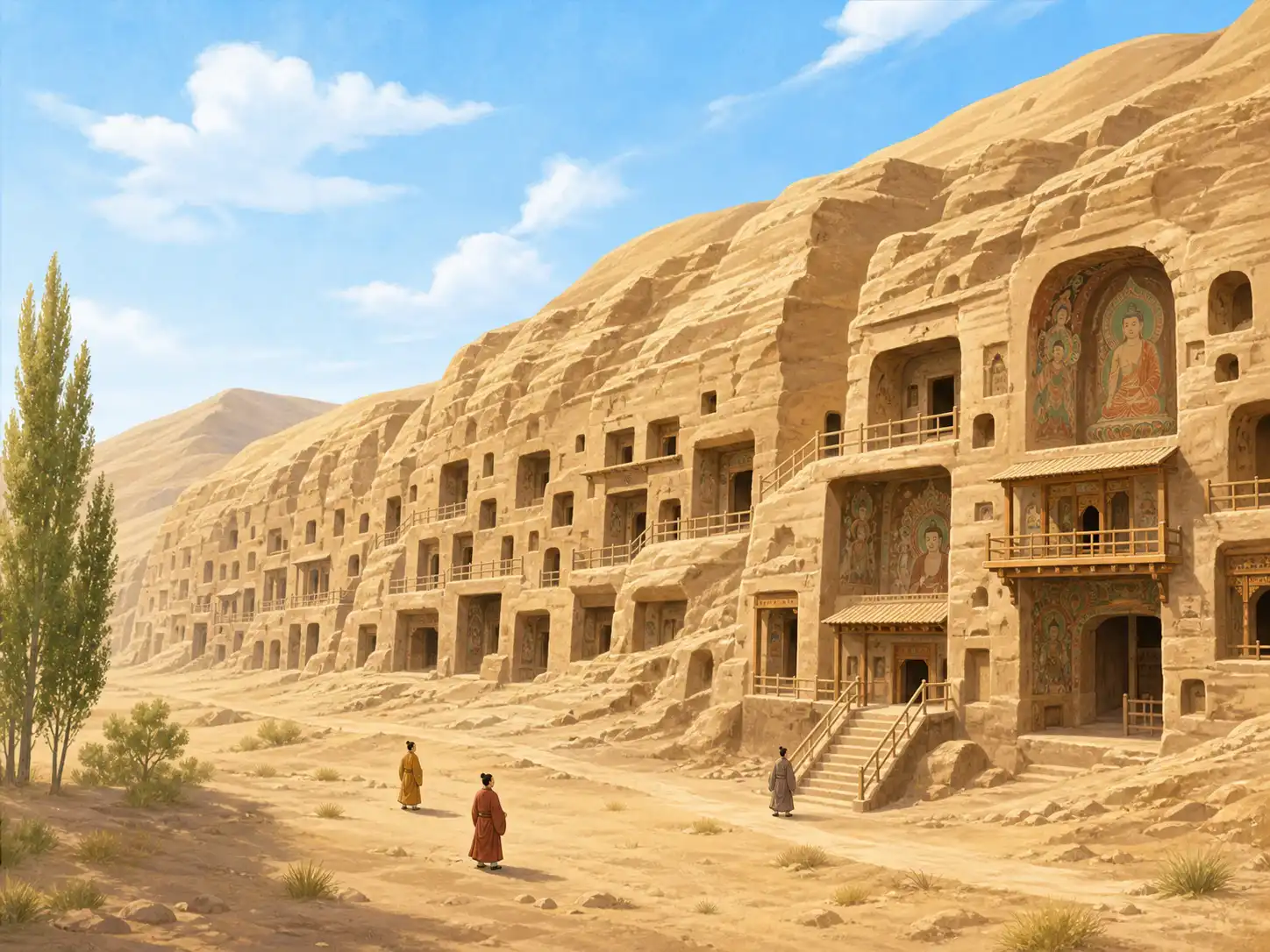
This is a modern imagined scene, not a historical photograph of Mogao. The real cave fronts, walkways, and murals do not all look like this.
假如一面旧墙上画着乐队、马车和忙碌的人,我们能不能把它当成一张一千年前的照片?在中国西北的敦煌,莫高窟会让人产生这样的错觉。崖壁里密布着人工开凿的洞窟,里面有壁画和彩塑,画中人物仿佛下一刻就要走动起来。不过,墙画不是照相机按下快门留下的瞬间。它是有人出钱、有人设计、有人一层层制作出来的图像,也会把宗教故事、理想世界和真实生活画在同一面墙上。
一块公元698年的碑写道,僧人乐僔在公元366年开凿了第一座洞窟。这个说法很重要,却不是366年的现场记录;碑立成时,已经过去了三百多年,其他后世文献记的起始年代也不完全一样。因此,更准确的说法是:按照后来的传统记载,莫高窟的开凿始于四世纪。今天保存下来的作品跨越十六国、北朝、隋、唐、五代、宋、西夏直到元代,前后延续约一千年。我们不能挑一座唐代洞窟,就说整个莫高窟一直都是那种样子。
Suppose an old wall shows musicians, carts, and people at work. Can we treat it like a photograph taken 1,000 years ago? At the Mogao Caves near Dunhuang in northwestern China, the painted figures can look ready to move. Yet a mural is not a moment caught by a camera. Someone paid for it, someone planned it, and teams made it layer by layer. One wall could hold religious stories, an imagined perfect world, and details from everyday life all at once.
An inscription made in 698 says that a monk named Lezun opened the first cave in 366. That account matters, but it is not an eyewitness record from 366. The inscription was made more than 300 years later, and other later texts give different starting dates. It is safer to say that, according to later tradition, cave making began here in the fourth century. The surviving art stretches across many periods, from the era of the Sixteen Kingdoms through the Northern Dynasties, Sui, Tang, Five Dynasties, Song, Western Xia, and Yuan. People worked at Mogao for about a thousand years. One Tang cave cannot stand for all of them.
Page 2
谁把沙石崖变成了画廊?
Who Turned a Gravel Cliff into a Gallery?
许多洞窟由出钱修建的“供养人”推动:他们可能是地方官员、家族、商人或普通信众。僧人安排礼拜和讲经,有人规划洞窟,有打窟匠凿开崖面,有木匠搭架,还有画工、塑匠和调制材料的工人一起劳动。帝王和有权势的人有时出现在记录里,但我们今天看到的每一块泥层和每一道线,也保存着许多没有留下姓名的手艺人的工作。
莫高窟的砾石岩比较松,不适合直接雕成细致石像。工匠常用木枝做骨架,缠上芦苇或草,再一层层塑泥、上色。画墙也不是拿笔往石头上一涂:研究人员在一些洞窟中发现,粗泥层里掺麦秸,细泥层里有麻,表面再画上朱砂、石青、石绿或青金石等颜料,有时还贴金。不同洞窟、不同年代的做法并不完全一样。这些材料提醒我们,莫高窟不只是“天才画家”的作品,更像一座持续了许多代人的大工地和大作坊。
Many caves were sponsored by donors. They might be local officials, powerful families, merchants, or other believers. Monks organized worship and teaching. Other people planned rooms, cut into the cliff, built wooden supports, prepared materials, painted walls, or shaped sculptures. Emperors and powerful patrons sometimes appear in the records, but every layer of plaster and every painted line also preserves the work of craftspeople whose names were never written down.
Mogao's gravelly rock is too crumbly for carving detailed stone statues. For many figures, sculptors tied branches into a frame, wrapped it with reeds or grass, added layers of clay, and then painted the surface. A mural was not simply brushed onto bare rock, either. Studies of particular caves have found straw in coarse mud plaster, hemp in a finer layer, and pigments such as cinnabar, azurite, malachite, or lapis lazuli bound to the surface. Some areas were gilded. Methods varied across caves and centuries, but the materials reveal one important fact: Mogao was not just the creation of a few famous artists. It was also a giant worksite and workshop carried on by generations.
Page 3
墙上有证据,也有会讲故事的想象
The Walls Hold Evidence - and Storytelling Imagination
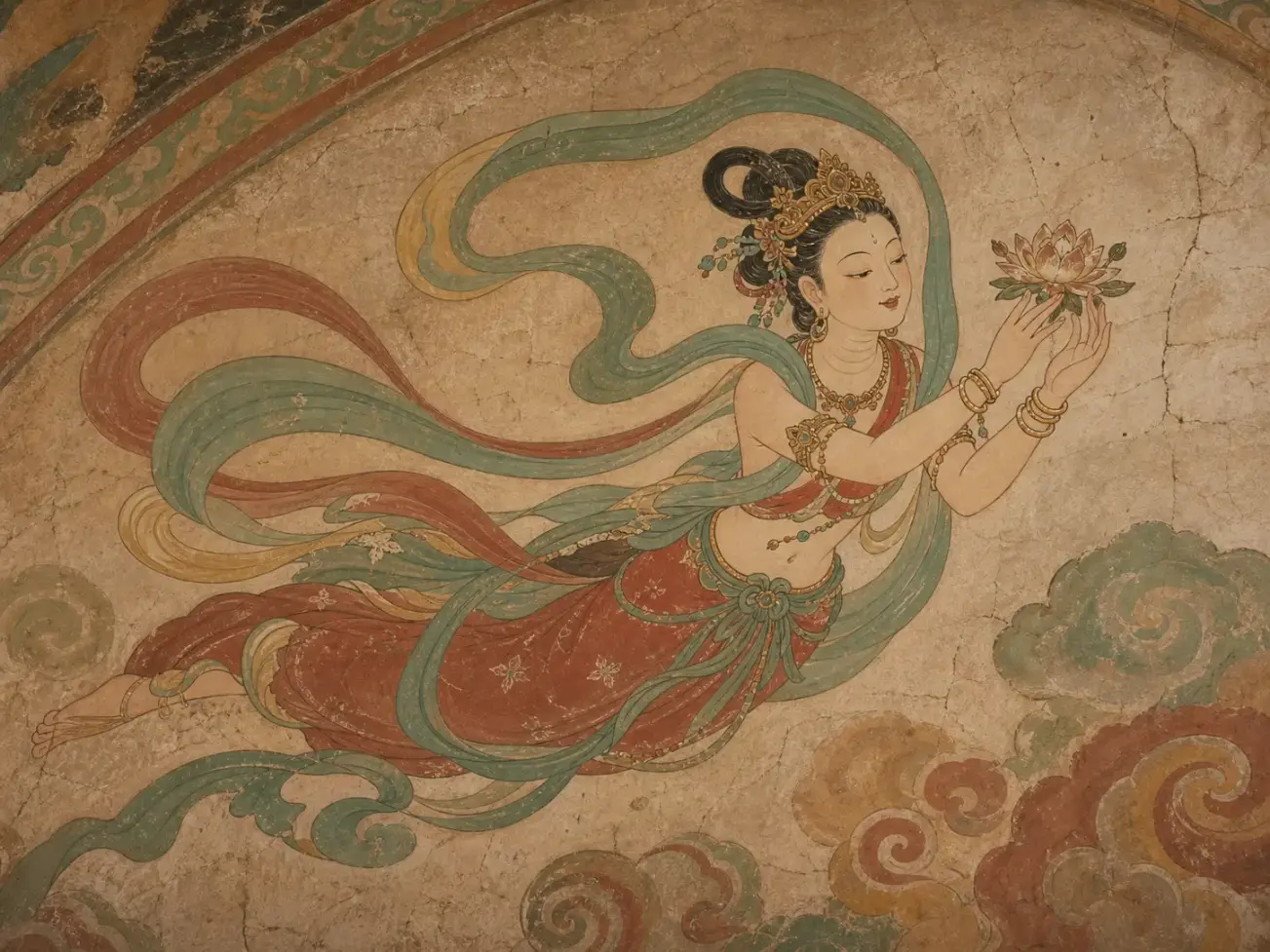
This modern illustration mixes Dunhuang-inspired elements. It is not an original cave mural or an exact copy, so it cannot prove a mural's date, colors, or details.
壁画确实能提供线索。画里的农具、衣服、乐器和供养人像,可以和文书、出土物以及其他遗址互相比较。但画工不是新闻摄影师。比如北魏第257窟的《鹿王本生》讲九色鹿救人又遭背叛的故事。画面像连环画,却不是从左到右顺着读:情节从两边展开,在中间相遇。它告诉我们古人怎样用图像讲佛教故事,不证明世界上真的有一只九种颜色的鹿。
飞天也是这样。她们不是“中国天使”,也不一定有翅膀。飞行的天人和乐神形象随着佛教艺术从印度经过中亚传来,在敦煌又与本地的仙人想象、衣裙、飘带和绘画方法不断结合。早期、隋代和唐代飞天的身体、服饰和动作都在变化。中唐壁画里还有著名的“反弹琵琶”:乐舞者把琵琶放到身后。今天有人能够尝试类似动作,但一幅宗教乐舞图不是录像;它不能单独证明当时舞者怎样连续移动,也不能让我们听见实际演奏的声音。
Murals do offer evidence. Tools, clothes, instruments, and donor portraits can be compared with written documents, excavated objects, and art at other sites. But painters were not news photographers. In the Northern Wei painting known as The Deer King Jataka in Cave 257, a nine-colored deer saves a person and is later betrayed. The wall works like a picture story, but its scenes begin at both ends and meet in the middle. It shows how artists told a Buddhist teaching story. It does not prove that a nine-colored deer once lived in the desert.
The flying beings called feitian need the same care. They are not “Chinese angels,” and they do not all have wings. Images of heavenly beings and musicians traveled with Buddhist art from India through Central Asia. At Dunhuang, artists combined them with local ideas about immortals, clothing, ribbons, and movement. Their bodies, costumes, and poses changed from the early caves through the Sui and Tang periods. A famous Middle Tang mural shows a dancer holding a pipa behind the back. People today can try similar positions, but a painted dance in a Buddhist paradise is not a video. By itself, it cannot prove every step of the movement or let us hear what the performance sounded like.
Page 4
藏经洞里不只有“经书”
The Library Cave Held Much More Than Sutras
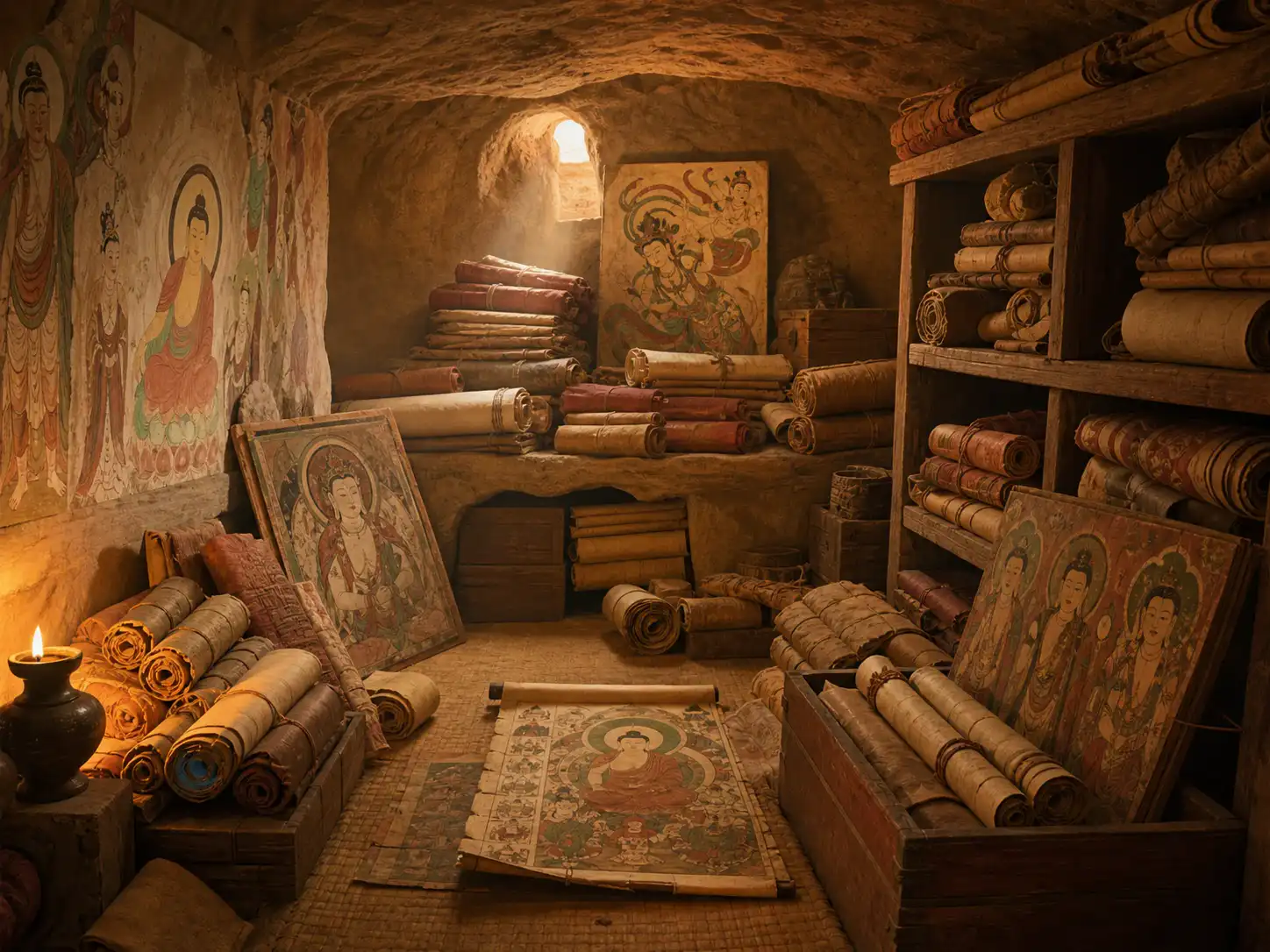
This is a modern imagined Library Cave, not a photograph from 1900. The objects were later moved, so their original arrangement cannot be fully reconstructed.
1900年,留在莫高窟照看并修缮洞窟的道士王圆箓,在第16窟甬道发现一道通往小室的封闭入口。这间后来编号为第17窟的小室里,塞着数以万计的手写卷子、印刷品、绘画和纺织品。人们常叫它“藏经洞”,可是里面不只有佛经,还有寺院账目、契约、购物清单、历书、旅行记录和不同信仰的文字;使用的文字和语言也不只一种。它像一个被封住的资料室,让我们听见僧人之外的商人、抄写者和普通居民留下的声音。
发现以后,王圆箓曾向地方官员报告,也把一些材料送去求助,却没有得到足够保护。1907年,受英属印度政府和大英博物馆资助的斯坦因来到这里,用不高的价钱取得大批文书、绘画和织物;1908年,法国考察者伯希和又取得数千件。后来还有物品被带往日本、俄国等地。说王圆箓“偶然找到宝物,然后外国人买走了”并不够:他既是发现者和看守者,也参与了出售;地方官员的忽视、贫弱的保护条件和由外国机构支持的考察活动,共同造成文物大规模流散。今天这些物品分藏多国,让研究者可以从不同地方研究,也让人必须继续追问:谁有权决定文化遗产离开哪里、留在哪里?
In 1900, the Daoist priest Wang Yuanlu was caring for and repairing the Mogao site when he found a sealed entrance off the corridor of Cave 16. The tiny room behind it is now Cave 17. It was packed with tens of thousands of handwritten documents, printed pages, paintings, and textiles. It is called the Library Cave, but it did not contain only Buddhist sutras. There were temple accounts, contracts, shopping lists, calendars, travel records, and writings from several religions, in many languages and scripts. The room is like a sealed archive that lets merchants, copyists, and ordinary residents speak alongside monks.
Wang reported the discovery to local officials and carried some manuscripts away to ask for help, but the collection did not receive strong protection. In 1907, Aurel Stein arrived on an expedition funded by the British Indian government and the British Museum. For a small payment, he obtained large groups of manuscripts, paintings, and textiles. In 1908, the French explorer Paul Pelliot obtained thousands more. Other objects later went to collections in Japan, Russia, and elsewhere. It is too simple to say, “Wang found treasure, and foreigners bought it.” Wang discovered and guarded the cave, but he also took part in the sales. Official neglect, weak local resources, and well-funded foreign expeditions together led to a massive dispersal. Today, the objects can be studied in collections around the world, but their journey leaves a hard question: who gets to decide when cultural heritage should leave its home?
Page 5
数字图像能留住什么?
What Can a Digital Image Save?
莫高窟的墙一直在变化。有些矿物颜料很稳定,有些会受光、湿度和化学反应影响而变黑或褪色;墙面还可能起甲、酥松、剥落。游客呼吸带来的水汽和二氧化碳,也会短时间改变小洞窟里的环境。因此,保护人员监测温度、湿度、二氧化碳和参观人数,必要时限制开放;他们还用高分辨率摄影和三维扫描记录洞窟,让更多人不必挤进原窟也能仔细观看。
数字资料非常珍贵,却不能让泥层停止老化,也不能代替站在真实洞窟里的空间、材料和历史。保护更不是一次修好后就“永久保存”,而是不断观察、研究并做尽量少而合适的处理。现在回到最初的问题:壁画不是一千年前的照片。它更像一位复杂的证人 - 既保存过去留下的痕迹,也带着讲故事的方法、材料的变化和后来人的选择。学会问“这幅图是什么时候、为谁、用什么材料做的?哪些是证据,哪些是想象?”我们才真正开始看懂敦煌。
Mogao's walls are still changing. Some mineral pigments are fairly stable, while others can darken or fade because of light, moisture, and chemical reactions. Painted surfaces may lift, crumble, or flake away. Even the moisture and carbon dioxide in visitors' breath can briefly change the environment of a small cave. Conservators therefore monitor temperature, humidity, carbon dioxide, and visitor numbers. They may close or limit access when needed. High-resolution photography and 3-D scanning also let more people study the caves without crowding into the originals.
Digital records are extremely valuable, but they cannot stop clay from aging or replace the space, materials, and history of a real cave. Conservation is not a one-time repair that makes an object last forever. It is continuing work: watch closely, study carefully, and make the smallest suitable treatment. So, is a mural a photograph from 1,000 years ago? No. It is more like a complicated witness. It carries traces of the past, but it also carries an artist's way of telling stories, changes in its materials, and choices made by later people. To begin reading that witness, ask: When was this image made, for whom, and from what? Which parts are evidence, and which are imagination?
看墙,也要学会问墙
Look at the Wall - and Question It
敦煌让我们看见的不只是漂亮的飞天。它还让无名工匠的劳动、跨越许多朝代的变化、被封存又流散的文物,以及今天仍在继续的保护工作,一起进入故事。
一面墙不会自动说真话。可是当我们把图像、材料、文书和历史记录放在一起,它就能告诉我们比“古代真美”更多的事。
Dunhuang shows us much more than beautiful flying figures. It brings together unnamed craftspeople, changes across many periods, objects that were sealed and later scattered, and conservation work that continues today.
A wall does not tell the truth all by itself. But when we compare its images with materials, documents, and historical records, it can tell us much more than “the ancient world was beautiful.”